Translated from the Turkish original. Read the Turkish original.
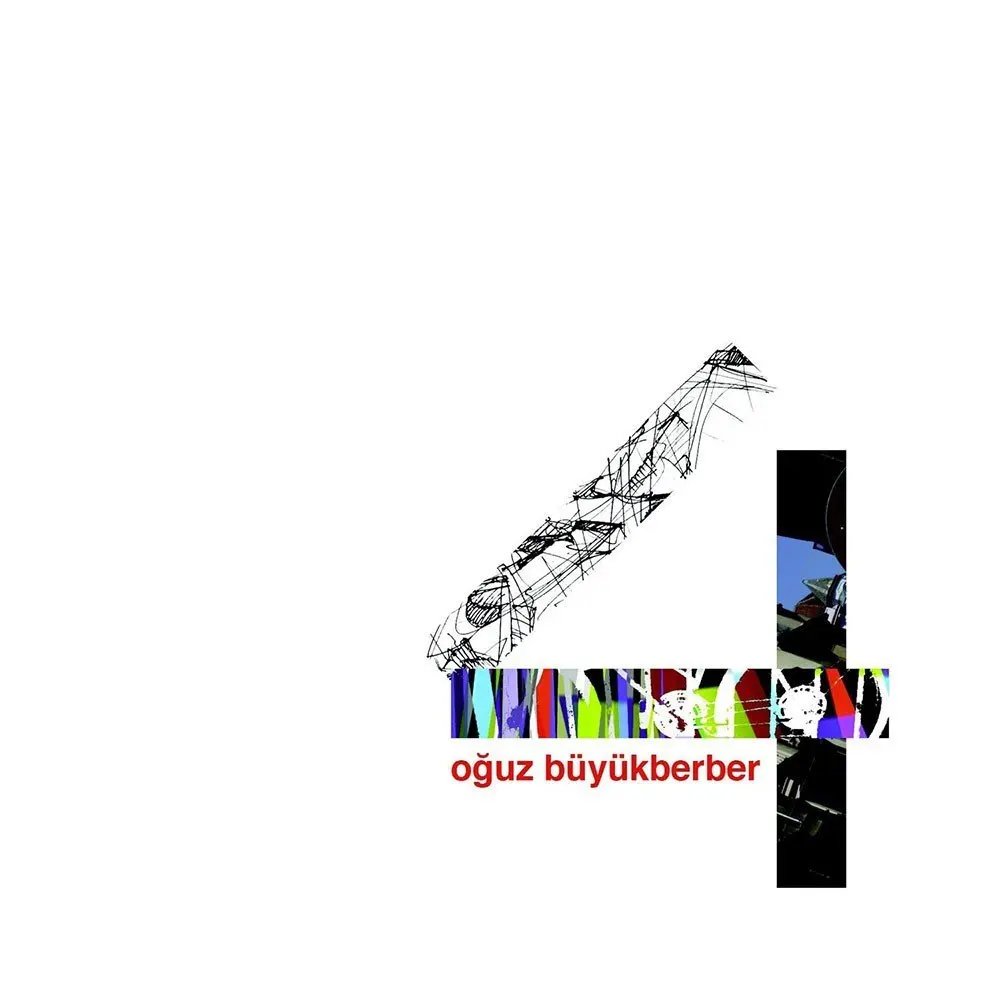
“4” FOR THE PRICE OF ONE
When I was asked to write something about Oğuz Büyükberber’s new album “4”, I said ‘yes’ without a second thought. Then I got myself into a state: ‘How am I supposed to write “objectively” about an album by such a close friend?’ Then I stopped fretting, put my faith in the Almighty, and decided to write without worrying about objective or subjective. “4” is like a business card showing 4 sides of a many-sided personality. In today’s Music market, where versatility has become a confusing quality, almost something to avoid, this is Büyükberber’s defiant “well, here you are, 4 sides of me together for now; there’s actually more, but let’s keep the loading to this much for the moment” album. The first track, “I/4”, is a collage Büyükberber made himself from recordings of him playing clarinet and bass clarinet, made by composer Emanuele de Raymondi in an empty Berlin office building with a very natural, long reverberation in 2010. Emanuele de Raymondi made his own entirely separate collage from these recordings and released it in New York as a CD called “Büyükberber Variations”. Büyükberber, meanwhile, made “I/4”. It would probably be fair to say that in these recordings Büyükberber “plays” the space, and the space plays Büyükberber: a mutual play of work and working. The varying reverberations in different corners of the space, and its natural filters, were recorded using different microphones and microphone positions. Büyükberber created the recorded material by playing while moving around the space, stamping his foot or playing “body percussion”, adding the reverberations of harmonics to one another, using key sounds and other modern performance techniques. We could describe the piece as a journey in which highly melodic passages mingle with effects textures, and spacious, long-breathed sounds turn into denser, more complex structures. Some melodies sound very “local”, makam-based and like folk songs, but as they develop they are generally disrupted, in one way or another, by “the universal”. The melody in the 12th minute, for example, comes from Seikilos’s tombstone, found near Aydın, the oldest example of written Music in the world; it gradually undergoes a metamorphosis, dissolving into a more chromatic, microtonal structure from which upper octaves suddenly flash out. “I/4” is a track in which, as you listen, you hear many stories from the present or the past, from Anatolia or contemporary Music concert halls. The second track, “II/4”, is a collage of 2 days of recordings made at Babajim Stüdyo in Istanbul in 2011, with Büyükberber on piano, Demirhan Baylan on bass guitar, Cengiz Baysal on drums on day 1 and Cem Aksel on day 2. Many of you may not know that Büyükberber began Music on piano, moved to clarinet later, but began to give piano a certain weight again from his Amsterdam years onward. In fact, the presence of an irresistible Fazioli F228 piano in the studio, where this lineup had gone to record an album with Büyükberber on clarinet, also led to these piano-trio recordings and produced the material for “II/4”. (The clarinet recordings will most likely become his next album, but that’s anooother matter.) One important feature of this track is that it was recorded “Live to 2 track”: mixed during the performance and recorded directly to 2 channels. That resulted in a more focused, balanced recording with a stronger live-performance feel. “II/4” is a successful example of the freely improvising piano-trio format, of which we rarely encounter recorded examples in our country. We won’t be looking here for “the familiar face of a standard”, “the answer to what to play over an altered dominant chord” or “prearranged metric modulations”. We’ll be listening to a spontaneous conversation between 4 mature Turkish musicians. As we listen, we’ll encounter various “standard” moods, swing and groove, examples of textures, polyrhythms derived from the “concept of the 1/8 note”, phrasing that flows at times and fragments and scatters at others, and harmonies that thin and thicken. Right here, let me also salute Demirhan Baylan, Cem Aksel and Cengiz Baysal with respect, and add this: apart from certain special live occasions, many of you will rarely have heard these musicians play like this. One reason is that they are musicians open to developing and changing until they die, putting their hearts entirely into the Music they play. Another is the scarcity of settings and projects in which they can reveal every aspect of their creative potential. My wish is for all our musicians to be able to reveal all their sides with the openness, sincerity and creativity heard here; and also for the incoming generations to say, “What on earth are our old guys up to? Let’s have a look”… The third track, “III/4”, is a collage of Büyükberber’s electronic/electroacoustic work of recent years. Having shown his interest in and affinity for this approach since his 2001 album Velvele, Büyükberber also wrote his master’s thesis at Amsterdam Conservatory on “Electroacoustic Live Solo Performance Techniques”, worked at Amsterdam’s Steim electronic Music laboratory, and has lately combined electronic elements with his own videos in many solo concerts at home and abroad. You may have noticed that I can’t get beyond giving concrete references in a very abstract field of Music. Why? Because anyone with a little familiarity knows how hard it is to describe this kind of Music in writing. Those who love it really love it; those who don’t, don’t at all. Still, I’ll try to write this much. Although Büyükberber uses contemporary synthesis techniques to a certain extent in “III/4”, he has preferred mainly to “process, layer and color” existing sounds, on a spectrum from lightly treated to extreme and unrecognizable. In doing so, I think he has used both his real-time live electronics equipment and prepared material. The result, “III/4”, is a piece that most “fresh” electronic Music listeners like to describe as “horror-film Music, the crackle of changing radio stations, wild animals bellowing, robot arias in an arcade game, the effect of a helicopter engine slowing down as it crashes, an out-of-tune distorted bazooka, a lame elephant tumbling down wooden stairs”. Seasoned, well-aged electronic Music listeners, meanwhile, might use such incomprehensible descriptions as “just the right amount of filtering, fluid layering, a balanced blend of the very low and very high registers, some sounds seem like presets but are actually used extremely musically, I think the recorded bicycle wheel and bell are from a 1972 German model he recorded himself, I wish that pink-noise groove at the very end had given us a whiff of itself and vanished before settling in properly, hmmm…fractal…”. In the end, everyone hears as much of any Music as they hear, carries its imprint according to the shape of their soul, and is wounded and strengthened to the extent they are open to its effect. Let’s take a trip… The fourth “track”, “IV/4”, is the album’s “cover art”: examples of recent visual work by Büyükberber, who has designed covers for many albums in the scene, including his own. A compelling reason to “buy” the CD format so you can experience the album in its entirety. As many of us also don’t know, Büyükberber graduated from Mimar Sinan GS’s Interior Architecture Department in 1994, and is active in the visual arts (painting, photography, video). Born with 10% vision, he has been drawing since the age of 3, trying to bring together the worlds he “sees” inside and outside himself. In the album’s cover art, “IV/4”, we can “look” at what he means by his own words: “For years I’ve been experimenting with combining two of my best guides in this life. Taking Sound and Image as my basis, I explore their conversation and their contrasts.” To finish with Büyükberber’s own words again: “if you can shed your prejudices and expectations and carry this Music into your dream world, you may encounter surprises that make you happy,