Translated from the Turkish original. Read the Turkish original.
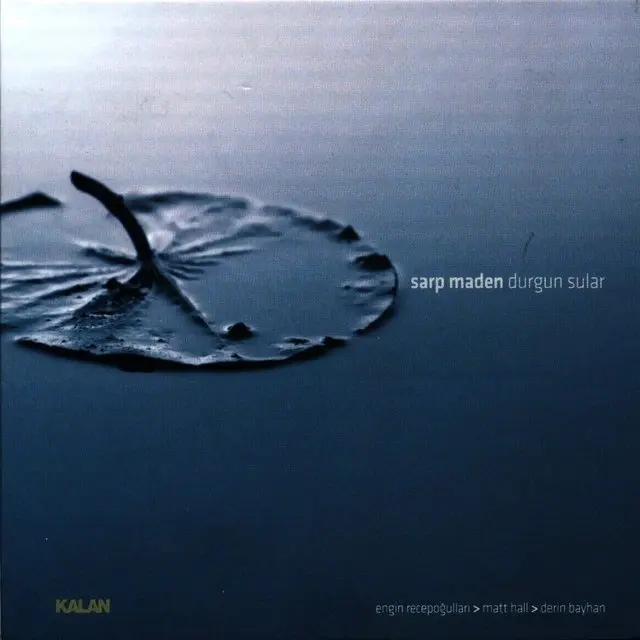
Durgun Sular (“Still Waters”), the third album under his own name by my dear friend Sarp Maden, one of the first names that comes to mind when you say “jazz guitar” in Turkey, was released on 14.11.2011 by “Kalan Müzik”. The album features Sarp Maden on guitar, Engin Recepoğulları on tenor saxophone, Matt Hall on double bass and Derin Bayhan on drums. Playing regularly together for about 2 years as “Sarp Maden Dörtlüsü”, the group has built up an extensive repertoire consisting entirely of Sarp Maden’s compositions. They have come to know one another deeply; a group spirit, sound and interplay have taken shape, and their approaches to improvisation have developed in ways that nourish the Music. So the ideal conditions for going into a studio and recording an album in a short time have ripened of their own accord. Unlike his previous albums, Sarp Maden particularly wanted to record his ballads—his slower pieces—on this one, showing a different side of his musicianship. For the sessions, they chose the late Tanju Duru’s studio, now “Kalan Müzik Stüdyosu”. Maden had also recorded his first two albums under his own name in this studio while Duru was alive. The recording therefore took place over 2 days in a familiar, comfortable studio environment, one of the requirements for a good album. Four of the album’s twelve tracks are interludes, transitional pieces improvised solo by the group members. Six of the remaining eight were already in the group’s regular repertoire; only two (“Antares” and “Yaz Akşamı”) were played for the first time in the studio, bringing a different freshness to the sessions. They recorded 2-3 live takes of each piece, then selected from them. The only overdubbing was a second accompaniment track that Sarp Maden played beneath his own solos. The reason was to let the sophisticated details of the harmony be heard under the single-line guitar solos in these already slow pieces, and to use some quality filler between double bass and guitar to bind the Music together. On “Yaz Akşamı”, Maden also erased the electric guitar recording and recorded nylon-string acoustic guitar, to alter the group’s sound a little and find a different color.
- Antares is one of Sarp Maden’s earliest pieces. Written in the second half of the 80s, it was first seen and recorded by the group in the studio. Sarp describes it this way: “Back then I was playing certain chords; I liked them, but I didn’t actually know what they were. Since I didn’t know functional harmony, I couldn’t quite work out their relationships either, but I kept writing anyway. This piece came to mind on the day of the recording, and I brought it into the studio. The result was interesting too.” The piece opens the album in a relaxed, expansive mood: the tenor saxophone states the melody clearly in its upper register, the guitar accompanies with close-voiced chords and counterpoint, and the double bass and drums provide lazy but knowing support. Sarp Maden takes the first solo, weaving the first eight bars from long-breathed figures based on motivic development. He then moves into the instrument’s higher register, increasing the note density, variety of intervals and complexity of the phrases to raise the tension. Once again, we witness Maden blending his unique technique with his musical aesthetic. A second guitar track, added later, accompanies the solo with simple, tasteful chords. At the end of the unusual 28-bar form, Engin Recepoğulları restates the melody in the same spirit as the opening. The listener, expecting the piece to end as usual, is surprised by a long coda of over a minute and a half, graced with an emotionally and technically intense saxophone solo. The piece ends with a different kind of peace from the one with which it began.
- Aeo is “a piece I wrote during military service in the 2000s”, says Sarp Maden. It takes its name from all its chords coming from the Aeolian, or natural minor, scale. The piece seems proof that an extremely sophisticated, deep and accomplished composition can be written using just one chord type and one scale type. Maden opens with a short 8-bar solo guitar intro, then plays the melody with Engin Recepoğulları in “chord-melody” style. Again, the guitar takes the first solo. As an overdubbed guitar pad voices the constantly modulating chords in an ethereal tone, Maden begins his solo in a manner that moves between Turkish makam Music and a modern guitar approach. Using the tremolo arm with exquisite taste, he strings together one singing phrase after another. The listener notices neither the asymmetrical 37-bar form nor the ¾ bars that slip in and out; the flow never breaks. After the guitar solo, whose tension rises and falls with the same mastery as in the opening track, Engin Recepoğulları plays a coherent solo that proves his constant awareness of where he has come from and where he is going, harmonically and melodically. The melody returns with the same maturity as at the start, this time without drums for the first 8 bars. It ends with a short cadence and a slowing of the tempo. Though the piece was written during military service, it seems to carry the weight of a longing for somewhere very, very far away.
- Tabi Tabi (“Of Course, Of Course”) takes its name from its player’s unfailingly understanding, polite and agreeable nature. This 02’:08” tenor saxophone solo, played as an interlude by Engin Recepoğulları, reflects his command of and confidence on the instrument from its very first phrase. The opening phrases use wide intervals and arpeggios without ever relinquishing their melodic aesthetic. Generally exploring melodic possibilities through a modal approach, the solo also drops in on chromatic neighbors through various modulations, breaking the flow with surprises and never coming close to boring us. In the last 15 seconds, consciously or unconsciously, we hear a very distant, “faded” quotation from “Solar” (the Miles Davis piece). This “Tabi Tabi” is a sad, solitary lament.
- Sonbahar is a ballad with a very inward atmosphere. Its melody is so elusive it seems barely there. Is it an arpeggio or a melody? It’s hard to tell—in a good way—at least until bar 17. A certain definition seems to emerge there, but it lasts only 8 bars before the same elusiveness returns. Knowing Sarp Maden as I do, I don’t think it would be wrong to say there is a little French Impressionist influence here. In the guitar solo and the saxophone solo that follows, things enter a very different dimension. The whole group produces a more outward, aggressive, angular energy. Having just 4 repeating chords beneath the solos—few, but to the point—helps release a freer improvisational energy. It makes a pleasing, well-placed contrast within the album. After the solos, the energy levels return to the opening’s elusiveness, and just as they’re about to pull off pretending nothing has happened, there’s another surge in the coda and the piece ends.
- Ş: let’s fulfill our paparazzi duty by saying “a piece Sarp Maden dedicated to his girlfriend”, then get straight back to the Music. Matt Hall opens the first eight bars of “Ş”’s melody with the bow, over peaceful guitar accompaniment; Engin Recepoğulları completes the last eight. Maden plays a minimalist chord solo that makes the actually rather complex harmony sound easy. A plain, egoless solo, straight from the heart. The melody returns in its original form, and ends. This piece seems to say, “Real love doesn’t need fireworks.”
- Örölt Pörkölt takes its funny name from the brand of coffee Sarp Maden brought back from Hungary as a gift for Derin Bayhan. In this drum solo, played as an interlude, Bayhan takes the listener exploring in his instrument’s Still Waters. The 01’:38” interlude has more the atmosphere of a classical percussion composition than a jazz drum solo. In the intro, mallets explore the sounds of the cymbals. Then the toms enter, with soft but dense tremolos, in an approach reminiscent of timpani. As the phrases are orchestrated mainly between the toms and an occasional open snare, kick and hi-hat are used very sparingly, like punctuation marks that break the flow. The cymbals’ sustained, harmonically rich sounds create an upper layer, a shimmering continuity. A very economical, tasteful solo from Derin Bayhan that sounds almost composed.
- Yaz Akşamı (“Summer Evening”) is the second piece on this album that the group first saw and recorded in the studio. A warm acoustic guitar intro in 5/4 immediately signals what is to come. It doesn’t disappoint: a flowing, warm, gently ebbing summer-evening mood settles in. Minor chords keep evaporating into major chords; the bow of the melodic boat rises and falls on small waves; solos are played like old friends who know one another inside out chatting about this and that; cats sleep inside the bass drum and beneath the double bass; bones warm in the evening sun, warm earth is smelled, something is sipped.
- Yedinci Renk is a slow jazz waltz in ¾. It is also the album’s only piece in a standard 32-bar AABA form. Another successful contrast in that respect. The A sections are major-major bright; the B sections, with minor and diminished chords, are lightly clouded. So are the saxophone, double bass and guitar solos that follow the melody. Everything is in its place, as it should be. If we had to say something about each solo, we could mention Recepoğulları’s command of the hard-bop language, Matt Hall’s careful intonation and playfulness, and Maden’s ability to take the Music wherever he wants, whenever he wants. But the Music itself says much more already.
- Cihaz: this interlude, played solo by Sarp Maden, is an electronic free improvisation in complete contrast to the album’s acoustic sound. Yet it has “emerged” as a coherent piece, full of surprises, that contributes something different to the overall flow without departing from the idea of “Still Waters”, showing another side of Maden and his playing: “still, but teeming underneath with different life forms”. Just below the surface, a soup is simmering with high overtones, dynamic delays, tense intervals that modulate and vanish, whistles and shouts into the guitar pickup, the noise of the tremolo spring, pads made with open filters, strings scraping in the cave next door, and many more organic beings.
- Art Niyet is another composition in which Maden achieves maximum effect with a small but effective selection of chord types and scales. Melodies and harmonies keep going somewhere other than where they are expected to go, but their internal consistency lets us leave them alone and accept them as they are. The organic evolution of Maden’s modal thinking continues. The group members demonstrate their understanding and support of that development in their playing in the double bass, saxophone and guitar solos, in that order.
- Eve Nasıl Döndüğümü Hatırlamıyorum (“I Don’t Remember How I Got Home”) takes its witty name from Matt Hall’s nightly condition and his line every morning. This 01’:11” double bass solo, which Hall plays as an interlude, opens with a percussive intro on the body of the instrument. Then, as a modal motif is presented and developed, the percussion accompaniment on the bass’s body continues here and there. The solo changes tonal center a few times while retaining its modal atmosphere; the percussion accompaniment is dropped, leaving only melodies. It thus gives the impression of a duo piece actually played by one person. An inward, strong, exotic atmosphere prevails throughout. An extremely natural, balanced, egoless and musical double bass solo, with both the instrument and the room’s acoustics well recorded.
- Durgun Sular, which gives the album its name, is a funk ballad. Although it consists mainly of minor chords, its atmosphere is very airy and open. Lasting about five minutes, it is the only piece on the album without solos: just one long melody, played once, and finished. A collective goodbye, a well-chosen closing track…
Sarp Maden’s “Durgun Sular” is proof of the rich, advanced and complex structure beneath the stillness of a soul I’ve known for over 20 years… The group members are also at one with that soul. I think that’s a fairly decent closing sentence… Perhaps it’s a bad closing sentence… I don’t know… But I know it’s a closing sentence…