Translated from the Turkish original. Read the Turkish original.
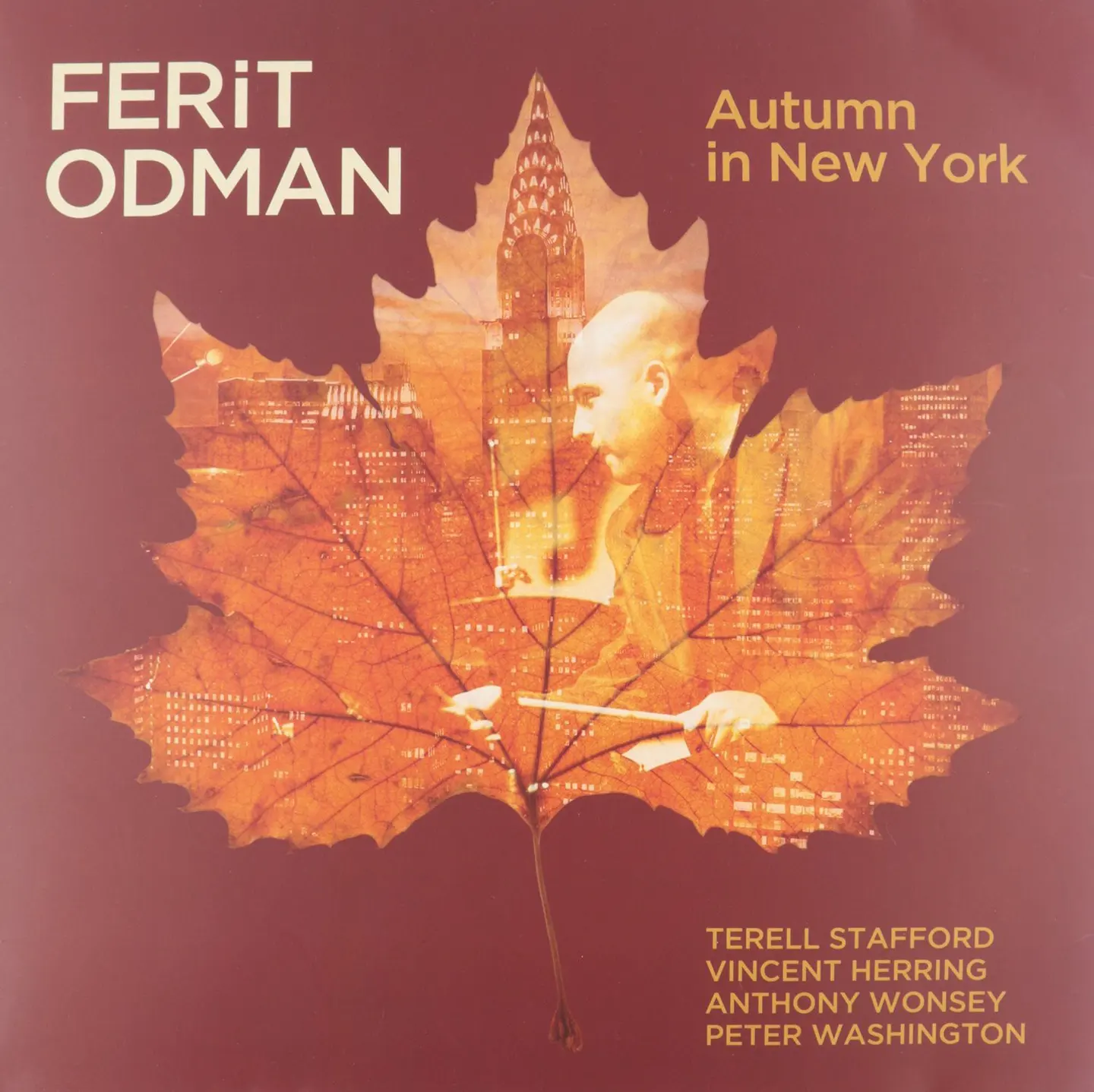
If the whole of “Autumn in New York”, the album by Ferit Odman, one of the leading drummers of Turkey’s younger generation, had appeared in Jazz Dergisi’s “Körleme” column, I’m absolutely certain many musicians would have answered incorrectly (unless they’d heard the album before). I imagine many would have guessed post-1960s Hard-Bop for the style, jazz’s homeland, the USA, for the geography, an alto saxophonist or trumpeter as the leader, and “remastered” for the recorded sound. Though some of our (critic) friends might think the very opposite, I regard these qualities as entirely positive. Because Ferit Odman is a musician who chose from the outset to play and make this Music, genuinely loves it, and does it full justice. Reliable sources such as Downbeat, Something Else and All About Jazz agree…
Ferit Odman recorded his first album, Nommo, in 2008 while doing a master’s at William Paterson University in the USA. His second album, “Autumn in New York”, which we have here, was recorded by Michael Brorby at “Acoustic Recording Studios” in Brooklyn on 18-19 November 2010, when Odman visited New York for 1 month, 2 years later. Alan Silverman did the mastering at “ARF! Digital” in Manhattan-New York. Released by Equinox Music on LP and CD, and dedicated to pianist-educator James Williams, who died in 2004, the album was also produced by Ferit Odman.
The lineup consists of Terell Stafford on trumpet, whom you may know from Benny Golson Sextet, McCoy Tyner Sextet, Kenny Barron Sextet, Jimmy Heath Big Band, Jon Faddis Orchestra and Vanguard Jazz Orchestra; Vincent Herring on alto saxophone, whom you may know from his work with Lionel Hampton Big Band, Nat Adderley, Cedar Walton, Freddie Hubbard, Dizzy Gillespie, Louis Hayes, Art Blakey, Horace Silver Quintet, Jack DeJohnette, Larry Coryell, Steve Turre, Mingus Big Band, Kenny Barron and Carla Bley; Anthony Wonsey on piano, whom you may know from his work with Russel Malone, Nicholas Payton, Donald Harrison, Kenny Garrett, Elvin Jones and Carl Allen; and Peter Washington on double bass, perhaps one of the most-recorded bassists of his generation, whom you may know from his work with a seemingly endless list of famous names including Art Blakey, Tommy Flanagan, Dizzy Gillespie, Benny Golson. Freddie Hubbard, Donald Byrd, Benny Carter, Hank Jones, Milt Jackson, Bobby Hutcherson, Kenny Burrell, Phil Woods, Cedar Walton, Joe Henderson, Clark Terry and Lionel Hampton. As the results make clear to the ear, this is a very sound, well-chosen lineup for such a project. If jazz has a shared “pool of consciousness”, all the names above and many more can be heard/felt in this album in one way or another.
Above all, they have captured in the studio the live-performance energy and interplay (playing together in a unity of spirit) that are unfailing qualities of a good jazz album. And that energy is very well balanced: it swings hard when needed, and lets us breathe through soft, lazy but flowing spaces when needed. Odman skillfully avoids the attitude of “drummer-bandleader who owns the album”, never dominating, playing whatever the Music requires with no ego and a fine aesthetic sense.
There are 7 tracks on the album. Of these, 3 are by pianist James Williams, to whom the album is dedicated. Odman says he “finds the repertoire more mature and romantic than that of his first album”.
The opening track, Benny Golson’s “Step Lightly”, immediately establishes the album’s spirit with a relaxed, medium-tempo swing. Beneath the trumpet and saxophone’s easy unison melody, with counterpoint here and there, Odman plays a bright, flowing, loose, light but assured accompaniment, skillfully shaping tension and release and dynamics within the boundaries the piece and style require. Trumpeter Terell Stafford takes the first solo. After an easy, bluesy opening, he gradually increases the complexity, chromaticism and rhythmic density of his phrases; having skillfully demonstrated his command of the instrument’s full range of pitches and tones, he hands over to the alto saxophone without letting the energy drop too far. Vincent Herring begins his solo with the trumpet’s final motif, moving between the simplicity of soul and the complexity of hard-bop, as though paying tribute to alto masters Cannonball Adderley, Phil Woods and Sonny Stitt. Anthony Wonsey’s piano solo has a much more inward tone, economical and gospel-like at times, complex and revealing advanced harmonic thinking at others. When the bass solo comes around, Peter Washington plays a very loose, tasteful, swinging solo. The horns expertly restate Golson’s melody together, and the album’s first track reaches a classic ending.
The second track is James Williams’s “Alter Ego”. After a lyrical 8-bar piano-bass-drums intro ostinato, the trumpet and saxophone play the 32-bar A-A-B-B melody in unison for the first A and B, and in 2 parts for the second A and B. Once again, trumpet takes the first solo, saxophone the second and piano the third. All three solos consist of one chorus, finely balanced in spirit and technique; though the piano solo is again a little more inward, all three trace a rising ramp of tension. Odman’s supportive, uplifting interplay has a large part in this. After the piano solo, the melody is played as it was at the beginning. The 8-bar “coda”, repeated 3 times at the end, provides a framework for a drum solo through its syncopated structure, but rather than a full drum solo, Odman chooses tasteful short phrases and “fill”s, and the piece ends with a lovely “ritardando”, a collective slowing down.
The title track, Vernon Duke’s “Autumn in New York”, is the third piece, reserved for trumpeter Stattford to display every subtlety of the art of ballad playing, accompanied by piano, bass and drums. The melody is played with a solitary, world-weary beauty and bearing. The solo is denser, with brighter colors. The “Rhythm section” provides entirely supportive accompaniment that clears a path for the soloist: richly filled when you listen closely, spacious and transparent when you don’t. Just as a ballad accompaniment should be.
The album’s second Williams piece, “The Soulful Mr. Timmons”, was written in tribute to Bobby Timmons, one of Art Blakey’s pianists. It begins with a piano intro in a modern ragtime style, then the melody takes on the characteristic soul- and funk-inspired air of Art Blakey Jazz Messengers or Cannonball&Nat Adderley. In a piece written by a pianist for a pianist, naturally the first solo goes to the piano. Wonsey plays a long, swinging solo here, much more expressive than on the other tracks. The same approach and energy continue in the trumpet and saxophone solos that follow, in that order. This piece is also solid evidence of how well Odman and Washington can swing together. The energy naturally drops a little in the short 16-bar bass solo, but in his equally short 16-bar drum solo, Odman simply connects the energy of the bass solo to that of the melody. In fact, he then plays much more like a soloist in the melody’s “break”s, raising the energy further and ending at just the right point.
Cedar Walton’s “Hindsight” maintains the previous track’s high energy, fluidity and swing. The quintet is perfectly together in the melody. The solos again come in the order of trumpet, saxophone and piano. It would probably be fair to call it the album’s second-fastest and second-most-intense piece. Another good choice as we approach the end.
The album’s second ballad, “My Ideal”, by Robin, Whiting, Chase, gives us one last breath before the finale. This time the space is reserved first for alto player Herring, then pianist Wonsey and bassist Washington, to say what they want to say about ballads. Everyone seems to have played for “their own ideal” in “their own ideal way”.
The final track is Williams’s “Changing of the Guard”, a fast, typically angular hard-bop composition. As often happens at the end of a live performance, Odman has decided to close the album at a peak of energy and intensity, and I think he was right. Without losing their finesse, everyone openly displays the full extent of their technique and musical vocabulary. The album ends with the energy and satisfaction of coming out of a good concert. Hoping this essay leaves the same aftertaste… Respect and affection to Ferit Odman…