Translated from the Turkish original. Read the Turkish original.
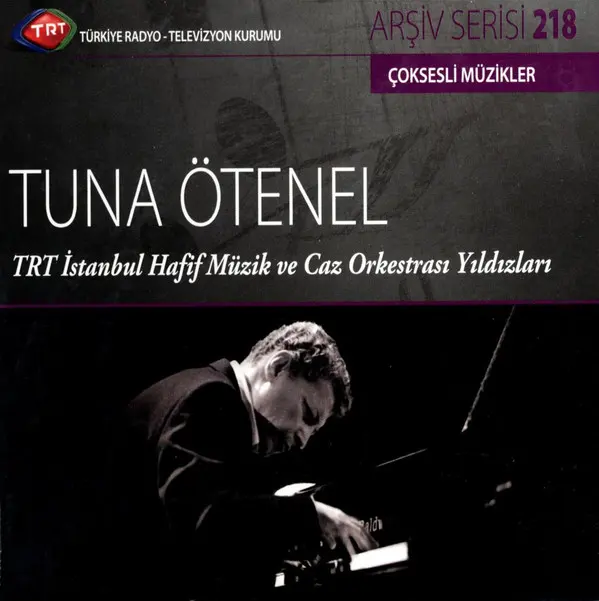
Just as our magazine was ready to go to press, this album arrived at the last moment, and as the writer on duty, it fell to me to introduce it. Doing that at the last minute is hard enough, but writing about this particular album is especially difficult for several reasons. The main one is that, rather than an artist’s conceived project and finished work, it is more of a documentary: a compilation of recordings in which Tuna Ötenel, one of our country’s foremost jazz masters, appeared as guest soloist with TRT İstanbul Hafif Müzik ve Caz Orkestrası. As far as I know, TRT has previously released 4 jazz albums in this archive series: “TRT İstanbul Hafif Müzik ve Caz Orkestrası I (1982-1997 arası kayıtlar)”; TRT İstanbul Hafif Müzik ve Caz Orkestrası II (2001 yılı kayıtları)”; “TRT İstanbul Hafif Müzik ve Caz Orkestrası Yıldızları NÜKHET RUACAN”; “TRT İstanbul Hafif Müzik ve Caz Orkestrası Yıldızları ATAKAN ÜNÜVAR”. This CD is the fifth. Beginning to make use of the archives in this way is a very positive development. Founded in 1982 under Süheyl Denizci’s leadership, TRT İstanbul Hafif Müzik ve Caz Orkestrası is our country’s first and longest-running institutional big band. It has included extremely good musicians from the outset, but has struggled to survive with the problems that arise wherever bureaucracy enters the picture. One of the biggest problems in our country is that certain Musics, and the structures and traditions associated with them, don’t arise of their own accord; instead, people try to establish them through individual effort under the umbrella of the state and its institutions. Consequently, these Musics and ensembles have no organic evolutionary process of their own; people devoted to this Music, who have given their lives to it, try to sustain and develop them through personal effort and goodwill. So when assessing this album in particular and this orchestra in general, we need to keep these realities in mind and show extra respect to everyone concerned. Especially at a time when the orchestra is going through a serious bottleneck. Some younger readers may not know the great master Tuna Ötenel, so let’s give a short account: he was born in 1947, the son of Ahmetoğlu Cevdet Bey, an immigrant from Bulgaria. Cevdet Bey was a versatile musician; indeed, he was given the surname Ötenel because he made bird sounds while playing the violin. His son, virtually born into Music, took his name from the Danube River, which runs from Bulgaria to Turkey. Beginning Music at an early age with piano lessons from his father, Tuna Ötenel was already accompanying his father’s dinner-and-dance orchestra at 5. Playing not only piano but various percussion instruments, and standing up to play the drums because he couldn’t reach them otherwise, Ötenel was learning from the ground up in those years. Before even finishing primary school, Ötenel passed the entrance examination for Ankara State Conservatory, leaving the teachers in awe of his talent. His friends soon nicknamed him ‘devil ears’ for his ability to memorize a melody as soon as he heard it. A student of Ferhunde and Ulvi Cemal Erkin at the conservatory, Ötenel gradually became interested in a Music that was strictly forbidden territory in those years: jazz. Sadly, he paid the price by being expelled, despite good grades in every subject. Ötenel spent the following years playing in his father’s orchestra and Ankara Radyosu Çocuk Kulübü. In 1964 he met Metin Gürel, who had introduced him to the jazz he fell in love with during his conservatory years, and began playing in Gürel’s jazz orchestra. A new chapter in Ötenel’s jazz adventure opened in 1968, when Gürel—of whom he says, “I learned jazz from him”—gave him an alto saxophone. Later playing both tenor and alto saxophone, Ötenel had no trouble mastering his new instrument thanks to his piano background, and became the most important saxophonist of his generation. After leaving Metin Gürel Orkestrası, Ötenel worked for a time with musicians such as Şanar Yurdatapan, Atilla Özdemiroğlu and Cezmi Başeğmez in Dün, Bugün, Yarın Orkestrası, then in other orchestras. His next stop was Erol Pekcan Orkestrası. The trio of Tuna Ötenel on piano and saxophone, Kudret Öztoprak on bass guitar and Erol Pekcan on drums made Turkey’s first jazz record, ‘Caz Semai’, in 1978. Apart from the traditional folk song Ali’yi Gördüm Ali’ yi, the album consisted of Ötenel’s compositions. In 1995 he made “Sometimes”, an album of his own compositions; in 1998, accompanied by Pierre Michelot on double bass and Philippe Combelle on drums, he made “L’Ecume De Vian – Vian Köpüğü”. He gave the album’s launch concert at the 3rd METU Jazz Days. That year, Jazz Dergisi readers voted it “Jazz Album of the Year”. He played with world-famous musicians such as Herbie Hancock, Benny Carter, Harry ‘Sweets’ Edison, Karyn Korg, Hilton Ruiz and Buster Williams. Alongside piano, he played drums, double bass and saxophone, composed and arranged. He performed at many festivals and clubs in Europe. Voyageur, recorded in France in 2000 with trombonist Raul De Souza joining Pierre Michelot and Philippe Combelle, and made available for sale worldwide, has yet to be released in Turkey. His album How Much Do You Love Me? came out on Auro Records in 2005. On this album, Ötenel played piano and saxophone, accompanied by Neşet Ruacan on guitar, İmer Demirer on trumpet, Kürşat And on double bass and Ateş Tezer on drums. Tuna Ötenel taught jazz piano in Istanbul Bilgi University’s Music Department for 3 years from 2003. Illness in recent years has forced him to take a break from performing—a break we sincerely hope will be temporary. As for the tracks on “TRT İstanbul Hafif Müzik ve Caz Orkestrası Yıldızları- TUNA ÖTENEL”, I’ll simply give brief information about them without venturing into commentary. You’ll be buying and listening to this documentary CD anyway, won’t you?:
- Body And Soul: Ötenel plays tenor saxophone on this Johnny Green piece, which he also arranged.
- How Much Do You Love Me: Neşet Ruacan conducts the big band on this Tuna Ötenel piece, arranged by Kamil Özler. The solos are by Tuna Ötenel on tenor saxophone and İmer Demirer on trumpet.
- Polonia: Neşet Ruacan conducts the big band on this Tuna Ötenel piece, again arranged by Kamil Özler. The solos are by Tuna Ötenel on tenor saxophone and Serkan Özyılmaz on piano.
- Count’em: This piece, composed and arranged by Quincy Jones, is played by a small group of 8 rather than the big band. The solos are by Süheyl Denizci on tenor saxophone, Tuna Ötenel on piano and Aydın Özarı on flugelhorn.
- Groove Blues: Süheyl Denizci conducts the big band on this Don Menza piece, whose arranger is not credited. The solos are by Tuna Ötenel on piano, Fatih Erkoç and Nejat Dayıoğlu on trombones, and Atakan Ünüvar on tenor saxophone.
- Splanky: Süheyl Denizci again conducts the big band on this Neal Hefti piece, whose arranger is not credited. The solos are by Tuna Ötenel on piano and Erol Duygulu on tenor saxophone.
- I Left My Heart In San Francisco: Süheyl Denizci again conducts the big band on this George Cory piece, arranged by Billy Byers. The solos are by Tuna Ötenel on piano and Fatih Erkoç on vocals.
- There Will Never Be Another You: Süheyl Denizci again conducts the big band on this Harry Waren/Mark Gordon piece, whose arranger is not credited. The solos are by Tuna Ötenel on soprano saxophone, Fatih Erkoç on vocals and trombone, and Neşet Ruacan on guitar.
Forgive me if this gets a little too romantic, but Tuna Ötenel and the other great masters of his generation are, quite literally, ancient plane trees that took root in the desert. Though they grew up at a time when access to any kind of information and Music was extraordinarily difficult, they brought their musicianship to an international level and became schools in themselves for the generations that followed. I’d like to end with a short anecdote: he once told me that, to transcribe the film Music that served as the standards of the day, he would go to the same film several times in a row, writing the pieces down by ear in the dark, then arranging and playing them for his band’s performance that evening. If musicians of this caliber can emerge from such scarcity through love of Music and pure talent alone, we expect plenty of young geniuses to emerge from today’s abundance. And through Tuna Ötenel, we send our respect, affection and gratitude to all the great masters of that generation…