1 – Intervals
Translated from the Turkish original. Read the Turkish original.
WARNING: According to a bulletin issued by the CSE (Jazz Standards Institute), knowing theory in the abstract, failing to apply it on your instrument and, above all, failing to HEAR it may cause dryness in playing and writing, unnecessarily intellectual-sounding results and confusion. To prevent these side effects, everything learned in theory must be played, sung -even if your voice is terrible- and, by whatever means necessary, HEARD. Or you should skip this theory business altogether and, as has been possible throughout jazz history, learn music simply by listening to recordings/ playing/ learning directly from masters (if there happen to be any around). Otherwise, our institution accepts no responsibility for any complications that may develop later.
First there is silence. (If we leave out the shrieking cell phones and heated conversations in the club or concert hall.) On the subject of silence, one might write something like this: …. …….. … ……..
Then a single note is played. Our little note actually contains other, smaller notes called overtones -depending on the instrument being played- but we still hear it as a single note. If this note is repeated, our instinct to protect ourselves against things we cannot name kicks in: we relate it to time, perceive it as a RHYTHM, meaningful or otherwise, and relax. Yes, we can play rhythm with this one note, or any A section of “one note samba”, but to fulfill the musical requirements of our world and weave melody/ harmony, our musician will play a second note (even a drummer or percussionist). Aaaand this is where INTERVALS, the first subject of our boring lesson, appear (unfortunately, we will also be giving some terms in English, since it is generally the language of Music education and knowing them might do no harm). So what is an INTERVAL? Simply, “the distance between two notes”. Intervals are the building blocks of all harmony and melody, just as atoms are the building blocks of all matter (ugh). So they are the first subject in every theory book, and could not escape being the subject of our first lesson either. In Western Music, where the octave is divided into 12, they are:
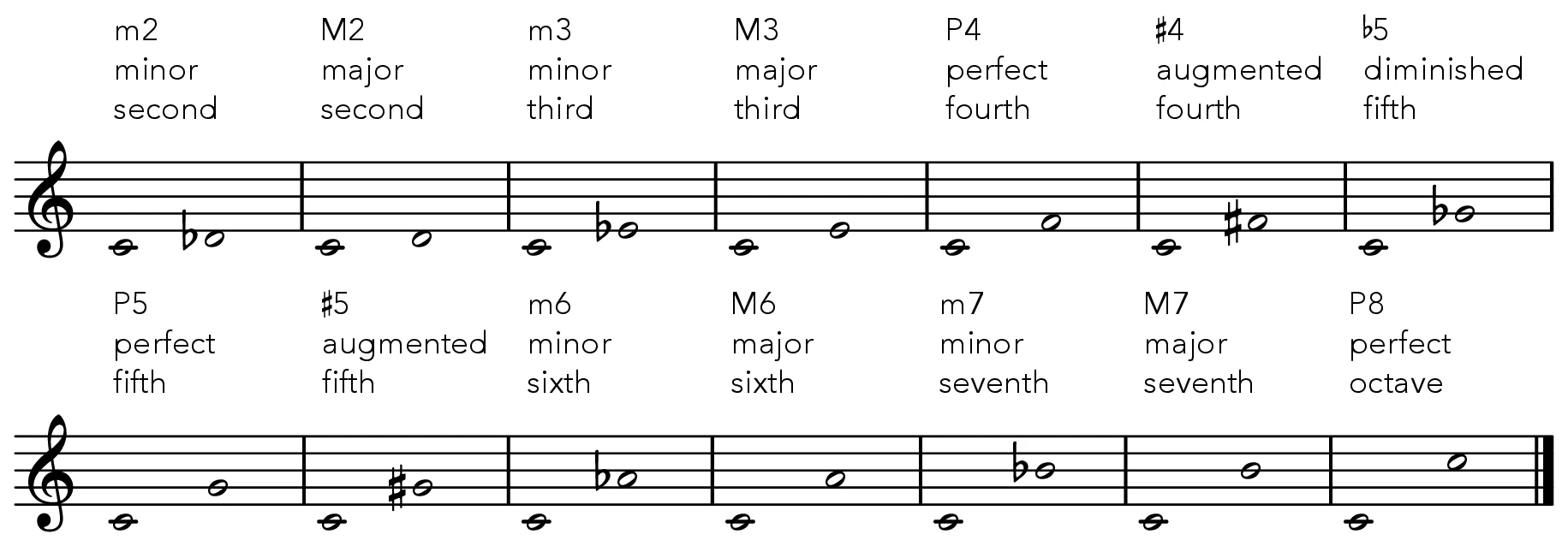
Sooo, what do we do now? First we play them from do, as written above, and we absolutely must sing them so we can hear them in our heads. Then we do the same in all 12 keys (this business of doing every exercise in all 12 keys appears in every book and is never actually done; as the years advance, we discover in dismay how stunted we are in certain keys –Fa #, Re b, etc.– and give our knees a thorough beating.)
One surprising thing I have often encountered while teaching guitar/bass: even students who have been playing for years sometimes look at me, when I say “could you play me a minor seventh interval (for hearts in seventh heaven)?”, as though I had said “could you play Giant Steps from re# at metronome 400 (for tachycardic hearts)?”
Our dear guitarist/bassist friends might perhaps get curious and put some thought into the 5-6 ways of playing each interval in different octaves on their instruments- provided, of course, that they do not know them already and want to learn Music this way.
Now let us come to an easy way of remembering intervals: one method is to make a list of tunes that begin with each interval in its descending and ascending forms and use it as a reference board. The table below is made of jazz standards; if you don’t know the tunes:
- you can say “ah, what a nice excuse, I might as well learn these tunes now that I’ve learned what their first intervals are”,
- you can make a list from tunes you know well (marches, pop, arabesk, it doesn’t matter for this purpose).
I added a Turkish tune or two to the list to give you the idea. Anyway, here is the list:
| Interval | Ascending | Descending |
|---|---|---|
| m2 | Blue Monk,Bastın Faka Bastın | Stella by Starlight |
| M2 | Four | Tune-up |
| m3 | Confirmation | Groovin’ High |
| M3 | Rhythm-a-ning,Yine Bir Gülnihal | Giant Steps |
| P4 | Bemsha Swing,İstiklal Marşı(Turkish) | Softly as in a Morning Sunrise |
| Aug4/dim5 | Isotope,Maria | Blue Seven |
| P5 | Bag’s Groove,Ilgaz(Anadolu’nun..) | Have You Met Miss Jones |
| m6 | Black Orpheus | Love Story |
| M6 | Misterioso | All Blues(between notes 2.-3.) |
| m7 | Aisha(end of measure 2.) | Watermelon Man |
| M7 | Invitation(between notes 2.-3.) | I Love You |
| octave | Blue Bossa | Cantaloupe Island |
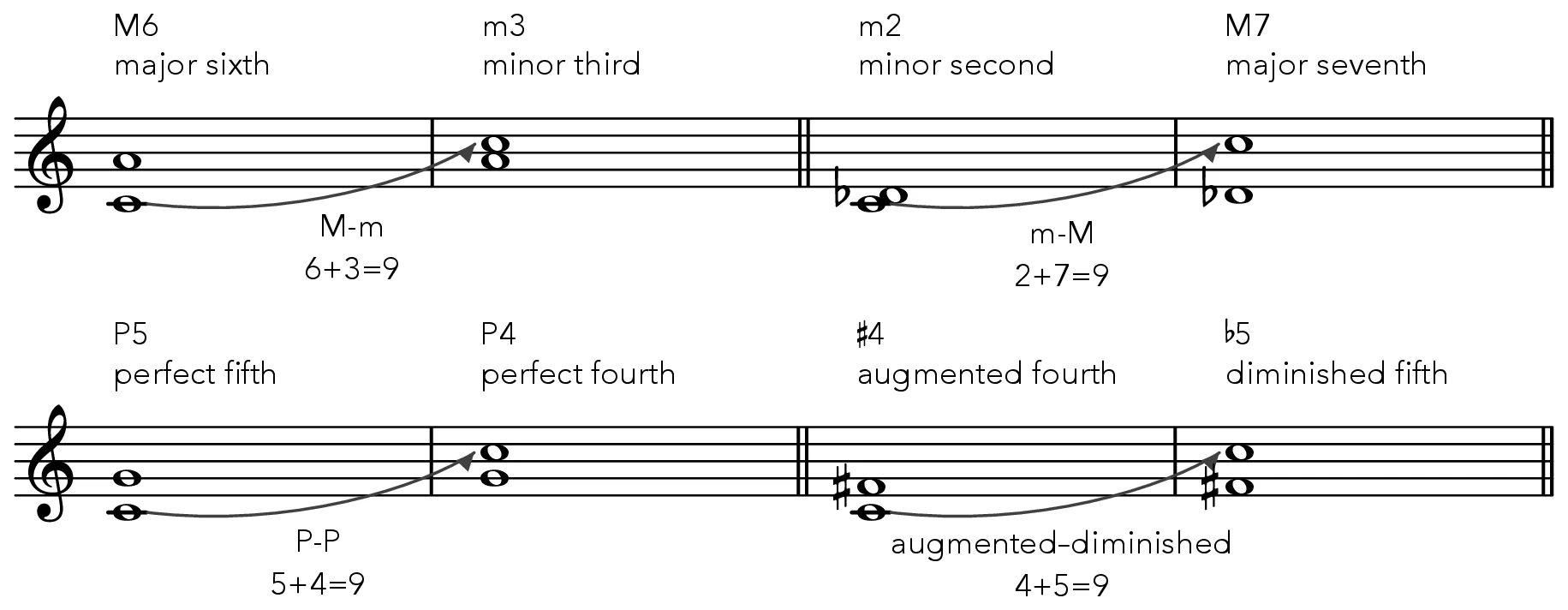
Now, ladies and gentlemen, we come to interval inversions. What does inversion mean? Taking the lower note and putting it an octave higher, or taking the upper note and putting it an octave lower. Of its countless benefits, to name one or two: instead of thinking up an M7, we can think down an m2 (the ascending M7 of “Do” is “Si”, and its descending m2 is also “Si”) – by the way, in Music “up” means higher in pitch and “down” means lower–; it can be very useful when we get to the chords that will descend upon us once we have escaped intervals, etc., etc. When we invert intervals, we observe some interesting standard behavior:
- an m interval becomes M, an M interval becomes m
- a P interval stays P
- an Aug interval becomes dim, a dim interval becomes aug
- the original and inverted interval numbers add up to 9.
Let us examine these internally consistent habits below:
Under the pressure of circumstances, our intervals sometimes exhibit deviant behavior, as below- not the sort of thing a jazz musician encounters every day. Still, I am including them so that if you do run into them, you will not panic and call 155. For now, you can look the other way and pretend they do not exist until you meet them:

In the example above, la double flat, for instance, sounds no different from sol, but in certain circumstances that I do not want to delve into and confuse matters, it may need to be written this way. Anyway, I must now sit down and practice “playing while forgetting all this”. Don’t give me any jazz. (Our Beautiful Turkish Language-1) I wrote about intervals in December; in February it’ll be Schubert, or should I say Schubruary: with one more dreadful joke of that sort, I leave the scene…