Bass Line 3
Translated from the Turkish original. Read the Turkish original.
Çağ layan Y ı l d ı z b
Bass Layn- Bass Line No3
Seventh-chord (4-note chord) arpeggios
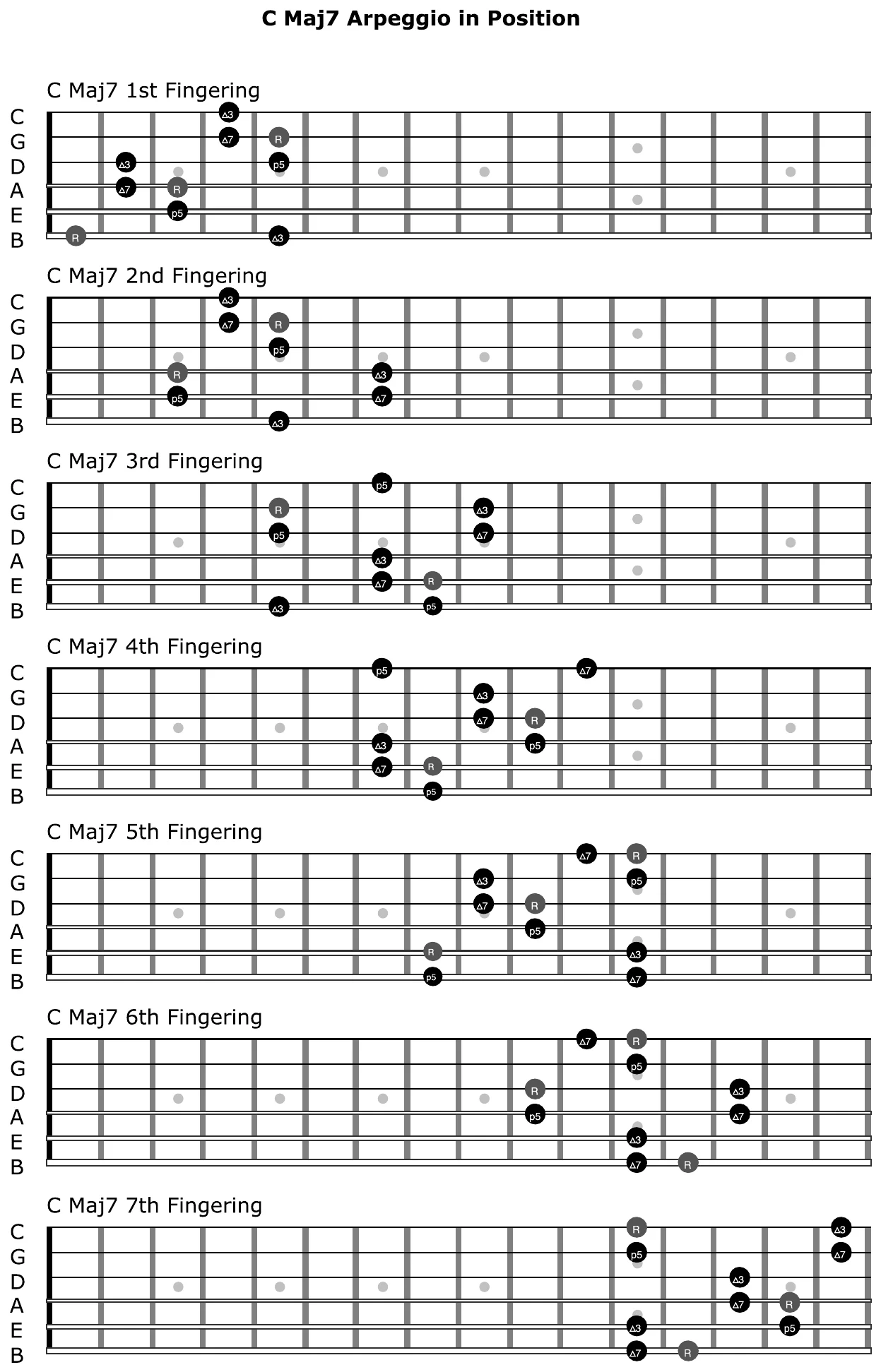
Let me tell you that you can find my column from last issue and all my lessons at www.caglayanyildiz.com, including any subjects here that make you say, “Whaaaat’s that?”, and get straight to the point. Arpeggios are “vertical” harmonic structures used as “horizontal” melodic structures. Although arpeggios are vehicles every bassist uses frequently and safely to outline the harmony clearly in every genre of Music, many of us are not 100% in control of them. (See: bent trees and poles at critical harmonic intersections.) Arpeggios are generally learned in just 1-2 positions, usually spanning 1 or 2 octaves from root to root, and left at that; their full potential goes unused. I approach arpeggios in 2 ways: “Arpeggios in Position” and “2-Notes-per-String Arpeggios”. You probably know this already, but I’ll repeat it anyway. In guitar and bass guitar technique, “Position” means an area covering 6 frets across all 6,5,4 strings, depending on how many strings your bass has: a range of “2 octaves+ an augmented 4th” on a 6-string bass, “2 octaves+a minor 2nd” on a 5-string bass, and “1 octave+a minor 6th” on a 4-string bass. When we place each of the left hand’s 4 fingers on a fret, fingers 2. and 3. each play just one fret, while fingers 1. and
- each play 2 frets. Reaching one fret with finger 1. or 4. is called a “stretch” of 1 and 4.
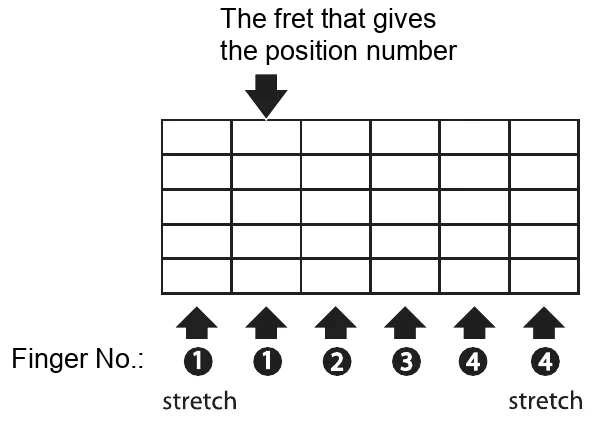
The fret that determines which position we are in
- the fret on which we place our finger without a “stretch” gives the position its name. So if finger 1. is on fret 5., we are in “position 5.”.
Finger No:
Now for 4-note chords. As we all know, there are 18 most frequently used ones. (“What an annoying teacher, always saying ‘as we all know’, as though we’re supposed to know… If I knew, I wouldn’t be reading lessons in the first place…”):
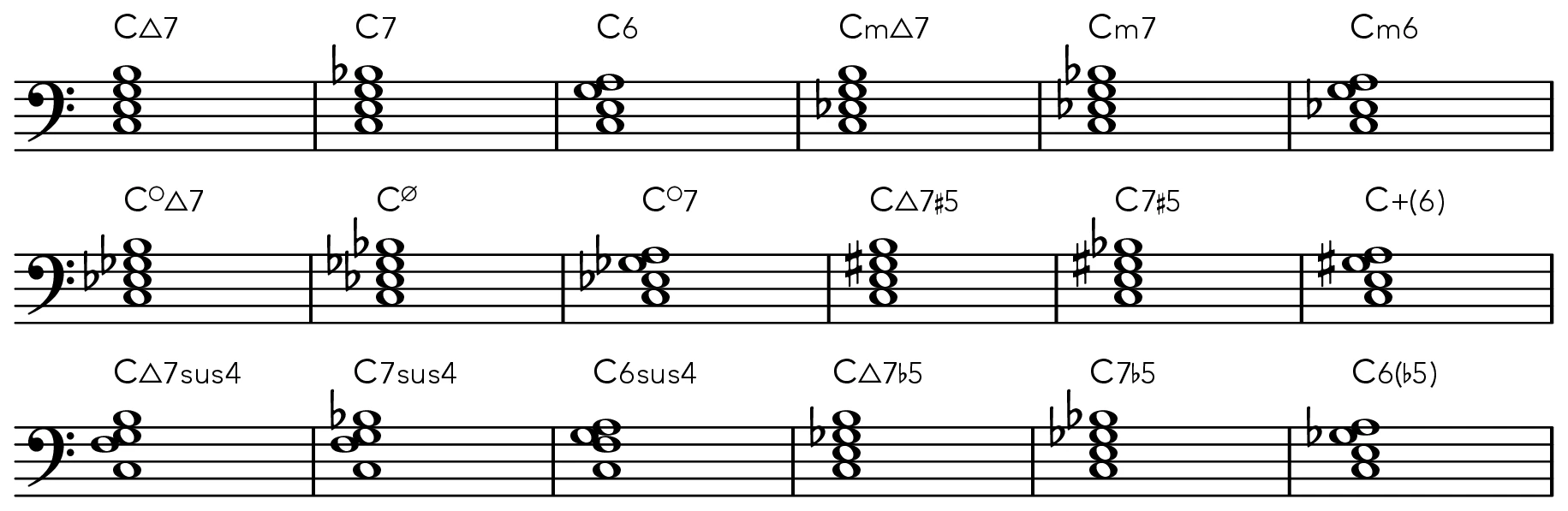
Anyone with no idea about this is immediately sent off to Seventh Chords (Four-Note Chords). (Great, as if that weren’t enough, now he’s sending us to another lesson…) Below we will give only the arpeggio of the “C maj7” chord, but you creative students can, of course, move the necessary notes this way and that, raise and lower them, and find all 18 arpeggios in the same positions, can’t you? (“Look at him, now he’s giving us a pointless pep talk…”) So you can glance at the chords above and work out that for a C7 arpeggio we lower only the 7th, and for Cm(maj7) only the 3rd, and so on, can’t you? (“Look, he’s still going on and on…”) Then you’ll practice all of them in all positions in 12 keys, won’t you? (“Ohhh, enough alreeeady … ”) I have given all the examples below for 6-string bass; as appropriate, you can reduce the number of strings and move the positions along the neck to whichever string and key you wish…
“2-Notes-per-String Arpeggios” are self-explanatory. Below we again see the F maj7 arpeggio. But of course we are going to learn these with all 18 types of 4-note chord and in 12 keys too… (“I swear I’m giving up guitar right here and now…”)
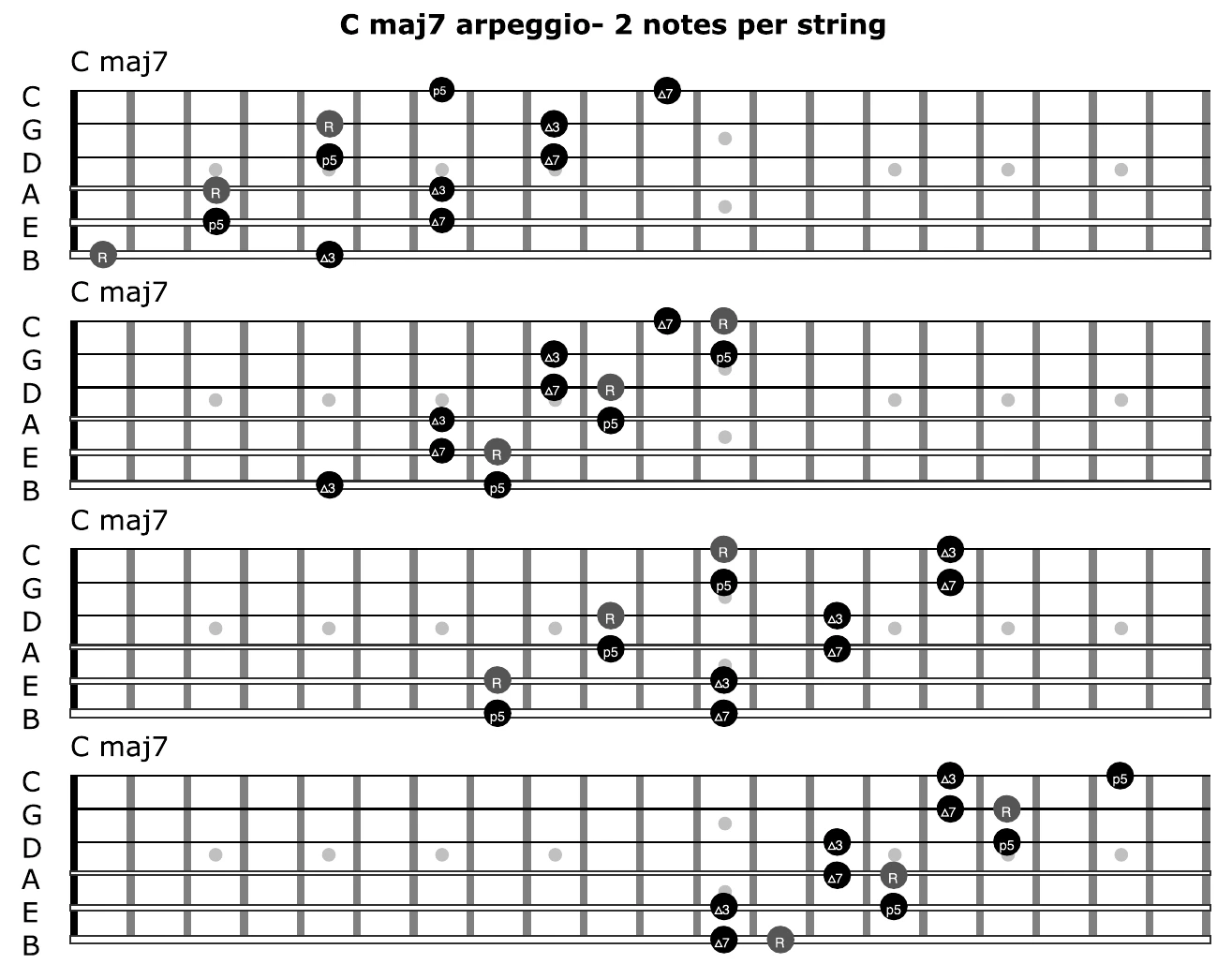
We have noticed, haven’t we, that the same shape repeats in 2-string sets (B-E, A-D, G-C), which makes things much easier? What? You didn’t notice? You gave up bass? Come on, is it worth giving up over (7 shapes x 18 chords x 12 keys) + (4 shapes x 18 chords x 12 keys) = 2376 arpeggios? Pick the ones you need and learn them, that’s all. If you need them all, you’ll gradually learn them all over time. Go on, pick up your bass; this is getting embarrassing… Now I’ll suggest something else. Take the chords of any tune you play and play their arpeggios while always “trying to stay in the same position”. Say we have a chord progression like Gmaj7 | F#m7b5 | B7+ | Em(maj7):
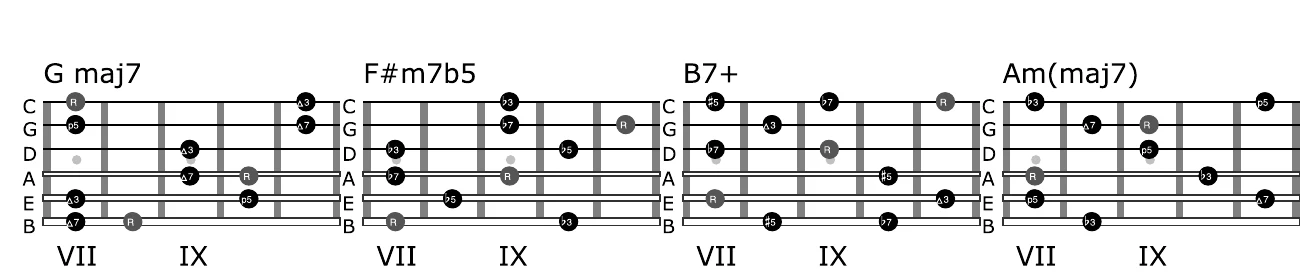
See? Putting it into practice wasn’t that hard. Now let’s play it in the other 7 positions… Then with all 4 forms of “2-Notes-per-String Arpeggios”… Let’s play with different rhythms and articulations, as though we’re playing Music rather than exercises. Well, what am I supposed to do if Music is such a vast subject… “Did III creeeate it, did III creeeate it, this kiiiind of arpeggiooo, did III creeeate it” … Muttering something along those lines, I once again make a swift exit from the scene…