7 – Coltrane Changes
Translated from the Turkish original. Read the Turkish original.
WARNING: According to a bulletin issued by the CSE (Jazz Standards Institute), knowing theory in the abstract, failing to apply it on your instrument and, above all, failing to HEAR it may cause dryness in playing and writing, unnecessarily intellectual-sounding results and confusion. To prevent these side effects, everything learned in theory must be played, sung -even if your voice is terrible- and, by whatever means necessary, HEARD. Or you should skip this theory business altogether and, as has been possible throughout jazz history, learn music simply by listening to recordings/ playing/ learning directly from masters (if there happen to be any around). Otherwise, our institution accepts no responsibility for any complications that may develop later.
I would like to begin, of course, by correcting a printing error in my last column. In fact, it turned the piece into a little puzzle and made it even more entertaining. The notation that should have been printed first was printed last, shifting every musical example one slot above where it belonged. (The same error appeared in Cem Tuncer’s column, so some kind of notation-shuffling virus must have got into the publisher’s computer.) Anyway, Jazz magazine is apparently treating anyone who solved this “cross your eyes and understand pentatonics” puzzle to a spread at Blue Note for an evening.
Having made our customary entrance, let us begin a column that is supposed to teach a little as well as entertain. The subject is the “Coltrane Chord Progression”, or “Coltrane Changes”, which John Coltrane introduced into the jazz language in 1959 with “Countdown” and “Giant Steps” on his album “Giant Steps”. This chord progression made waves as a revolution in jazz harmony. Yet Coltrane was actually using Slonimsky’s “Thesaurus of Scales” as a source at the time. The very first sections of that book concern the equal division of 1 octave and 2 octaves. In short, Coltrane used the principle of dividing the octave into 3 to expand the II-V-I cadence, a cornerstone of jazz harmony. Above we see the normal II-V-I cadence in C major, and below, the Coltrane cadence:
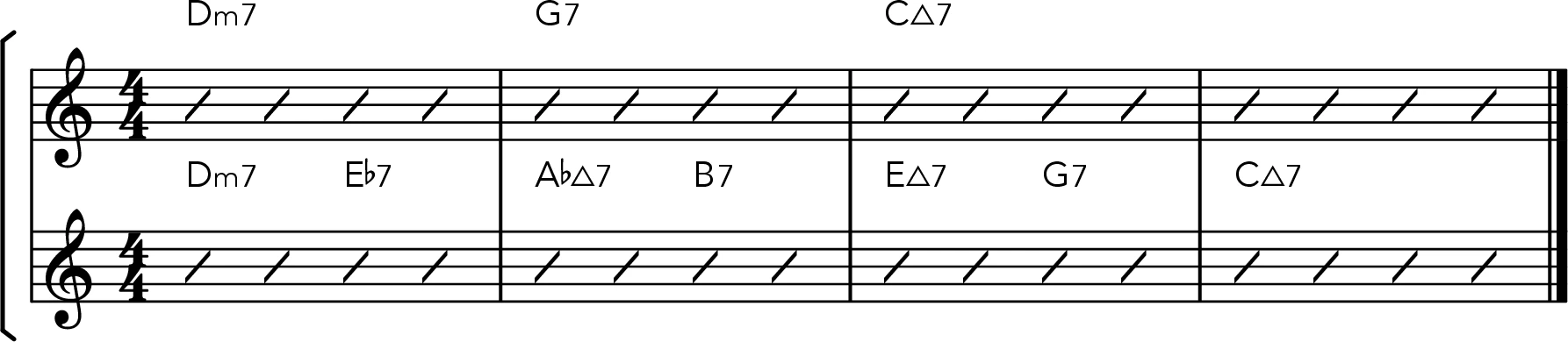
Dividing an octave into three gives us a “major 3rd” (12/3=4, 4 half steps= major 3rd). Dividing an octave starting on Do into three= C, E and Ab . After the original D-7 chord, Coltrane uses Ab’s dominant, Eb7, to get to Ab; B7 to get to E; and finally G7 to get to C, the actual tonal center. It is that simple. It is that simple, but playing it is nothing like that simple. Especially at Coltrane’s tempos (Countdown’s metronome marking is around 340).
Countdown is actually a modification of Miles Davis’s “Tune Up”. (A Miles tune dressed as Coltrane, in other words; a Doğan dressed as a Şahin.) “Tune Up” is, of course, ideal territory for Coltrane changes: it is a 16-measure tune made up of 3 4-measure II-V-I phrases in D,C and Bb in turn, followed by a 4-measure tailpiece (for contrast). Coltrane reharmonizes the first 12 measures and leaves the tailpiece as it is:
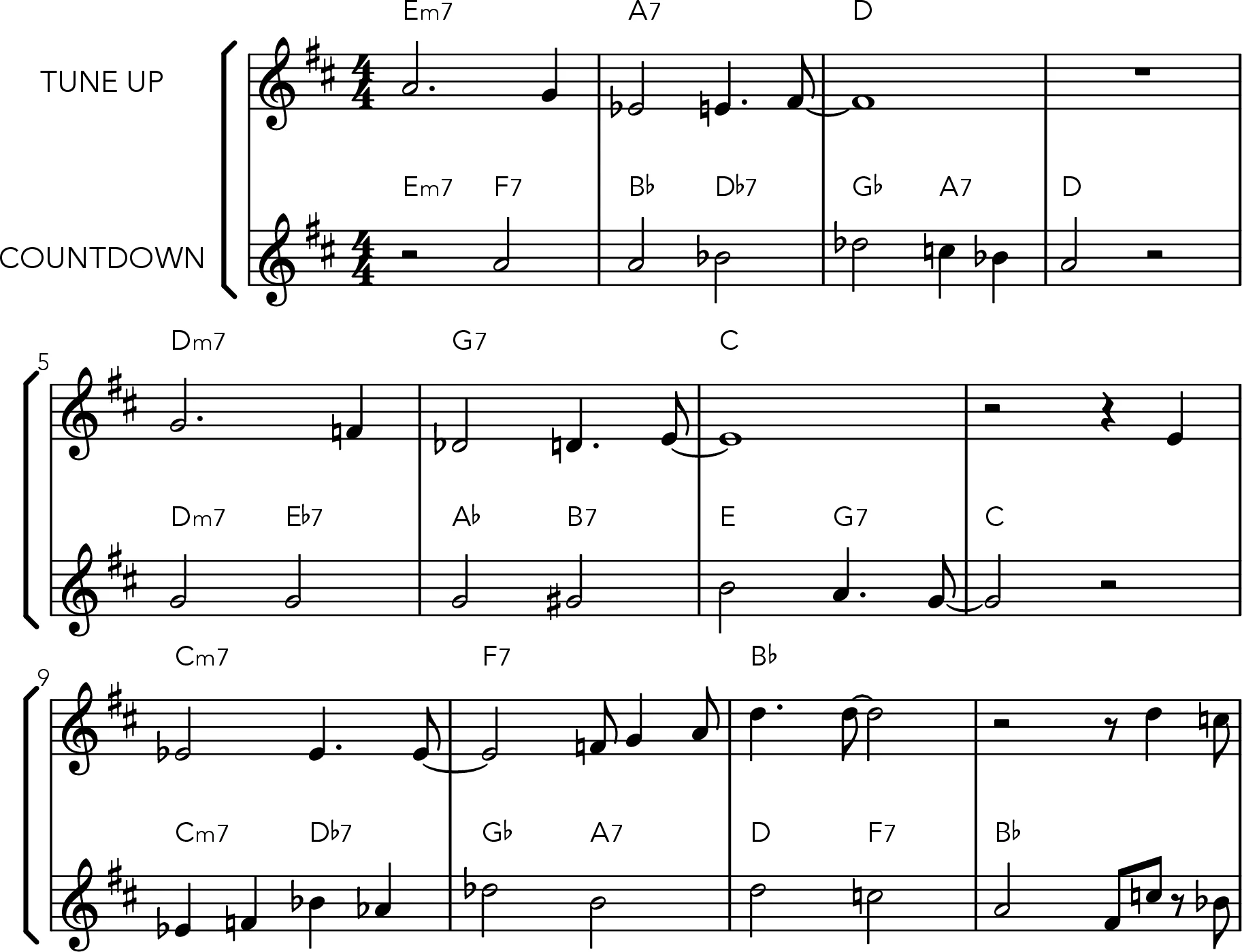
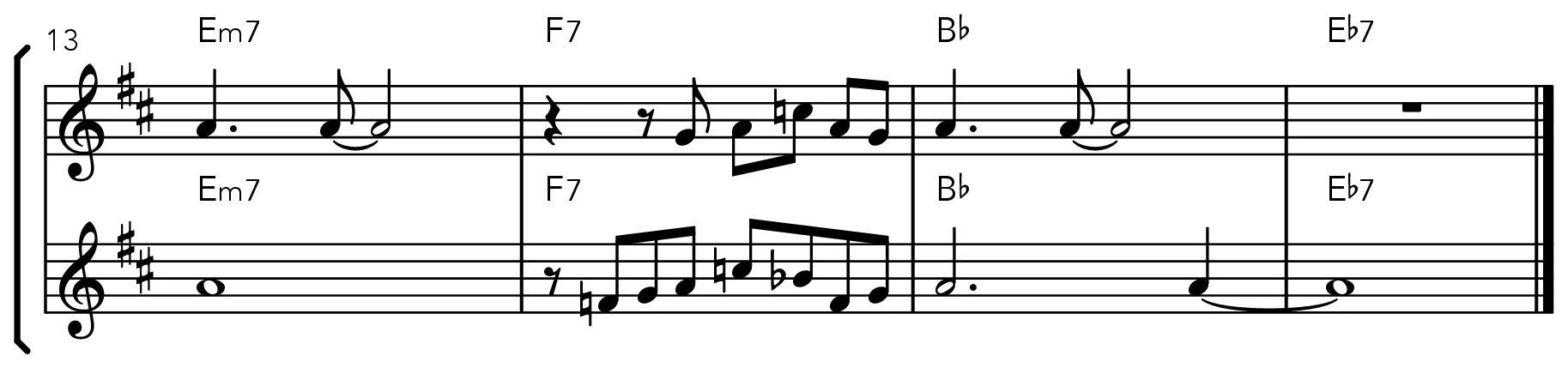
The melody is almost a joke. He stays quite faithful to the “Tune Up” melody, using basic rhythmic variation techniques and altering it to fit the new harmony (Şahin/Doğan). He also stays faithful to the architecture of “Tune Up”: a “sequence” of 4-measure units in the first 8 measures, a new 4-measure phrase for contrast and movement, and an answer to it in the last 4 measures.
Since the harmony resolves to the tonic in measure 3 in “Tune Up” and measure 4 in “Countdown”, he expands the rhythm of the original melody from measure 2 onward (augmentation), inverts its intervals (inversion) and modifies it to fit the harmony. Looking at the interval relationships: Tune Up: M2 down, M3 down, m2 up, M2 up Countdown: m2 up, m3 up, m2 down, M2 down (and one additional m2 down to resolve to the tonic)
- The phrases beginning in this measure are more or less the same graphically. They also start on Eb and have D as their highest note. Coltrane naturally has to add more notes because his harmony is more active, and the overall contour undulates more. Also, the phrase in measure 9 of “Countdown” is a rhythmic expansion (augmentation) of the idea in measure 14 of “Tune Up”, with its contour adapted to the harmony. The last 4 measures are almost completely the same. Coltrane merely expands and displaces the rhythms and changes 2-3 notes (probably because of copyright law).
That is how compositional bodywork is done. As children of a nation that turns a VW Bee- Volkswagen into a limousine in Bursa, who knows what you might do? How many ways might you divide the octave, and what chord progressions might you create? Anyway, making use of the gas I’ve just pumped you full of, I speed away from the scene.