6 – Pentatonics
Translated from the Turkish original. Read the Turkish original.
WARNING: According to a bulletin issued by the CSE (Jazz Standards Institute), knowing theory in the abstract, failing to apply it on your instrument and, above all, failing to HEAR it may cause dryness in playing and writing, unnecessarily intellectual-sounding results and confusion. To prevent these side effects, everything learned in theory must be played, sung -even if your voice is terrible- and, by whatever means necessary, HEARD. Or you should skip this theory business altogether and, as has been possible throughout jazz history, learn music simply by listening to recordings/ playing/ learning directly from masters (if there happen to be any around). Otherwise, our institution accepts no responsibility for any complications that may develop later.
I would like to begin by correcting the errors in my last column, written in strict accordance with the laws of last-minute deadline panic. Its title was, of course, as its contents made clear, “scales”, not “diatonic harmony”. How this error came about is a complete mystery to me. Another error arose because some fonts on my computer were missing from the printer’s computer: in the table at the end, the “Parent scale and position” column had arrows pointing up and down for each scale; they disappeared completely, rendering the whole thing incomprehensible. The last error was my forgetting to put a # before the G in the “C lydian augmented” scale. Anyway, you can find the correct version, and a little more, at www.caglayanyildiz.cjb.net . I hope this correction will benefit all 5 of the friends still doggedly reading my columns, whose number will fall to 3 after this issue’s installment.
In case the heading says something else, let me make it clear: in this column I want to touch on pentatonic -that is, five-note- scales, which have managed to establish a subculture of their own within the world of scales. No, I don’t mean that this is the first -and perhaps only- scale many guitarists learn. (If I did, I would talk about how masters like Jimi Hendrix and B.B. King spent their whole lives with these scales and played magnificently.) What I want to emphasize is their use in modern jazz from the 1960s onward, and in the Music that followed. Having seen 3 books devoted entirely to this subject, I will discover what I can do with it in 2 pages when I finish writing in a few hours. (Where was the “Delete” key on this computer?)
There are 2 most widely used pentatonic scales: major and minor pentatonic. Minor pentatonic: 1 b3 4 5 b7 Major pentatonic: 1 2 3 5 6 And these two scales are actually the same: they are modes of one another, just as C major (ionian) and A natural minor (aeolian) are the same:

Despite the various debates on the subject, let me say that, for practical purposes, I prefer to think only in terms of minor pentatonic.
The beauty of pentatonic scales is that they change color like chameleons over different harmonies, creating different tensions. As an example, let us examine the chord degrees produced by the C minor pentatonic scale over the chords it is most frequently used with:
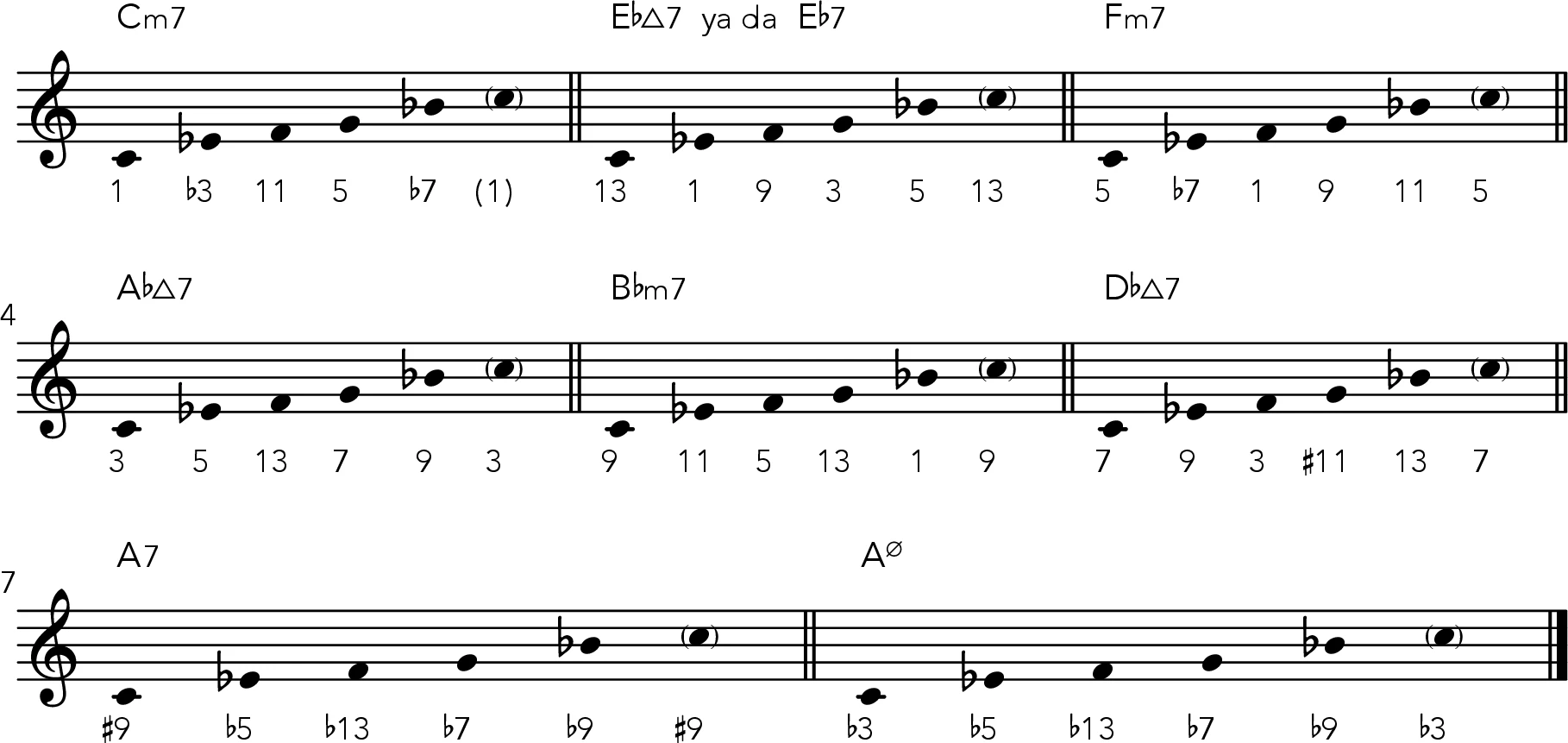
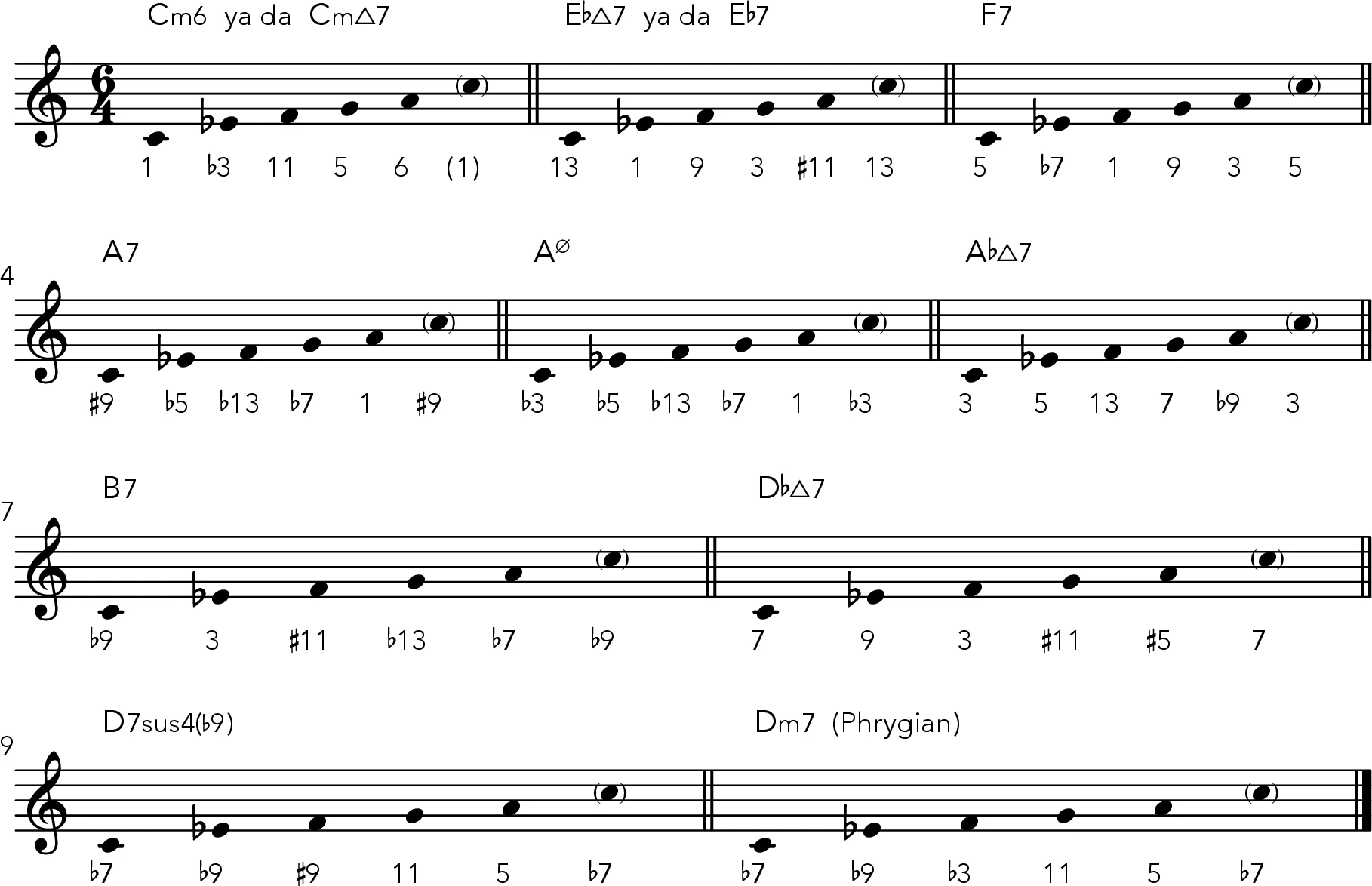
Transposing the above information into 12 keys, taking a tune and working out which pentatonics can be played over each chord is, of course, up to you -unless you employ someone on salary, with benefits, solely for this purpose. And the information below too… Sorry about that… Another of our pentatonic scales is “minor 6 pentatonic”: 1 b3 4 5 6 Now, as an example, let us examine the chord degrees produced by the “C minor 6 pentatonic” scale over the chords it is most frequently used with:
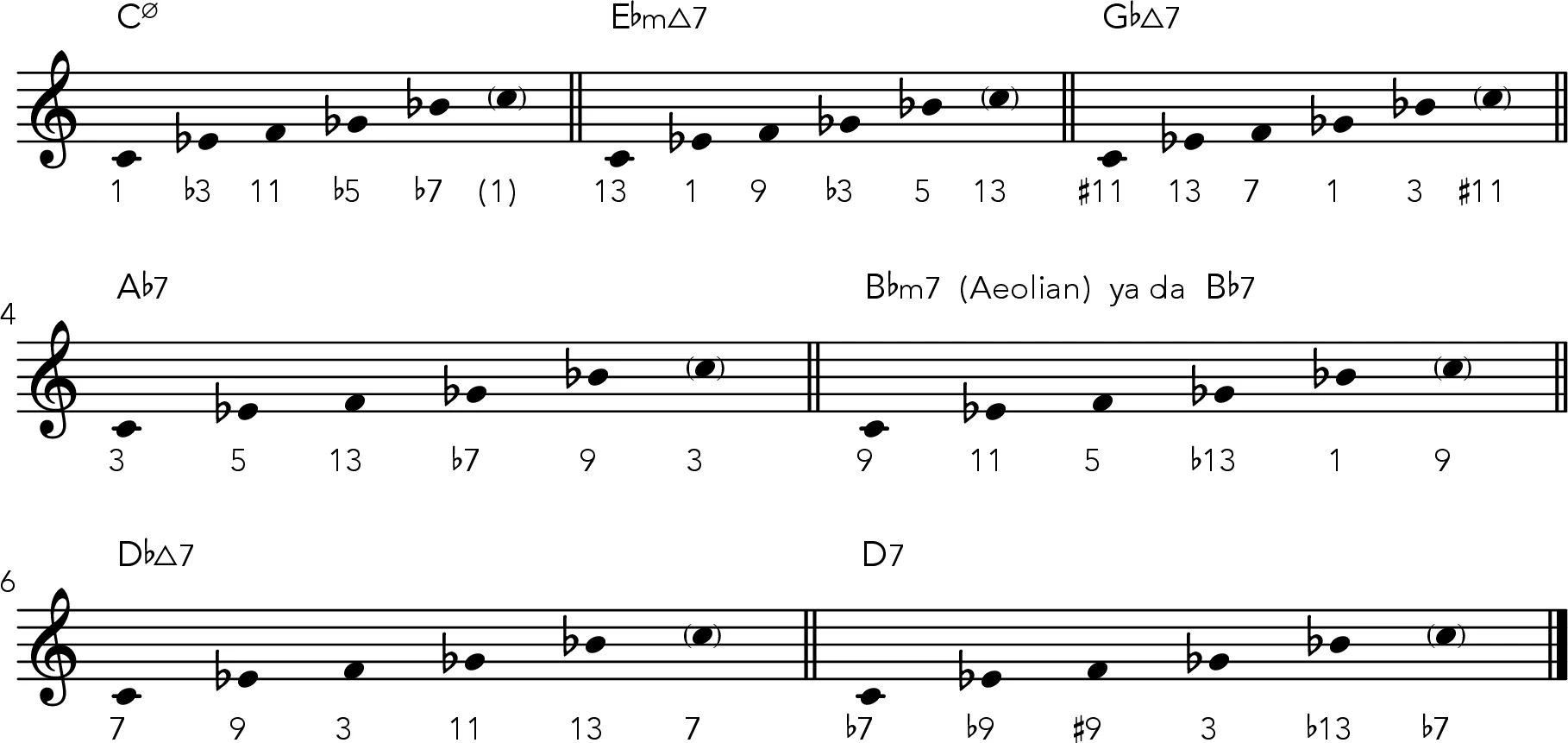
Another of our pentatonic scales is “minor pentatonic b5”: 1 b3 4 b5 b7 Now, as an example, let us examine the chord degrees produced by the “C minor b5 pentatonic” scale over the chords it is most frequently used with:
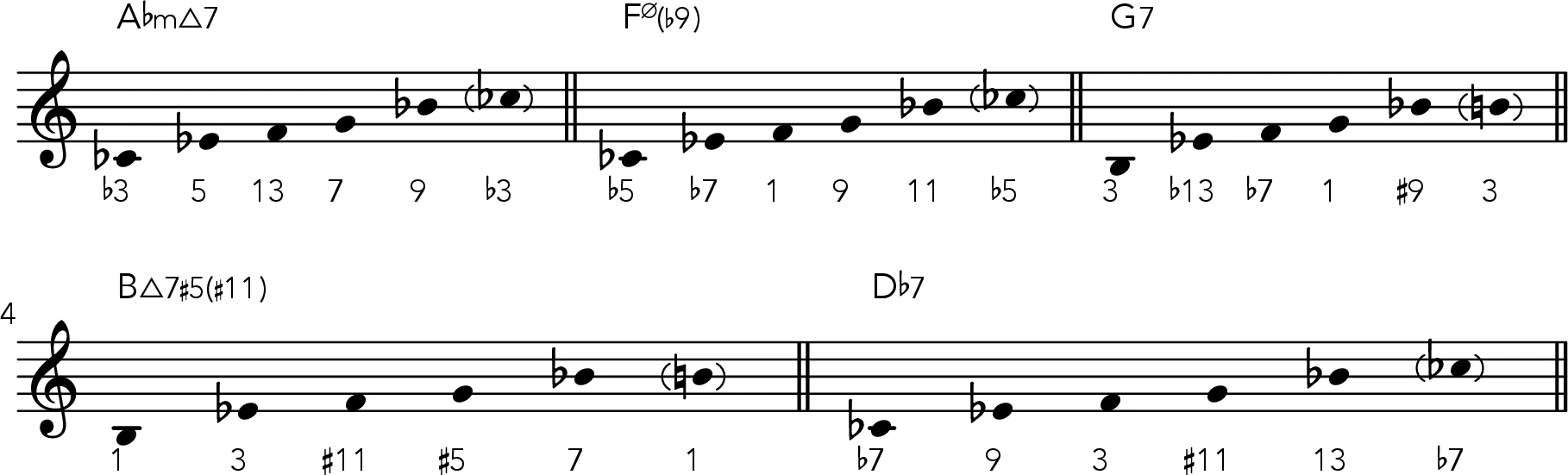
Another of our pentatonic scales is “major b6 pentatonic”: 1 2 3 5 b6 There is something interesting here: certain factions who, like me, are obsessively accustomed to thinking in minor pentatonic, or wish to become so (may God spare you, brother…), can think of this scale as “minor pentatonic, but with the root replaced by the note a half step below”:

Now, as an example, let us examine the chord degrees produced by the “Eb major b6 pentatonic” scale (or, for the obsessives, “C minor pentatonic, but with B instead of C”) over the chords it is most frequently used with:
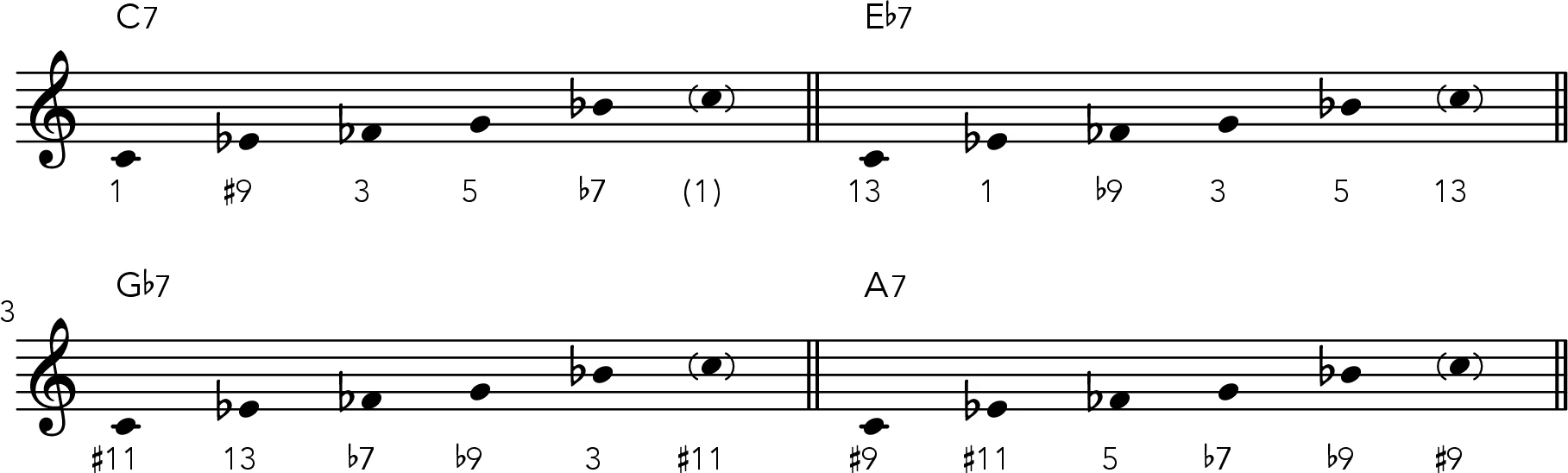
Riiight, take a deep breath and bear with me a little longer. Another of our pentatonic scales is “major b2 pentatonic”: 1 b2 3 5 6
The same interesting situation applies here: the aforementioned obsessive factions can think of this scale as “minor pentatonic, but with 4 replaced by the note a half step below”:

Applying our standard procedure:
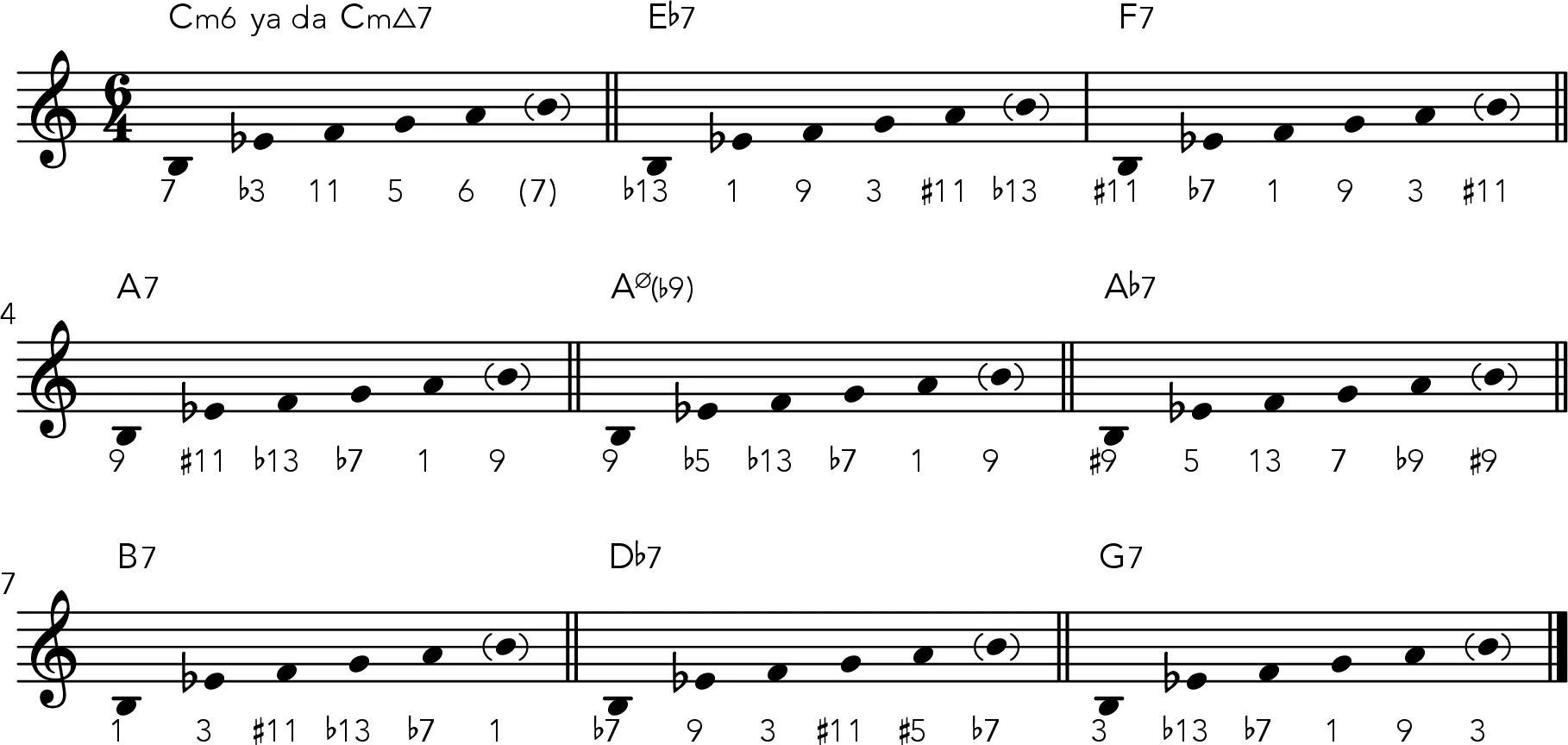
The last pentatonic scale we will mention is “whole-tone pentatonic”: 1 3 #4 #5 b7 Here we have the situation that has by now lost all its interest: factions I no longer even wish to describe can think of this scale as “minor 6 pentatonic, but with B instead of C”:

And of course:
If absolutely necessary, we can sum it all up in a table like this:
| C min pentatonic(C Eb F G Bb) |
|---|
| C min6 pentatonic(C Eb F G A) |
| C min7 b5 pentatonic(C Eb F Gb Bb) |
| Eb major b6 pentatonic(C min pentatonic w/B instead of C)(B Eb F G Bb) |
| Eb major b2 pentatonic(C min pentatonic w/E instead of F)(C Eb E G Bb) |
| B whole-tone pentatonic(C min6 pentatonic w/B instead of C)(B Eb F G A) |
| Cm7Eb maj7/Eb7Fm7Ab maj7Bbm7Db maj7A7Am7b5 | |
|---|---|
| Cm6F7A min7b5B7altA7altAmin7b5Eb maj7#11/Eb7#11D 7b9susDmin7(phrygian)Db maj7#5Abmaj7(#11,b9) | |
| Cm7b5Eb m6Ab7D7altGb maj7b5Bb min7Bb7Db maj7 | |
| Ab m/maj7G7altDb7#11F min7b5(9)B maj7#5 | |
| C7Eb7F#7A7 | |
| C-maj7Eb7F7A7Am7b5(9)B7altG7Db7Ab7 |
The steadfast among you can prepare a table for lifelong use, with chord types in the left column and, in the right, which type of pentatonic can be played on which degree.
If there is one thing I am good at, it is leaving the scene… Especially at 3 in the morning…