9 – Hexatonics
Translated from the Turkish original. Read the Turkish original.
Çağlayan Yıldız
Very Boring Music Lessons 9:
Hexatonics (Triad-over-Triad Chords)
WARNING: According to a bulletin issued by the CSE (Jazz Standards Institute), knowing theory in the abstract, failing to apply it on your instrument and, above all, failing to HEAR it may cause dryness in playing and writing, unnecessarily intellectual-sounding results and confusion. To prevent these side effects, everything learned in theory must be played, sung -even if your voice is terrible- and, by whatever means necessary, HEARD. Or you should skip this theory business altogether and, as has been possible throughout Music history, learn Music simply by listening to recordings/ playing/ learning directly from masters (if there happen to be any around). Otherwise, our institution accepts no responsibility for any complications that may develop later.
Let me tell you that you can find my entire column from last issue at www.gitardergisi.com, and all my lessons at www.caglayanyildiz.com, and get straight to the point.
One way to build complex harmonic/melodic structures from simple building blocks is to create Hexatonics by placing a Triad over a Triad. (“Anyone who takes a lover on top of a lover ought to be shot,” but that is another subject.)
As we know, there are 4 types of Triad, or Three-Note Chord: Major, Minor, Augmented, Diminished. Anyone looking blank for even a moment is sent off to lesson 2. at www.caglayanyildiz.com. Hexatonics:
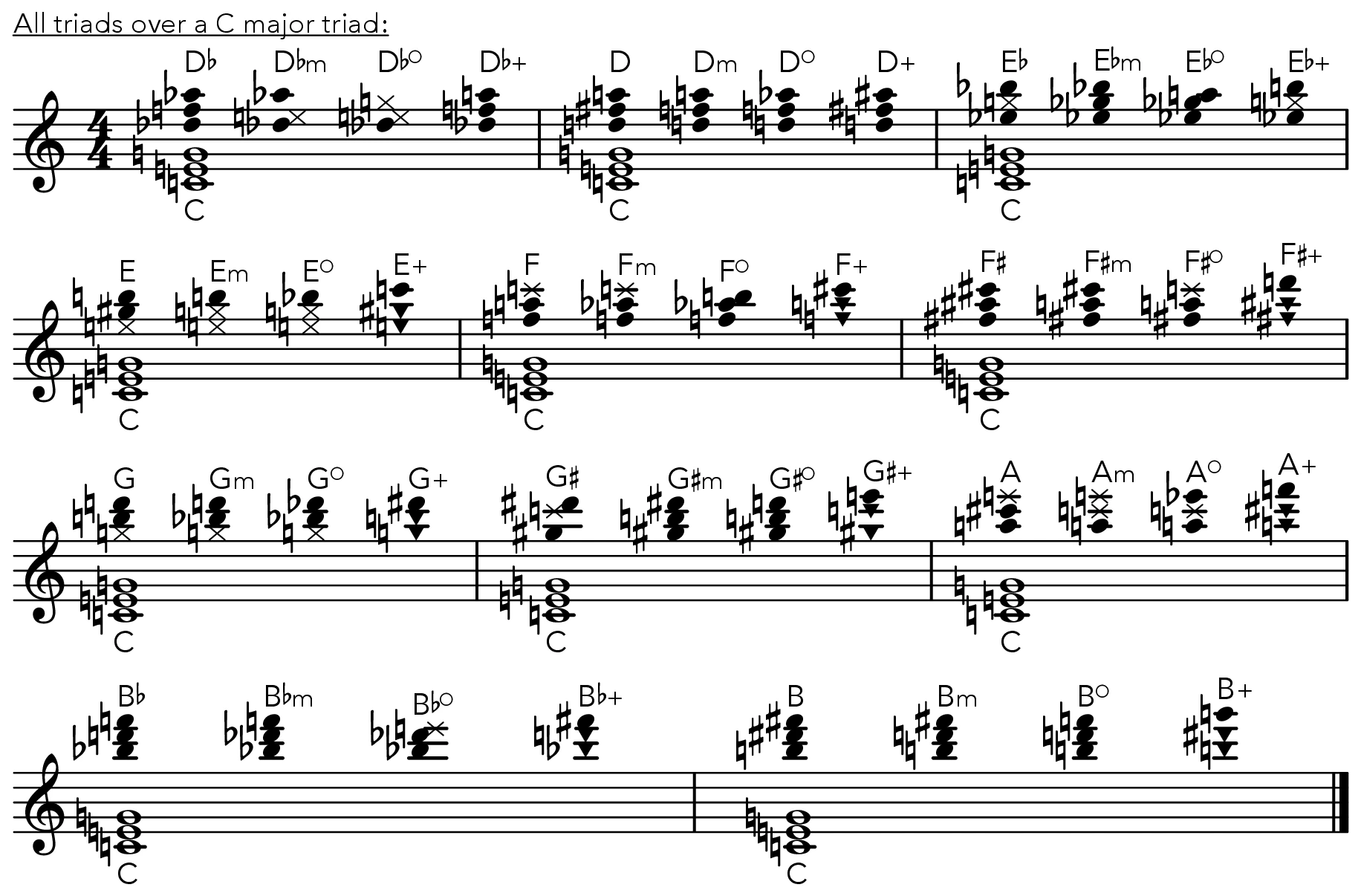
Here are the steps we followed in creating the Hexatonics above:
- We wrote every possible triad over a C Major triad.
- To find true 6-note chords, we marked the notes of the C major triad (C,E,G) with an “x” wherever they occurred in the upper triads. We will not use these.
- We marked “Augmented (+)” chords containing the same notes with a “triangle”. (Db+=F+=A+, D+=F#+=Bb+, Eb+=G+=B+) We will not use these either.
- We carried out the same operations over C Minor, C Diminished and C Augmented triads. Space restrictions prevent us from publishing these in the magazine. Either write them out yourselves using the same system, or visit www. gitardergisi.com and www.caglayanyildiz.com. Our next task is to choose the chords containing neither an “x” nor a “triangle”, and turn them into 6-note scales. After all, a chord is a scale sounding all at once, and a scale is a chord spread out in time:
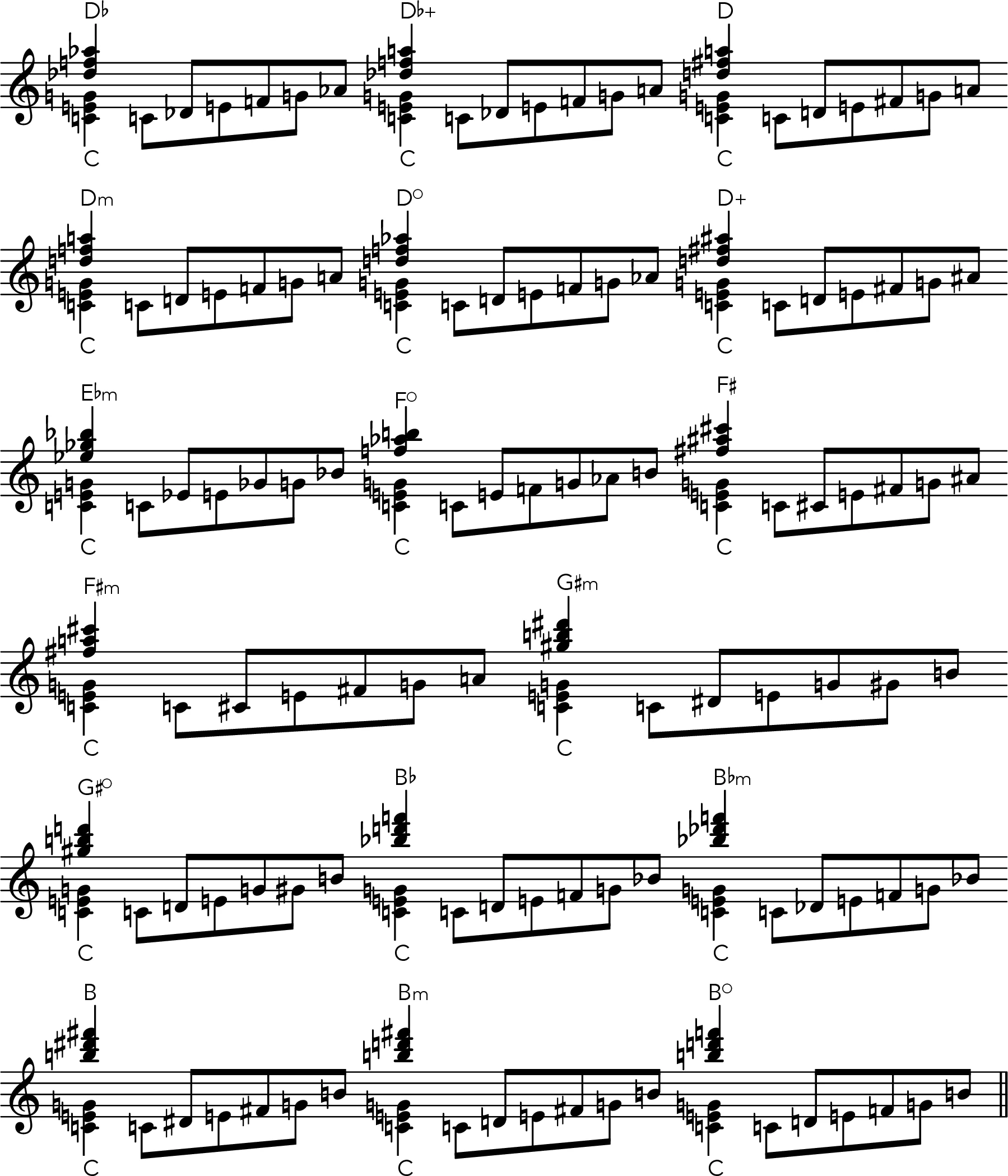
We carried out the same operations over C Minor, C Diminished and C Augmented triads. Space restrictions prevent us from publishing these in the magazine either. Either write them out yourselves using the same system, or visit www.gitardergisi. com and www.caglayanyildiz.com.
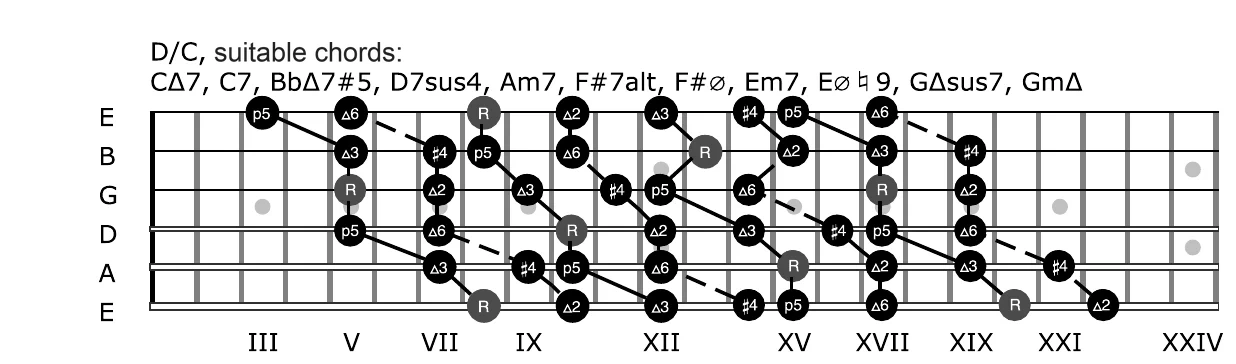
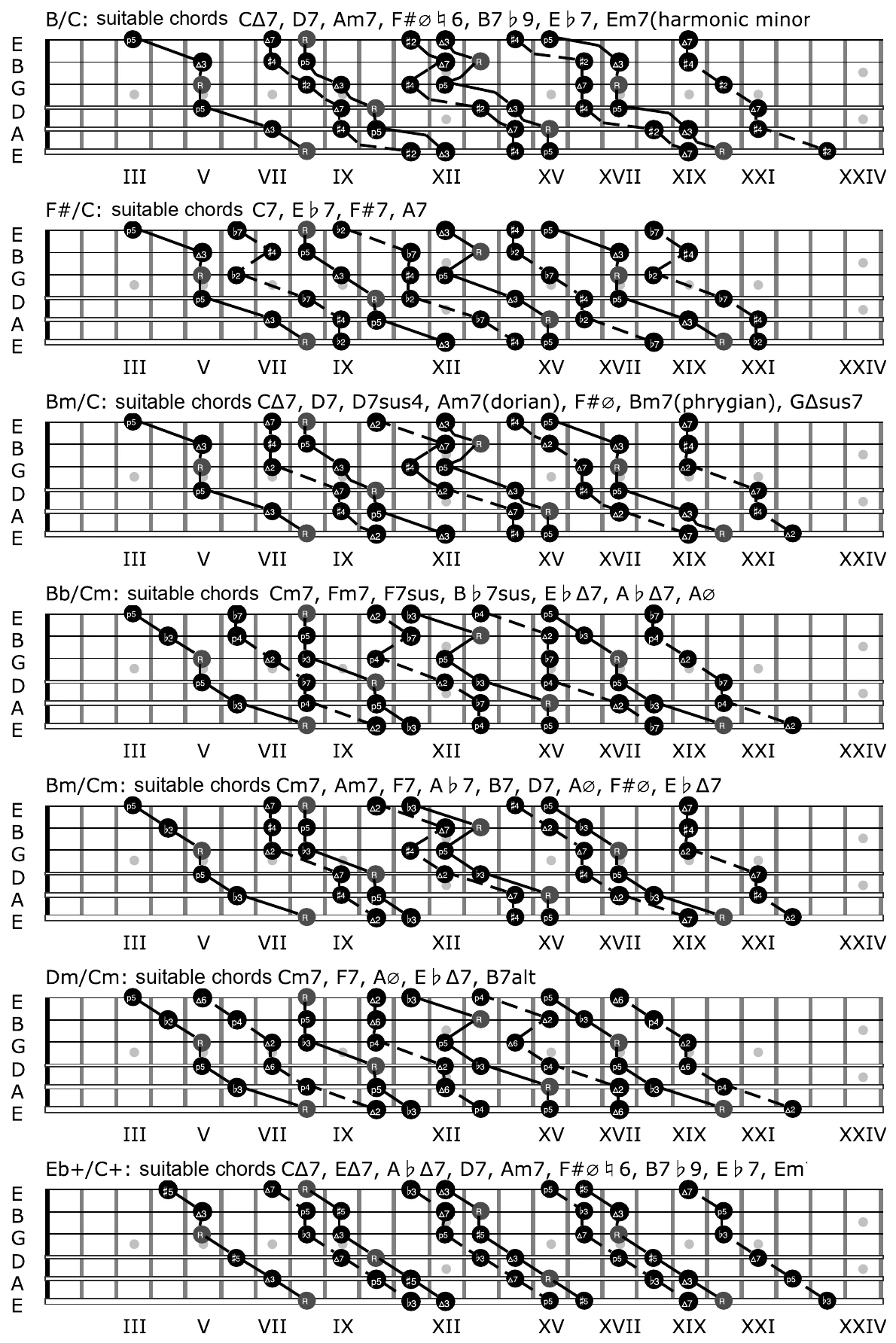
The next step is to choose those likely to be most useful and find which chords they might fit over. Then draw/think about/memorize their maps on the fretboard. Take the D/C chord, for example. I have marked the notes of the C triad with solid lines, and those of the D triad with dashed lines. I have also labeled each note by its degree relative to the C root:
What can we do from here? Learn this Hexatonic in all positions and 12 keys, of course. We can practice over static harmonies first, then over frequently encountered changing harmonies (by recording them, playing with a friend or using programs such as Band-in a Box or iReal Book). We can practice it as free improvisation or create our own patterns and licks. We can take each of the chords above as a static harmony and play the following example over it, listening to, understanding and enjoying how different the effects are:
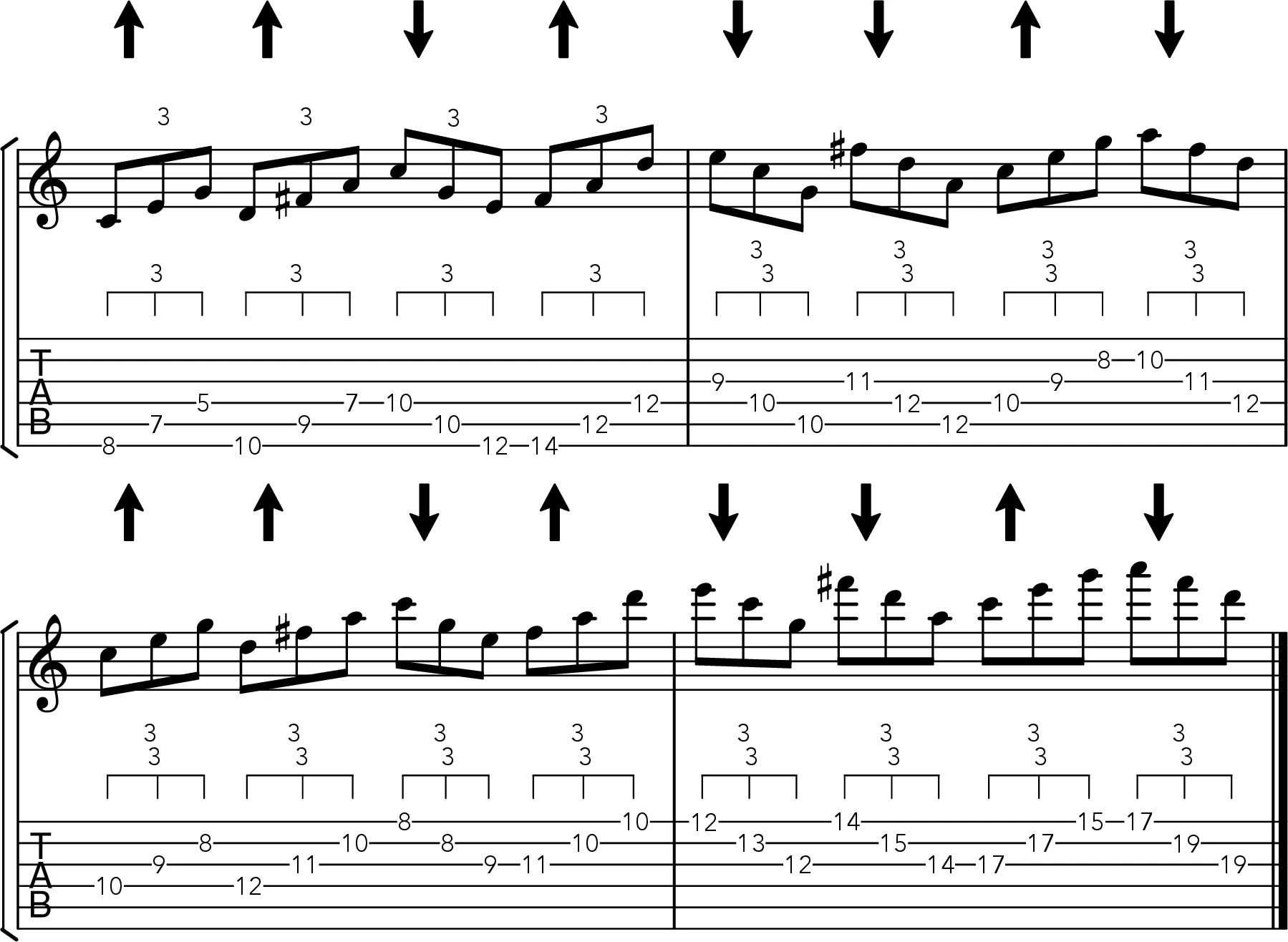
Or we can look at how to apply this Hexatonic to harmonies we encounter every day. Let us adapt the pattern in the first measure of the example above to the following harmonies:
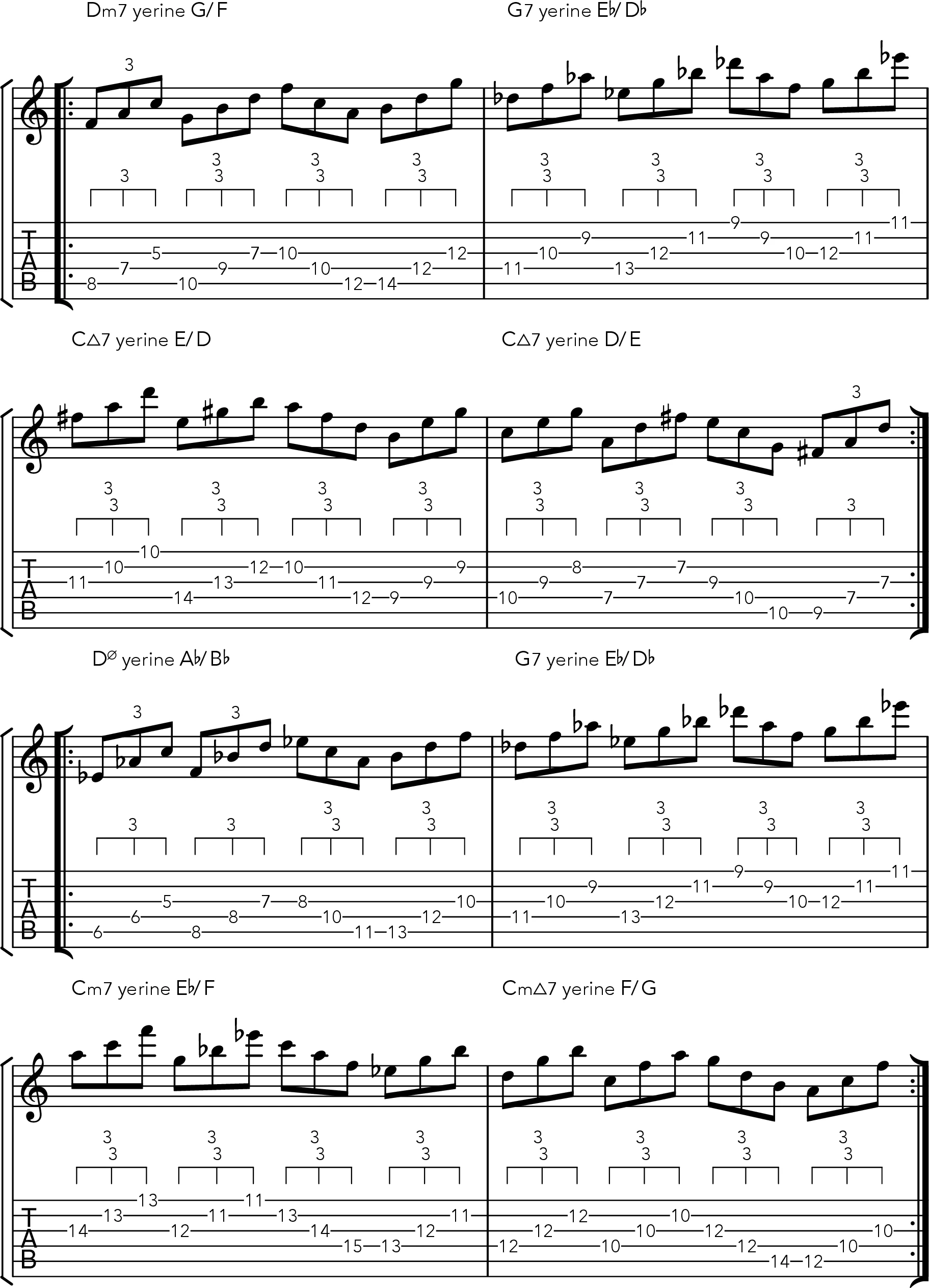
Below you will find maps of some frequently used Hexatonics and the chords they fit. Playing them plenty over time and learning them, thinking, having fun and creating patterns and licks are up to you.
I’m just trying to open a few doors for myself and for you, and leaving it to you how far you go… Mumbling something along those lines, I once again make a swift exit from the scene.