10 – Finger Aerobics (Permutation)
Translated from the Turkish original. Read the Turkish original.
Çağlayan Yıldız
Çağlayan Yıldız
Very Boring Music Lessons 10: Finger Aerobics from Permutations
WARNING: According to a bulletin issued by the CSE (Jazz Standards Institute), knowing theory in the abstract, failing to apply it on your instrument and, above all, failing to HEAR it may cause dryness in playing and writing, unnecessarily intellectual-sounding results and confusion. To prevent these side effects, everything learned in theory must be played, sung -even if your voice is terrible- and, by whatever means necessary, HEARD. Or you should skip this theory business altogether and, as has been possible throughout Music history, learn Music simply by listening to recordings/ playing/ learning directly from masters (if there happen to be any around). Otherwise, our institution accepts no responsibility for any complications that may develop later.
Let me tell you that you can find my column from last issue at www.gitardergisi.com, and all my lessons at www.caglayanyildiz.com, and get straight to the point.
Although I am a musician who finds “practicing technique for the sake of practicing technique” even more boring than “Very Boring Music Lessons”, I cannot deny that some exercises work like Lavaboaç drain cleaner on the blocked pipes between the brain’s neurons and the finger muscles. In this lesson I will discuss exercises of this kind that I think might help both you and me.
In general guitar technique, we actively use 4 fingers on each hand. (The 4 fingers
from index to little finger on the left hand, and the 4 fingers from thumb to ring finger on the right.)
Their names, which most of you already know and will be endlessly fed up with hearing again, are:
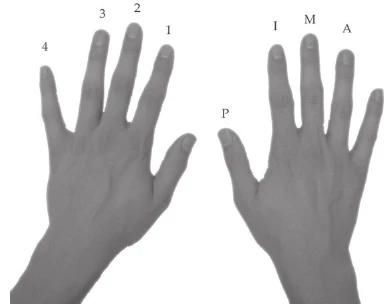
First, let us concentrate on the left hand and put the permutations of “1 2 3 4” into a table:

Yes, of course we all remember from maths lessons that “1 2 3 4” has 24 permutations, and we understand that this table gives us every possible movement of the 4 fingers (every brain neuron-finger muscle connection). And of course we saw at a glance that the first number in each column moves to the end as you go down, and that the white columns are mirror images of the grey columns before them.
Now, what can we do with this table? Ooh, I see some of you have abandoned the rest of the column and started exercising straight from the table already. Anyway, I will keep writing for the adventurous rabble determined to read on regardless:
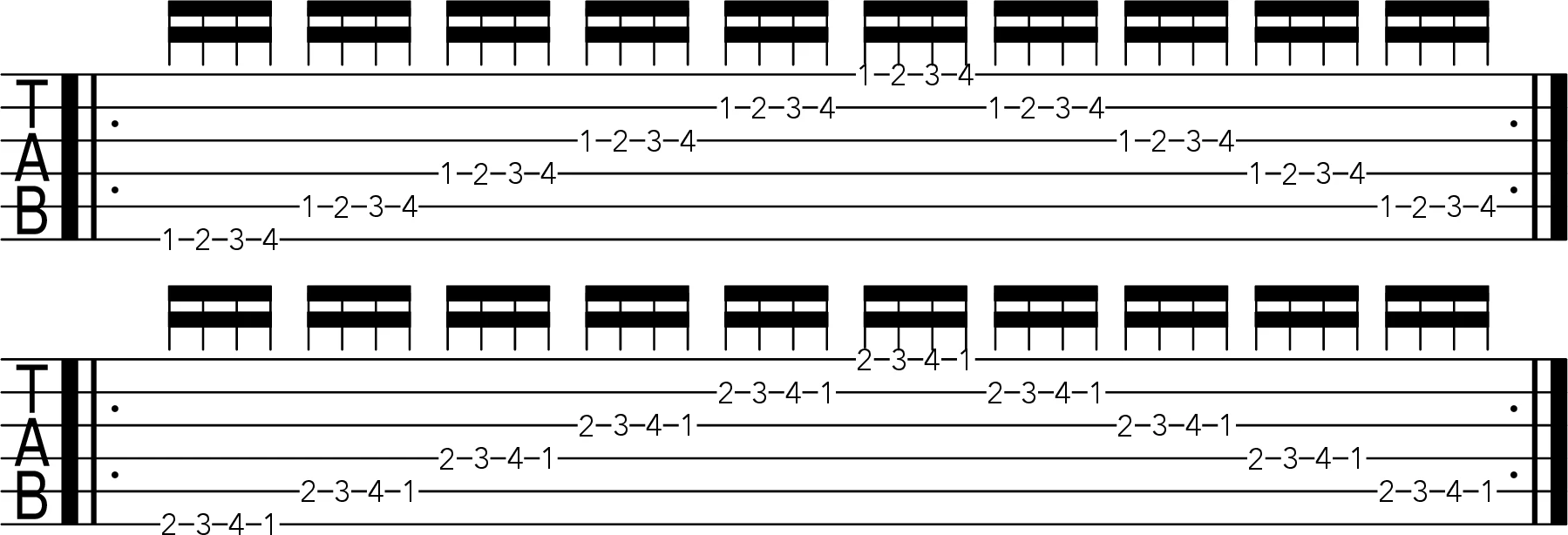
First, we can play every possibility on every string, working up each column from bottom to top before moving to the next. Below are the first two possibilities in the first column as examples; of course, you should play all 24:
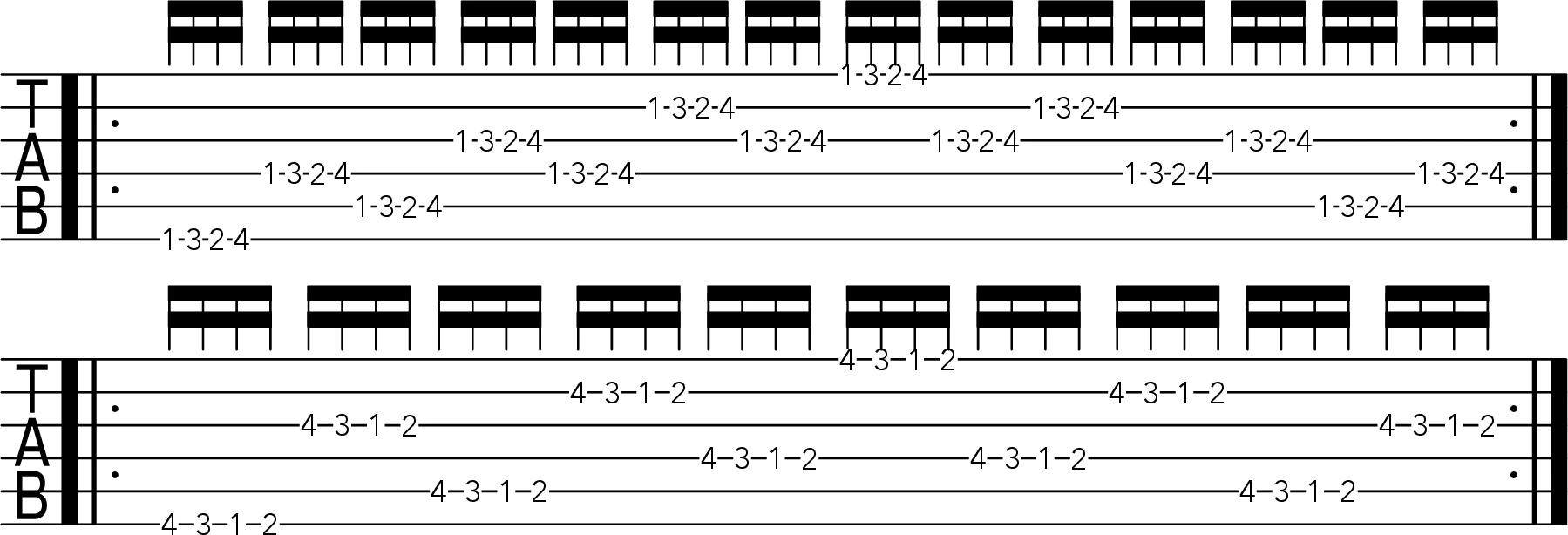
Can you think of any reason not to skip a certain number of strings in between?… Neither can I. Below, as examples, we see the 1324 pattern in action skipping 1 string, and the 4312 pattern skipping 2 strings:
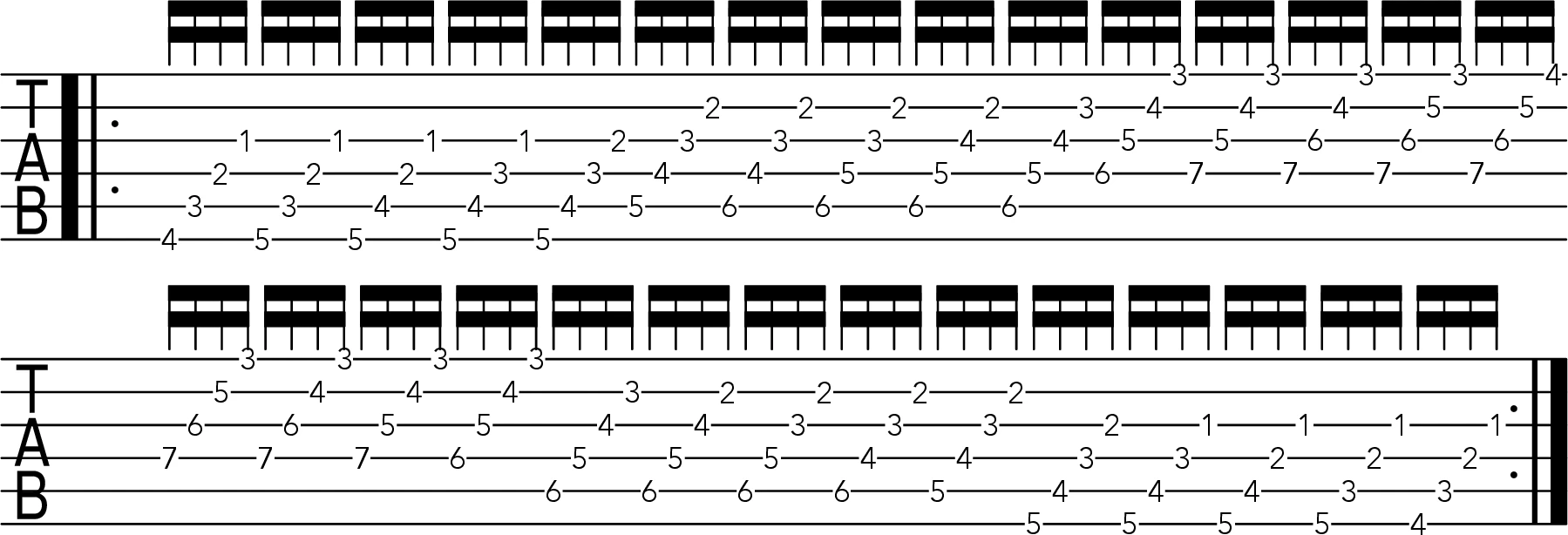
Can you think of any reason not to spread the same pattern across consecutive strings?… Neither can I. Below, as an example, we see the 1432 pattern spread across consecutive strings:

Can you think of any reason not to spread a few randomly chosen patterns across consecutive strings?… Neither can I. Below, as examples, we see the 4321, 2314, 3142 patterns spread across consecutive strings:

Some rather interesting (disgusting, to some of you) Music is beginning to emerge, isn’t it? Can you think of any reason not to use these ideas (interesting or disgusting) when composing?… Neither can I. But I can’t exactly provide a composition example in this limited space… Compose it yourselves, play it yourselves…
And can you think of any reason not to use these exercises for finger stretching?… Neither can I. Below, as an example, we see the 4321 pattern being used while stretching between fingers 1-2, 2-3 and 3-4 in turn:
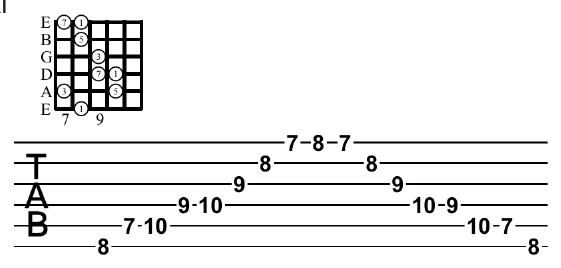
We can also use these patterns in a harmonic context. Treating each group of 4 as a chromatic approach, we can resolve its final note to the notes of the chord we wish to emphasize. Let us say we will apply chromatic approaches to the notes of Cmaj7 in 7th position. Our target notes are then as follows (the numbers in white circles are chord degrees):
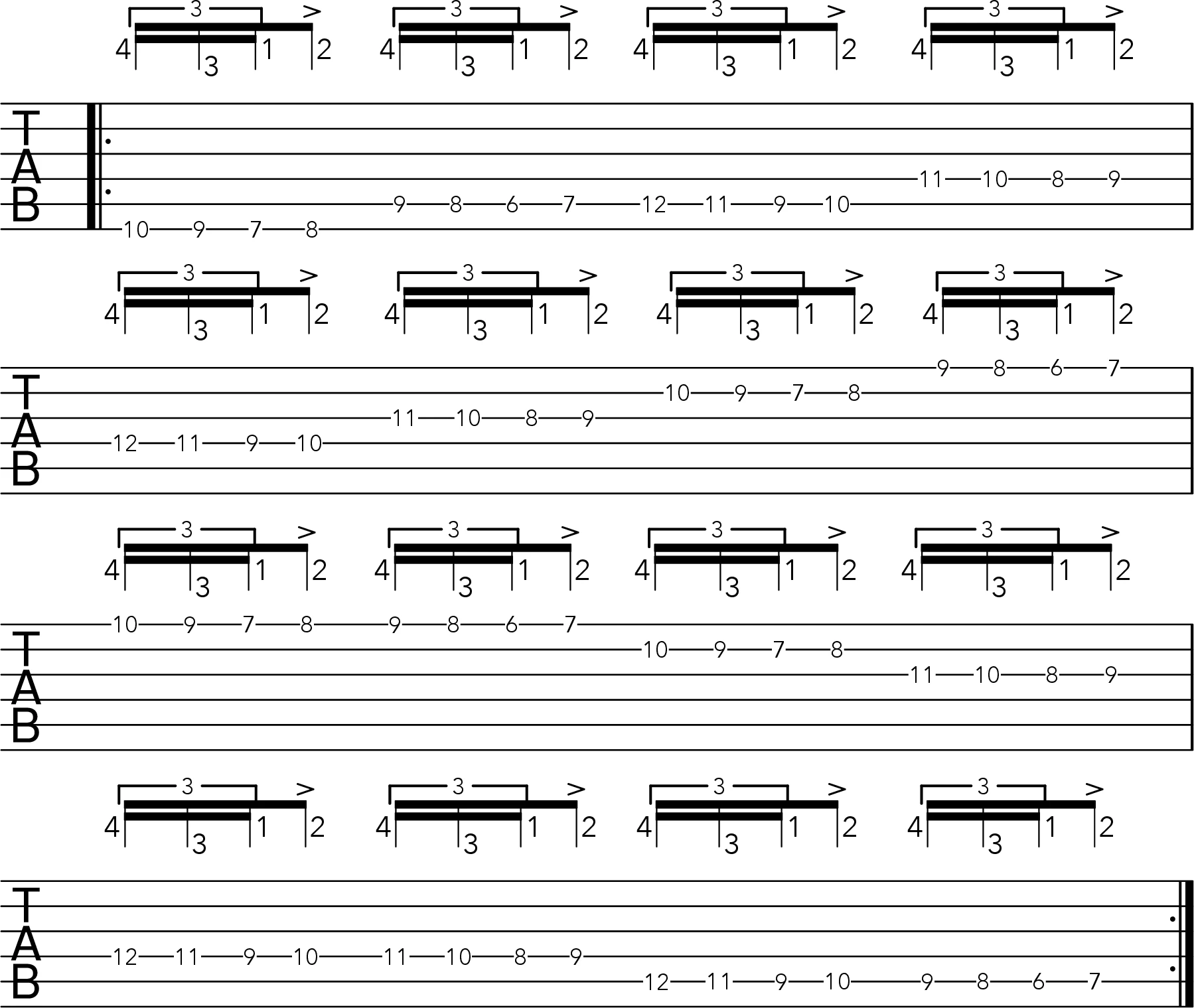
Now, as an example, let us apply the 4312 pattern below (the little numbers on the note stems are finger numbers), placing finger 2., the last note of the pattern, on the chord tones we want to emphasize. Let us also give those chord tones a longer duration than the chromatic approach notes and play them with accents:
Now let us show a little attention to our poor neglected right hand and make it feel loved. Here are the right hand’s 24 permutations. Those who hate the “PİMA” terminology can read the left-hand table for the right hand as 1=thumb, 2=index finger, 3=middle finger, 4=ring finger.
| pima | amip | pmia | aimp | pmai | iamp |
|---|---|---|---|---|---|
| imap | mipa | miap | paim | maip | piam |
| mapi | ipam | iapm | mpai | aipm | mpia |
| apim | pami | apmi | impa | ipma | ampi |
What can we do with this table? We can thoroughly develop our right-hand finger style technique by playing all 24 possibilities over the same 4-note chord:
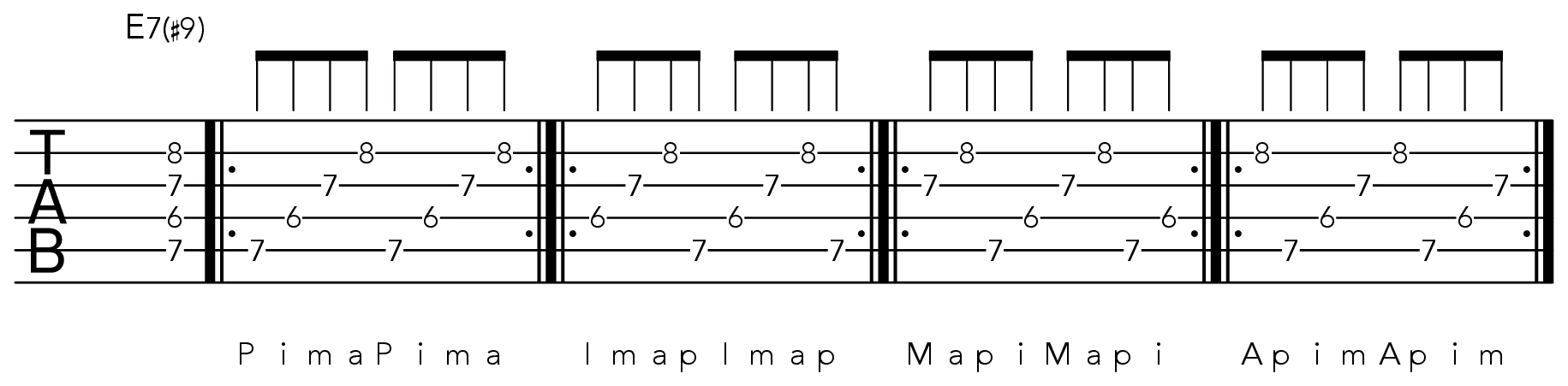
We can play the same right-hand pattern, or randomly chosen right-hand patterns, over different 4-note chords on different string groups. In the following example we see the “pmia” and “mipa” patterns over the chords:
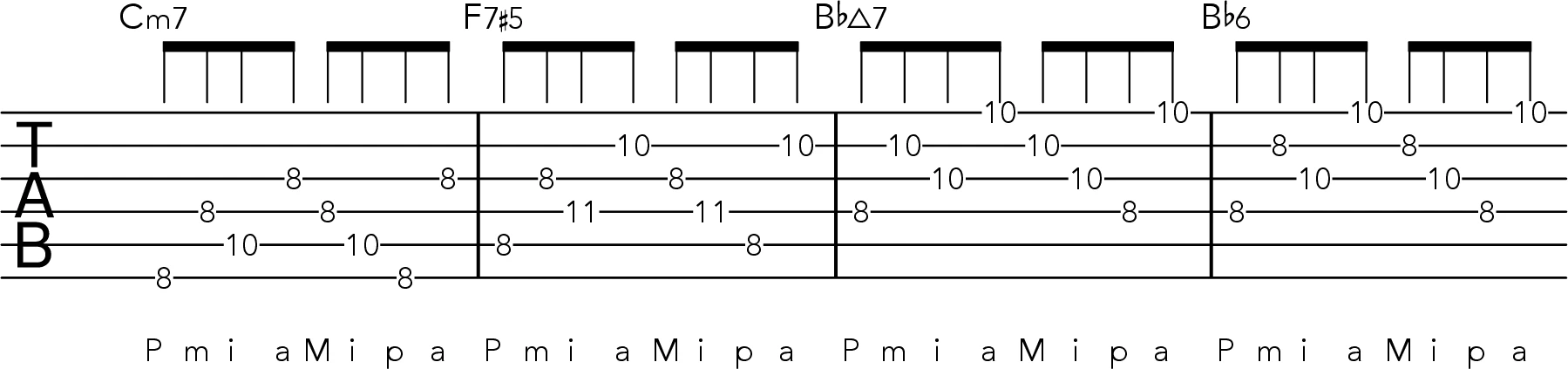
We can divide each pattern into “1 note+3 notes”, “2 notes+2 notes”, “3 notes+1 note” and sound the groups together. In the example below we see “pmia” played as “2 notes+2 notes” over the same chords as above:
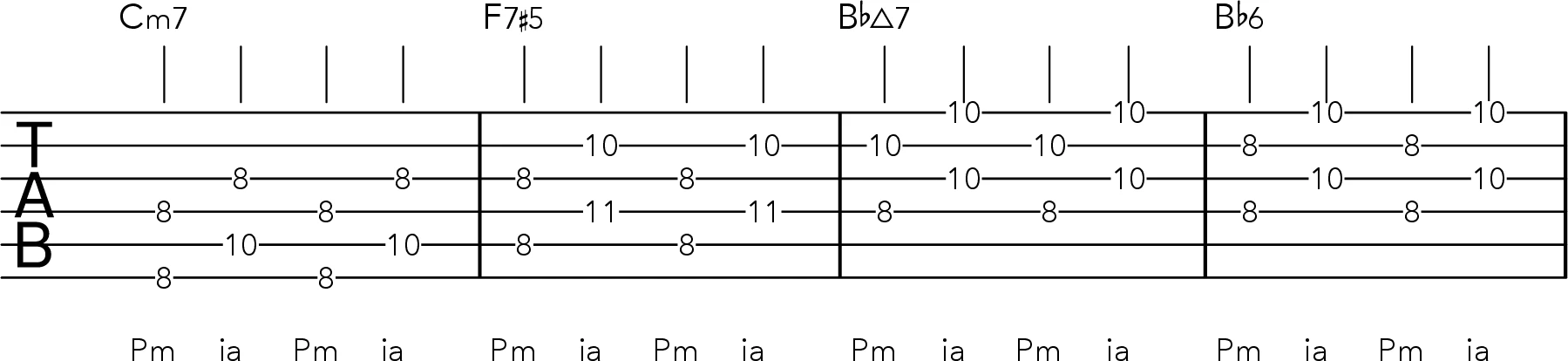
I’m sure you will create other right-hand exercises yourselves. Perhaps you will adapt some ideas from the left-hand exercises… Look at classical guitar technique books… Watch Fingerstyle masters… Who knows what else you might do…
Like the bride with a weak right hand who says “my space in the magazine is too small, and the left hand has left me neither room nor time anyway”… mumbling something along those lines, I make a swift exit from the scene…