2 – Triads
Translated from the Turkish original. Read the Turkish original.
WARNING: According to a bulletin issued by the CSE (Jazz Standards Institute), knowing theory in the abstract, failing to apply it on your instrument and, above all, failing to HEAR it may cause dryness in playing and writing, unnecessarily intellectual-sounding results and confusion. To prevent these side effects, everything learned in theory must be played, sung -even if your voice is terrible- and, by whatever means necessary, HEARD. Or you should skip this theory business altogether and, as has been possible throughout jazz history, learn music simply by listening to recordings/ playing/ learning directly from masters (if there happen to be any around). Otherwise, our institution accepts no responsibility for any complications that may develop later.
Before beginning, let me indulge in two small, unnecessary controversies. An extremist group called the Police Department and claimed responsibility for the “Dr. Gitar” heading on my column in the last issue, which was a relief. I mean, would I ever give it a name like that? Secondly, like many musicians around me, I object to the magazine changing every “caz” to “jazz”, because the word caz entered Turkish when jazz was dance Music, and shows that this Music gained a measure of acceptance here. Besides, how do we pronounce words like “rhythm and blues, soul, reggea”? In English, right? So when we write “jazz”, we should pronounce it “jazzz”, rather than the Turkish “caz”. A small but important detail in the magazine, I think. Anyway, back to our subject…
Riiight, so we have worked diligently through our previous lesson, learned our intervals completely and even begun to hear and sing some of them, have we? Take out a sheet of paper, then. We’re having a test. What do you mean, I didn’t warn you? Do you think we’re explaining all this for nothing? Of course we’re going to check whether you’ve learned it. Anyway, here are the questions:
What is the augmented fourth(#4) of Eb? What is the minor sixth(m6) of E? What is the major third(M3) of B? What is the augmented fifth(#5) of F#? What is the diminished fifth(b5) of Ab? What is the major seventh(M7) of D? Name the intervals below, if you please:

( In Western Music, we name notes with letters: La=A, Si=B, Do=C, Re=D, Mi=E, Fa=F, Sol=G. Yes, you need to memorize this too, to read chord symbols.)
(“Man, I really did study, but the interval teacher has it in for me…”) One last important point about intervals before we move on. If an interval is larger than an octave, we name it by adding 7; so by “#11” we mean “1 octave+ #4”, and by “b9” we mean “1 octave+ b2”. If you don’t know the rest, please write them out. Homework. I’ll check next week.
Now for triads, or three-note chords. What is a chord? Three or more notes sounding together: the 4th step in the silence-single note-interval-chord sequence. In Western Music, 3-note chords are obtained by stacking different 3rd intervals. There may be physical reasons for this, such as interference between wavelengths, but there may also be a reason along the lines of
“humans convincing themselves on shared social/ perceptual grounds”, which might mean absolutely nothing to a Martian. Anyway, we have four basic triads in Western Music:

The Major triad (M), obtained by placing an m3 interval above an M3 interval. The Minor triad (m), obtained by placing an M3 interval above an m3 interval. The diminished triad (dim/ o), obtained by placing an m3 interval above an m3 interval. The augmented triad (aug/ +), obtained by placing an M3 interval above an M3 interval.
As you will have noticed, we named the chord after its lowest note (C major, etc.). We call this note the “root”, and chords in this position “root-position” chords. Whaaat, there are chords in other positions too? Unfortunately, yes. We will get to those shortly.
Anyway, what do we do with this information, which has added yet more trouble to our troubles? Bearing the CSE warning at the beginning in mind, we will play the chords, preferably on a piano (otherwise on any polyphonic instrument- guitar, vibraphone, melodica, bouzouki, bass, etc.), try to hear the color of each and sing it. I don’t know how they strike you, but humanity’s general view (hearing) is that major chords have a happy/ open/ exuberant/ strong color, minor chords a sad/ closed/ inward-looking one, diminished chords a tense/ dangerous one and augmented chords a misty/ floating/ magical one. Still, discover your own perception for yourself (that really did come out like an advertising slogan; I’d better copyright it at once). We must also remember that these qualities are relative: we can create such tension that a minor chord sounds quite spacious and happy, etc.
Now, in the interests of continuing to learn Music, the most difficult project of our lives, we write out all the triads in 12 keys and commit them to memory. How? I wrote C; we continue from C#. How do we find a C# major chord? Put an M3 above C# and we get E#; put an m3 above that and we get G#. So C# major chord = C# E# G#. We repeat the process with the formulas for min, dim, aug chords. Then we move to Db: an M3 above Db gives F, and an m3 above that gives Ab, so Db major chord = Db F Ab. We repeat the process with the formulas for min, dim, aug chords. Come on, you can write the rest yourselves…
Riiight, on to chord inversions. As we fail to remember from our previous lesson, what did inversion mean? Taking the bottom note and putting it an octave higher; so inverted chords are chords with a note other than the root at the bottom. In other words:
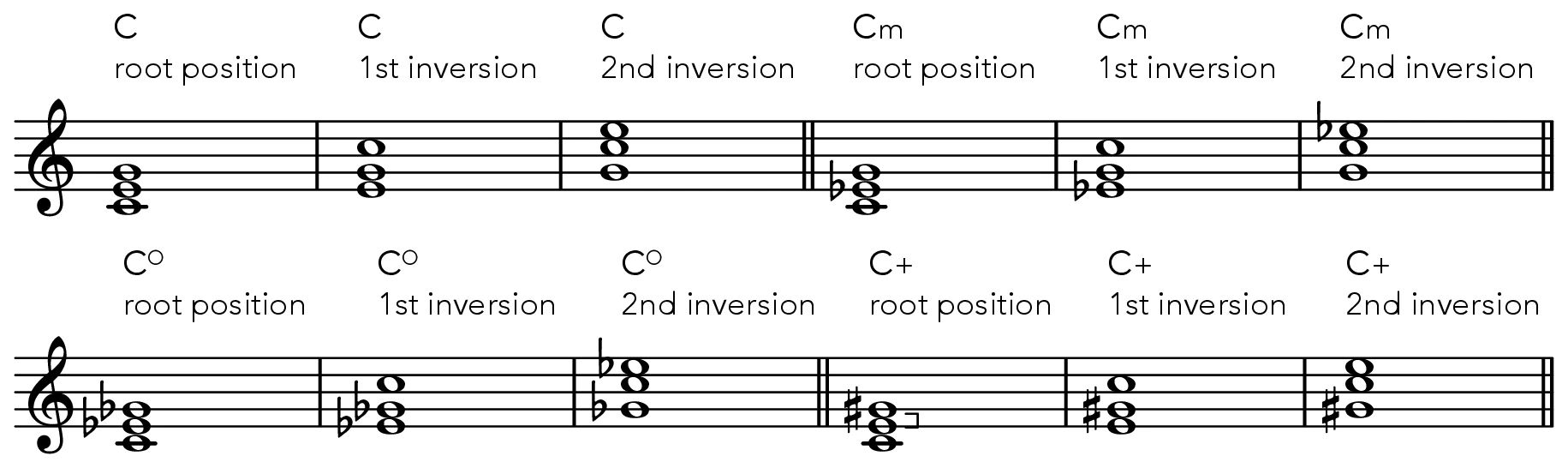
Yes, the symbol for C major is “CM” or simply “C”, for C minor “Cm” or “c”, for C diminished “Co” or “Cdim”, and for C augmented “C+” or “C aug”. Let me remind you that in classical Music the 1st inversion is called “6/3”, and the second inversion “6/4”; so if you encounter a symbol like C 6/4 in a classical theory book, you will know it means the 2nd inversion of C major.
The chords we have written above are in “close position”, arranged so that no other chord tone can fit between them. But we can spread them out a little and leave some ventilation gaps between them, which we very creatively call “open position”:

Yes, of course, before I have even opened my mouth, you have already written, played, listened to and sung the 1st and 2nd inversions and open/close positions of the triads you had already written out in 12 keys; or you have sold your instrument and started looking for a vacancy as an overlock-machine operator.
I continue for those who have tired of overlocking and returned to Music. What are we going to do with these triads? How are they used? Let us build triads on every note of the major scale using only notes from the scale, and examine the results:

As we can see, major and minor chords draw 3-3, while our diminished chord only manages to score 1; not a peep from augmented. Harmonizing a major scale with triads gives us: major chords on degrees I.,IV. and V. of the scale. Minor chords on degrees II., III., VI. of the scale. A dim chord on degree VII. of the scale. This applies to all major scales, of course, aaaand we write out and harmonize all the major scales in 12 keys as above. (Enough, I’ll confess everything…
As if that were not enough, we will do this for the other two most frequently used scales in Western Music, Harmonic minor and Melodic minor. First, of course, let us write them out for anyone who does not know them:

Let us build triads on every note of the Harmonic minor scale, using only its own notes, and examine the results:

Harmonizing the Harmonic minor scale with triads gives us:
Major chords on degrees V. and VI. of the scale. Minor chords on degrees I. and IV. of the scale. A “dim” chord on degrees II. and VII. of the scale. An “aug” chord on degree III. of the scale.
Let us build triads on every note of the Melodic minor scale, using only its own notes, and examine the results:

Harmonizing the Melodic minor scale with triads gives us:
Major chords on degrees IV. and V. of the scale. Minor chords on degrees I. and II. of the scale. A “dim” chord on degrees VI. and VII. of the scale. An “aug” chord on degree III. of the scale. Even I cannot bring myself to tell you what you must do now. For a moment I honestly felt sorry for you. But how is this country’s Music supposed to develop if you don’t learn this? Oh well, what cannot be cured must be endured…
Now let us make a table to pull things together (or complicate them further):
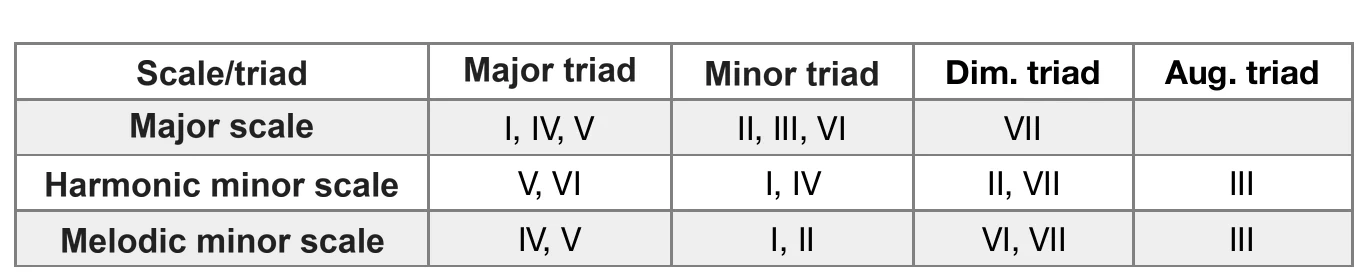
Scale/triad Major triad Minor triad Dim. triad Aug. triad
Major scale I, IV, V II, III, VI VII
Harmonic minor scale V, VI I, IV II, VII III
Melodic minor scale IV, V I, II VI, VII III
How can we use this table? Say we have a C major triad: what function might this chord have in different keys? Looking down the Major triad column, we see that it has functions I, IV and V in major scales, so it can be I in C major, IV in G major and V in F major. (Thinking along the lines of “IV= C, so I=? ;V= C, so I =?”, etc.) In Harmonic minor harmonization, we see that it can be V in F minor and VI in E minor. In Melodic minor harmonization, we see that it can be V in F minor and IV in G minor.
I realize this has been rather long and heavy going for beginners, but you do have 3 months to digest it; in fact, you have the rest of your lives.
Another test next issue. This time I’m warning you: don’t say nobody told you. Meanwhile, here are the answers to the questions above, so you can at least check your results yourselves:
1.A 2.C 3.D# 4.C “double#” 5.E “double b” 6.C# 7a.M6 b.aug4 c.m6 d.m2 e.m3 f.aug2 g.dim7 h.dim3 ı.aug6 i.p4 “Learning Music is a lifelong task; you have to enjoy it and be patient,” says Dandoldenyus (Can Barslan). All the same, I’d better quietly leave the scene before the students attack…