4 – Diatonic Harmony
Translated from the Turkish original. Read the Turkish original.
WARNING: According to a bulletin issued by the CSE (Jazz Standards Institute), knowing theory in the abstract, failing to apply it on your instrument and, above all, failing to HEAR it may cause dryness in playing and writing, unnecessarily intellectual-sounding results and confusion. To prevent these side effects, everything learned in theory must be played, sung -even if your voice is terrible- and, by whatever means necessary, HEARD. Or you should skip this theory business altogether and, as has been possible throughout jazz history, learn music simply by listening to recordings/ playing/ learning directly from masters (if there happen to be any around). Otherwise, our institution accepts no responsibility for any complications that may develop later.
The handful of friends still determined to follow these lessons are apparently to be knighted “Sir” by the Queen of Theory, in a proper ceremony. I heard it on the TV celebrity news, honest; I’m only repeating what they said. Meanwhile, I have met a few people who “read” the lessons but only “read” them. If they are not going to play/ hear them, reading a vocational high school’s Lathe Operation and Bench Fitting textbook could have just as much effect on their lives. Just a suggestion.
And here is the test you’ve been waiting fooor… Cook it yourself, eat it yourself again…
- What are the notes of the X four-note chord (for chord types, see the previous lesson)?
- X is the 3rd/ 5th/ 7th of which type Y four-note chord?
- What are the four-note chords of which X is the 3rd/ 5th/ 7th?
- If X is the 3rd of a type Y four-note chord, what is the chord’s 5th/ 7th? (Swap the numbers 3,5 and 7 in this question.)
- If X is the (lowest, lower, middle, upper) note of a type Y four-note chord (in close/drop 2/drop 3/drop2&4 position; root / 1st inversion/ 2nd inversion/ 3rd inversion), what are the chord’s other notes? [For example, if G is the top note of a “minor 7” chord in close position, 3rd inversion, the chord is naturally C minor 7, so the notes below it will be Eb, C and Bb.]
I admit that this question is a stinker, but once you can reel off the answers, who’s going to stop you… In the last lesson we said we would build four-note chords on the major, melodic minor and harmonic minor scales and observe the results impartially. This was the result:
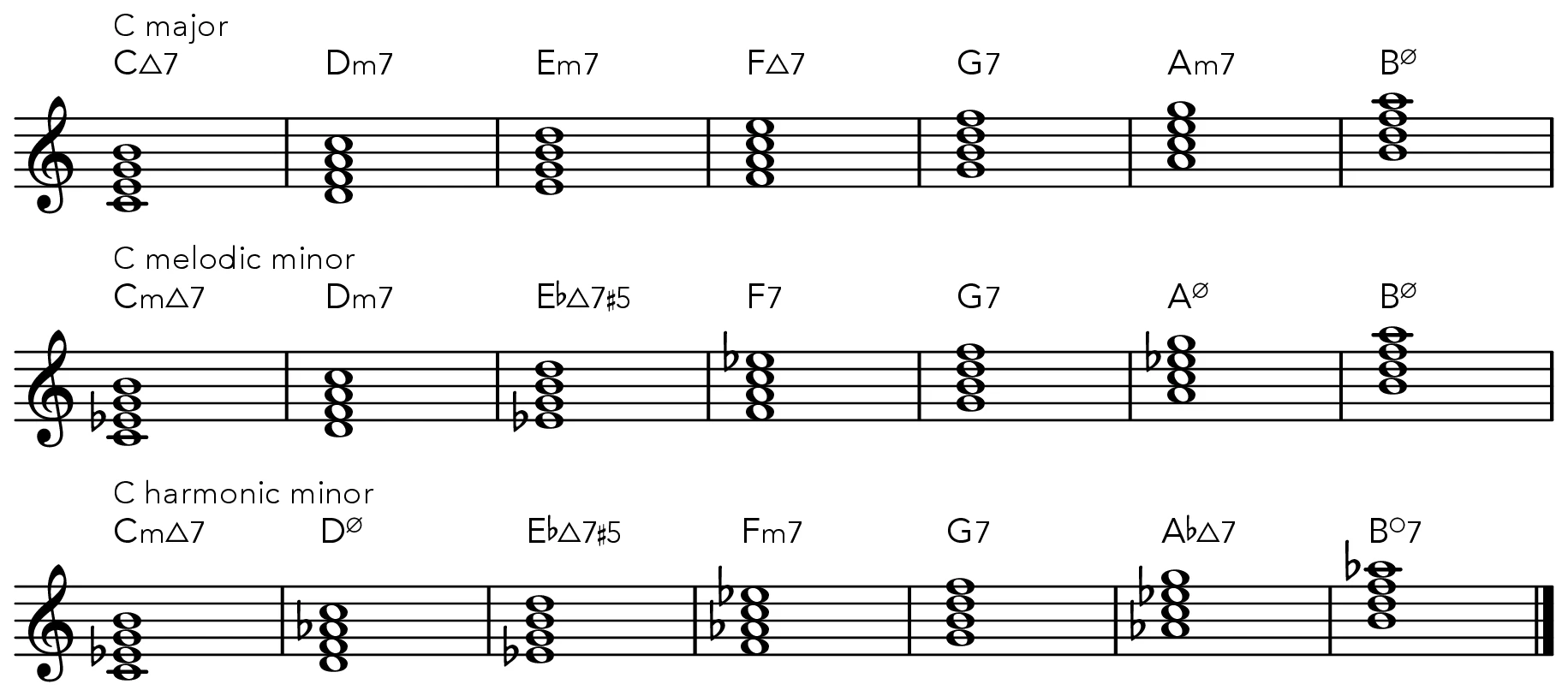
And when we put the chord types built on each scale degree into a table, this was the result (chord types across the top, scales in the left column):
| Chord-Scale | Maj7 | Min7 | 7 | Min7 b5 | Min/maj7 | Maj7 #5 | dim7 |
|---|---|---|---|---|---|---|---|
| Major scale | I, IV | II, III, VI | V | VII | - | - | - |
| Melodic min | - | II | IV,V | VI, VII | I | III | - |
| Harmonic min | VI | IV | V | II | I | III | VII |
Now we can finally move on to this lesson’s subject, diatonic harmony:
We know that in the major scale there is 1 half step between notes 3. and 4., and 7. and 8. When an interval of 1 half step occurs in a scale, the unstable note tends to resolve to the stable one; harmonic context determines stability/ instability. Since degree 3. belongs to the I major chord in major harmony, it is more stable than degree 4.; degree 4. is therefore a note that wants to move in major harmony, and wants to resolve to degree 3. Likewise, since degree 8. belongs to the I major chord in major harmony, it is more stable than degree 7. In jazz and popular Music, however, degree 7. has also been added to the I major chord, giving the note a tonic character. (Commercial break… If you too would like to acquire a tonic character, join the I maj chord… Commercial break.) Thus degree 7. has come to be considered unstable only when it appears “together” with degree 4. Between degrees 4. and 7. lies the #4/b5, or tritone, one of the most unstable intervals. So in major harmony, chords containing neither degree 4. nor degrees 4.+ 7. are stable tonic (T) chords; those containing only degree 4. are unstable subdominant (SD) chords; and those containing degrees 4.+ 7. are dominant (D) chords, the most unstable. Looking at the harmonization of the major scale with 4-note chords in the notation above from this perspective:

Since Music is a matter of tension and resolution, T, SD and D chords are used to create tension-resolution relationships, whose strongest form is SD-D-T, called a compound cadence. (Terminology is always a dreadful source of controversy, so don’t get too hung up on it.) In jazz and related Music it appears as II-7/ V7/ I maj7, and in classical and related Music as IVmaj7/ V7/ Imaj. Still, chords of the same character can replace one another; harmony can thus be perceived as T, SD and D regions, and this is (or may be) called tonal substitution.
For example, playing Fmaj7/B-7b5/E-7 instead of the D-7/G7/C maj7 cadence will carry the same tension-resolution effect, apart from the different effect of the root movement.
Moving to diatonic harmonization of the harmonic minor scale: we know that in this scale there is 1 half step between 2 and b3, 5 and b6, and 7 and 8. Since b3, 5 and 8 belong to the I minor chord in minor harmony, 2,b6 and 7 are the notes that want to move in harmonic minor. Degree 4. is added to these through listening habits acquired from major harmony. So in harmonic minor harmony, chords containing none of degrees 2, 4, b6 and 4.+ 7.(tritone) are tonic (T); chords containing only b6, without degrees 4.+ 7. (tritone), are subdominant (SD); and chords containing degrees 4.+ 7. are dominant (D). Looking at the harmonization of the harmonic minor scale with 4-note chords in the notation above from this perspective:
| Tonic | Subdominant | Dominant |
|---|---|---|
| I-maj7,bIIImaj7#5 | II-7b5,IV-7,bVImaj7 | V7,VII dim7 |
Moving to diatonic harmonization of the melodic minor scale: we know that in this scale there is 1 half step between 2 and b3, and 7 and 8. Since b3, 5 and 8 belong to the I minor chord in minor harmony, 2 and 7 are the notes that want to move in melodic minor. Again, degree 4. is added through listening habits acquired from major harmony. So in melodic minor harmony, chords containing none of degrees 2, 4 and 4.+7.(tritone) are tonic (T); chords containing only 4 are subdominant (SD); and chords containing degrees 4.+ 7. are dominant (D). Looking at the harmonization of the melodic minor scale with 4-note chords in the notation above from this perspective:
| Tonic | Subdominant | Dominant |
|---|---|---|
| I-maj7,bIIImaj7#5,VI-7b5 | II-7,IV7 | V7,VII-7b5 |
In jazz, the SD-D-T cadence in harmonic/melodic minor harmony appears as II-7b5/ V7(b9)/ I- maj7. Meanwhile, it is worth pointing out that although chords with the same function can replace one another in harmonic/melodic minor harmony too, only “I- maj7” provides a true tonic function, because the fifths of the other tonic chords are not perfect fifths (P5).
What can you do until I ask your questions next issue? You can write out, memorize and play the chords in major, harmonic/ melodic minor harmony in 12 keys (those who do not play harmonic instruments/ singers always have the option of arpeggios). Take any standard, find the cadences in its harmony, replace those chords with tonal substitutes and listen to how they sound; put the ones you like in your basket. Or acquire a vocational high school’s Lathe Operation and Bench Fitting textbook.
(This was written with the deadline breathing down my neck, so it’s a little short on jokes. I’d appreciate it if you sprinkled them in wherever needed.)