Bass Line 2
Translated from the Turkish original. Read the Turkish original.
Çağlayan Y ı l d ı z b
Bass Layn- Bass Line No2
Lay Down Those Bass Chords…
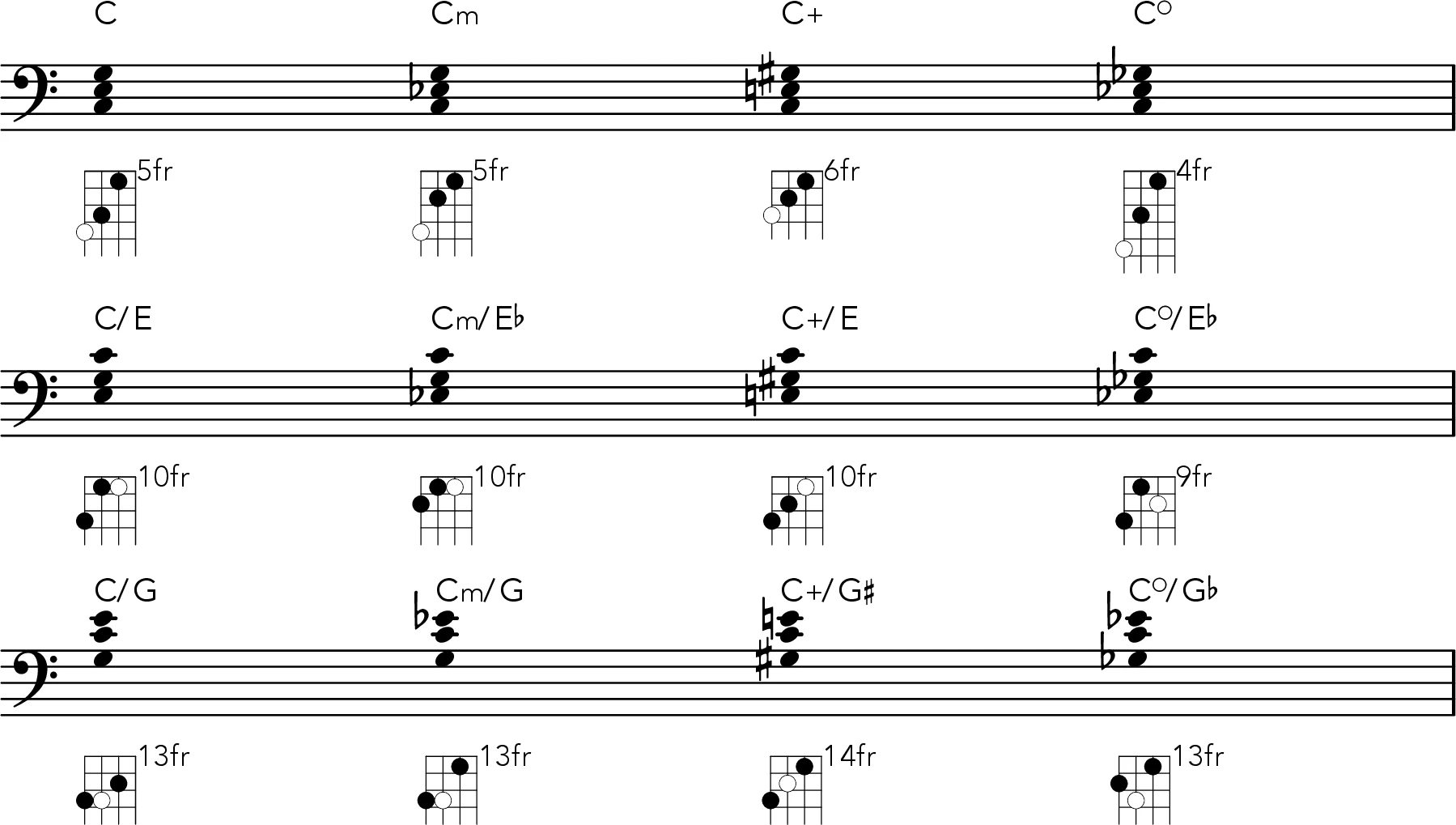
Let me tell you that you can find my column from last issue and all my lessons at www.caglayanyildiz.com, including any subjects here that make you say, “Whaaaat’s that?”, and get straight to the point. First, though, I would like to restart the 3 people who read my last column and got a blue screen at the calculation “512=244,140,625”: it should have been printed as “5 to the power of 12= 244.140.625”. This issue’s subject, as the heading fails to make clear, is “bass chords”. Yes, although the bass tradition is generally based on monophonic (single-note) playing, sprinkling chords into our accompaniment now and then may add color to the Music we play, or get us fired by a conservative bandleader with a scolding of “You call that bass playing, maaate?” Anyone wishing to consider both options should read on… As we know, we have 4 types of 3-note chord: Major, Minor, Augmented, Diminished. And they have root positions, 1st and 2nd inversions. In the examples below, given only from Do and on the lower 3 strings, the leftmost vertical line is the E string, the rightmost the G string, and the white circles show the root, “Do” in this example. As always, finding and learning them in 12 keys and on all strings is up to you:
Now for 4-note chords. As we all know, there are 18 most frequently used ones. (“What an annoying teacher, always saying ‘as we all know’, as though we’re supposed to know… If I knew, I wouldn’t be reading lessons in the first place…”) Below we see these 18 chords again from Do:
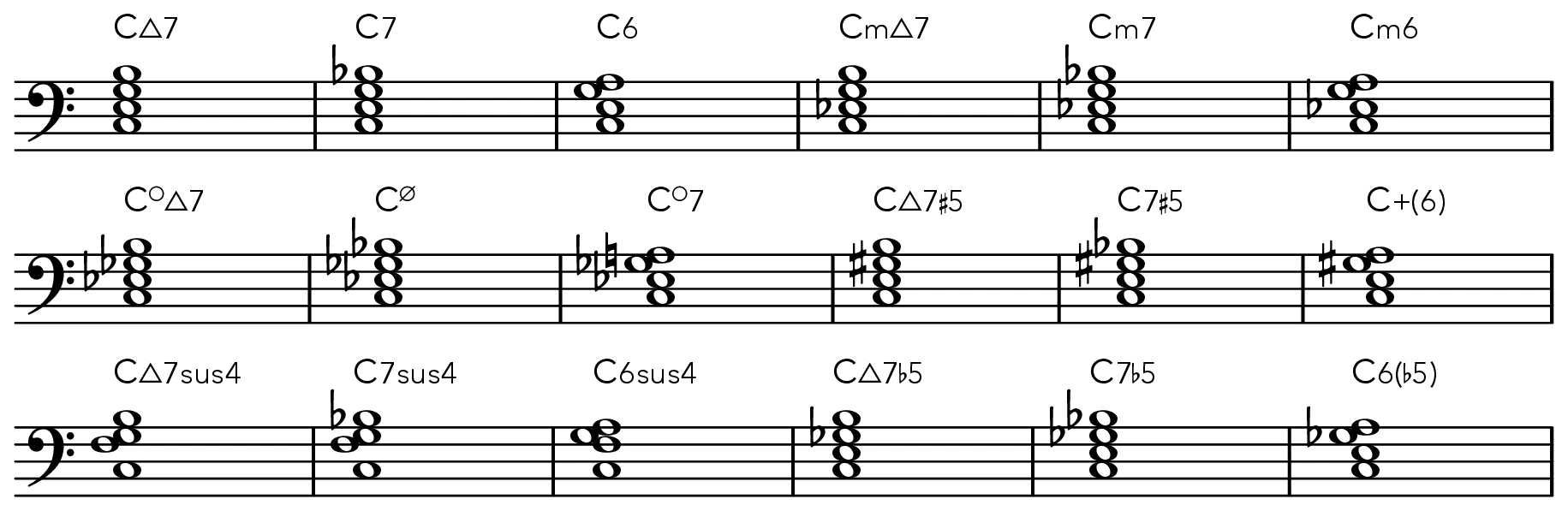
They too have root positions, 1st, 2nd and 3rd inversions. But unless your hands are like baker’s peels, most of these chords are impossible to play. Here, however, the technique called “Drop 2”, in which the 2nd note from the top is lowered an octave, rushes to our rescue with its superhero cape fluttering, making the chords playable. (Beside this.)

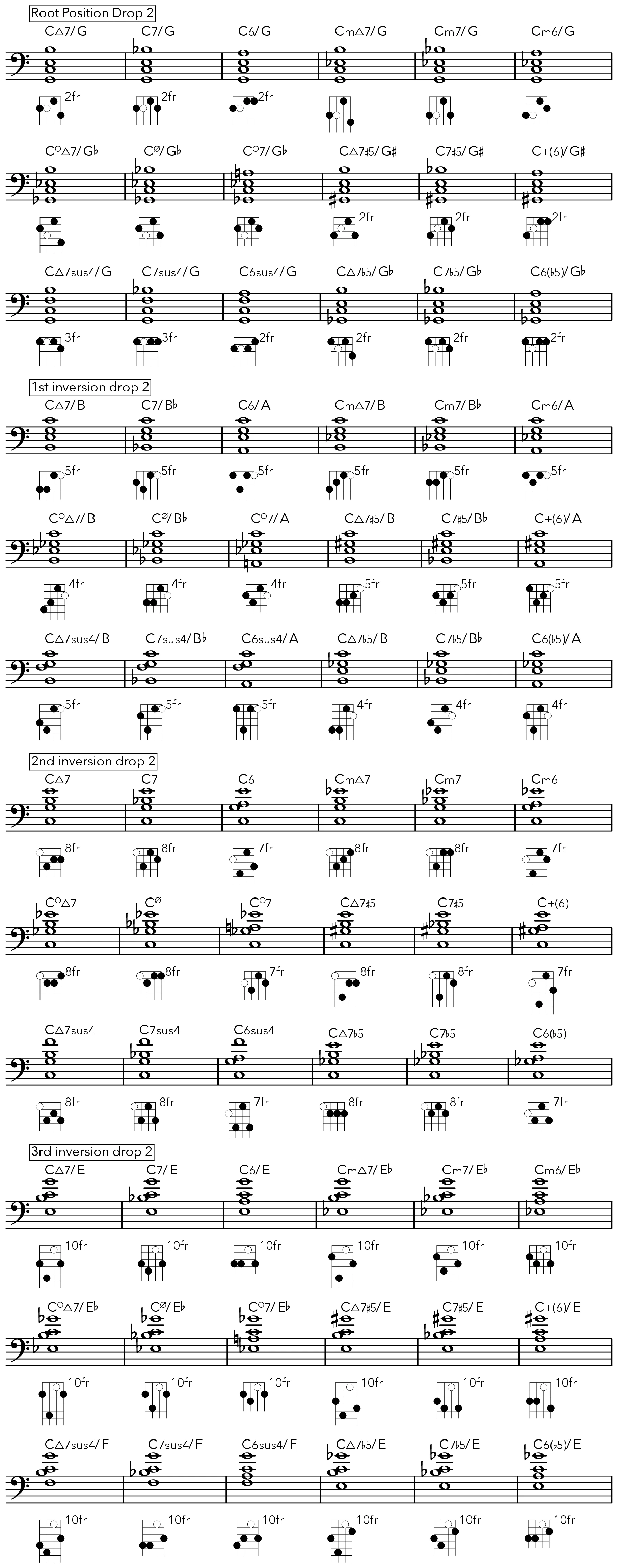
Below, as an example, we see the inversions of the “Do maj7” chord in “Drop 2”:

Of these, we can say that “Root Position Drop 2” and “2nd Inversion Drop 2” are the most practical and frequently used chords for bassists, since their lowest notes are the chord’s 5th and Root. Nevertheless, below I give the “Drop 2” voicings and shapes of all 18 types of 4-note chord from Do. Choosing which to use and learning them in 12 keys is up to you. The roots, “Do”s, are again marked with white circles:
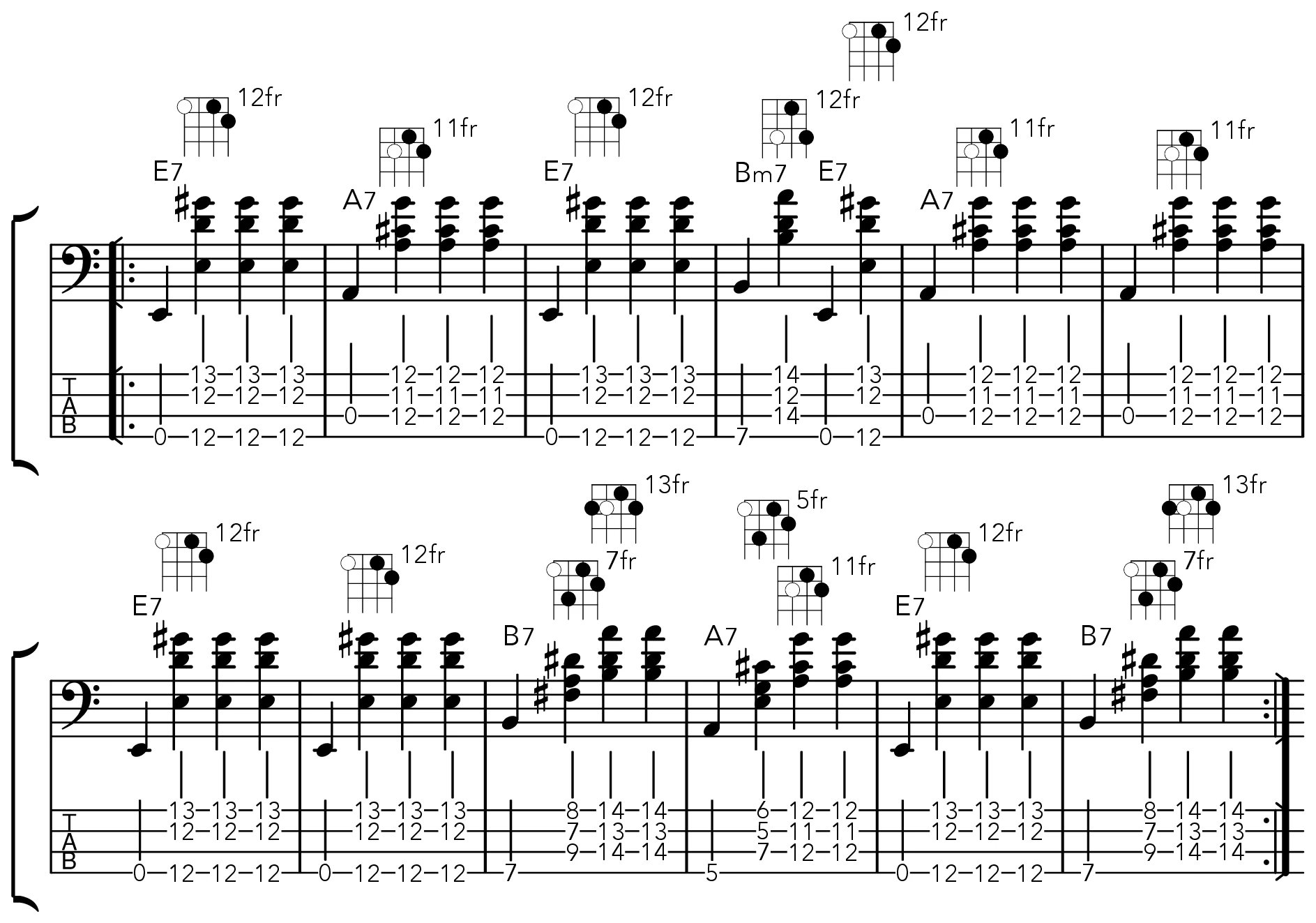
Now for how to use these chords. As I mentioned earlier, “Root Position Drop 2” and “2nd Inversion Drop 2” are the most frequently used on bass. Their “5ths” can generally be omitted if they are “Perfect 5ths”. (Technical detail: this is because the “Perfect 5th” is the strongest harmonic, already sounding within the root when we play it.) So “Perfect 5ths” can be omitted at will, and “4-note chords” can consist of 1, a (minor/major) 3rd and a (minor/major) 7th. Below we see an example of a blues from Mi, carrying the rhythm in straight quarter notes:
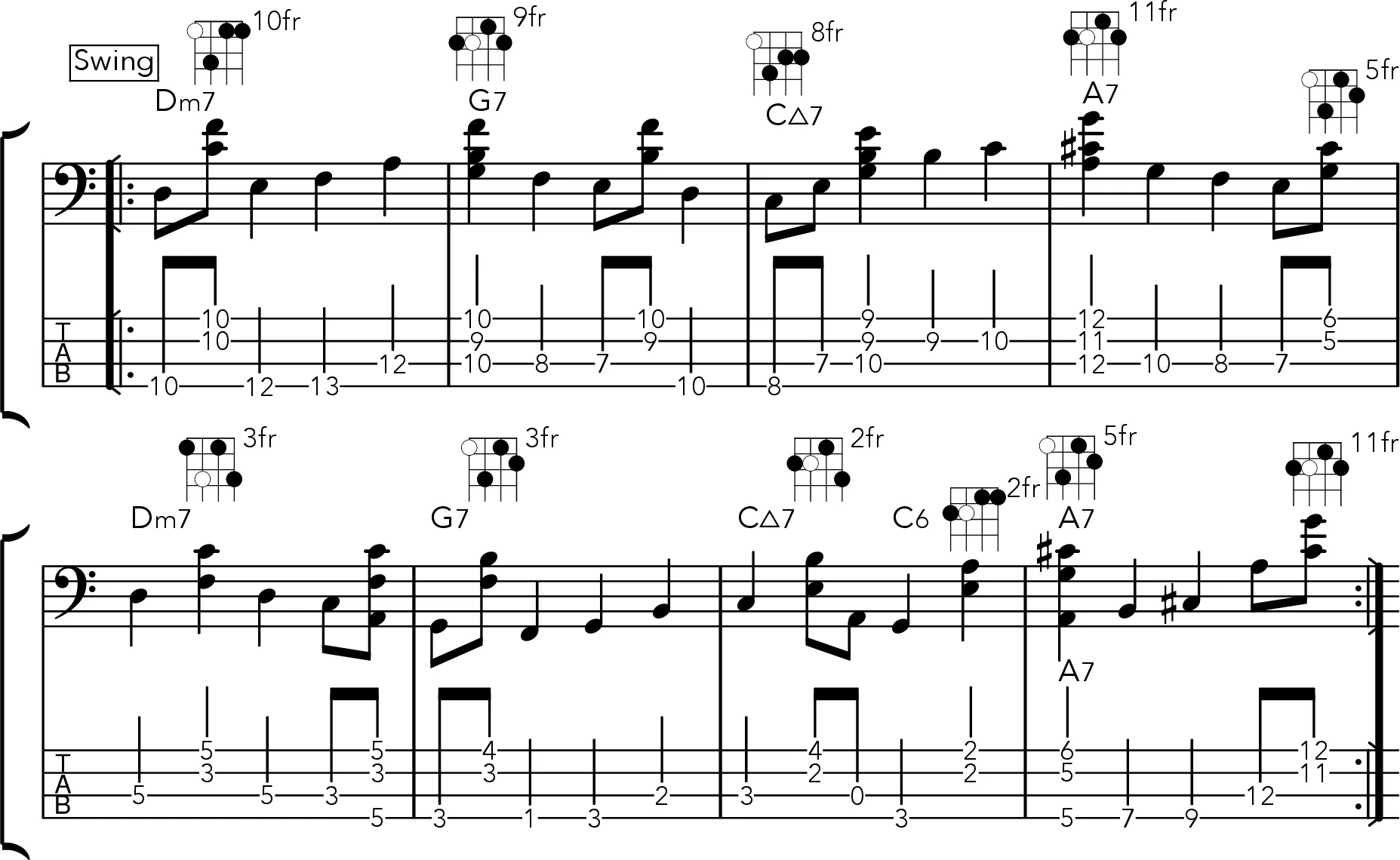
In the right hand, we use either classical guitar technique (one finger per note) or rhythm guitar technique (one finger or a pick). Below I have tried to give a simple example of sprinkling chords, sometimes on strong beats and sometimes syncopated, into a walking bass over a “Dm7-G7-Cmaj7-A7 turnaround”. I recommend using every tune you play as a guinea pig for this technique. Notice also that I use the chord forms partially rather than in their entirety.
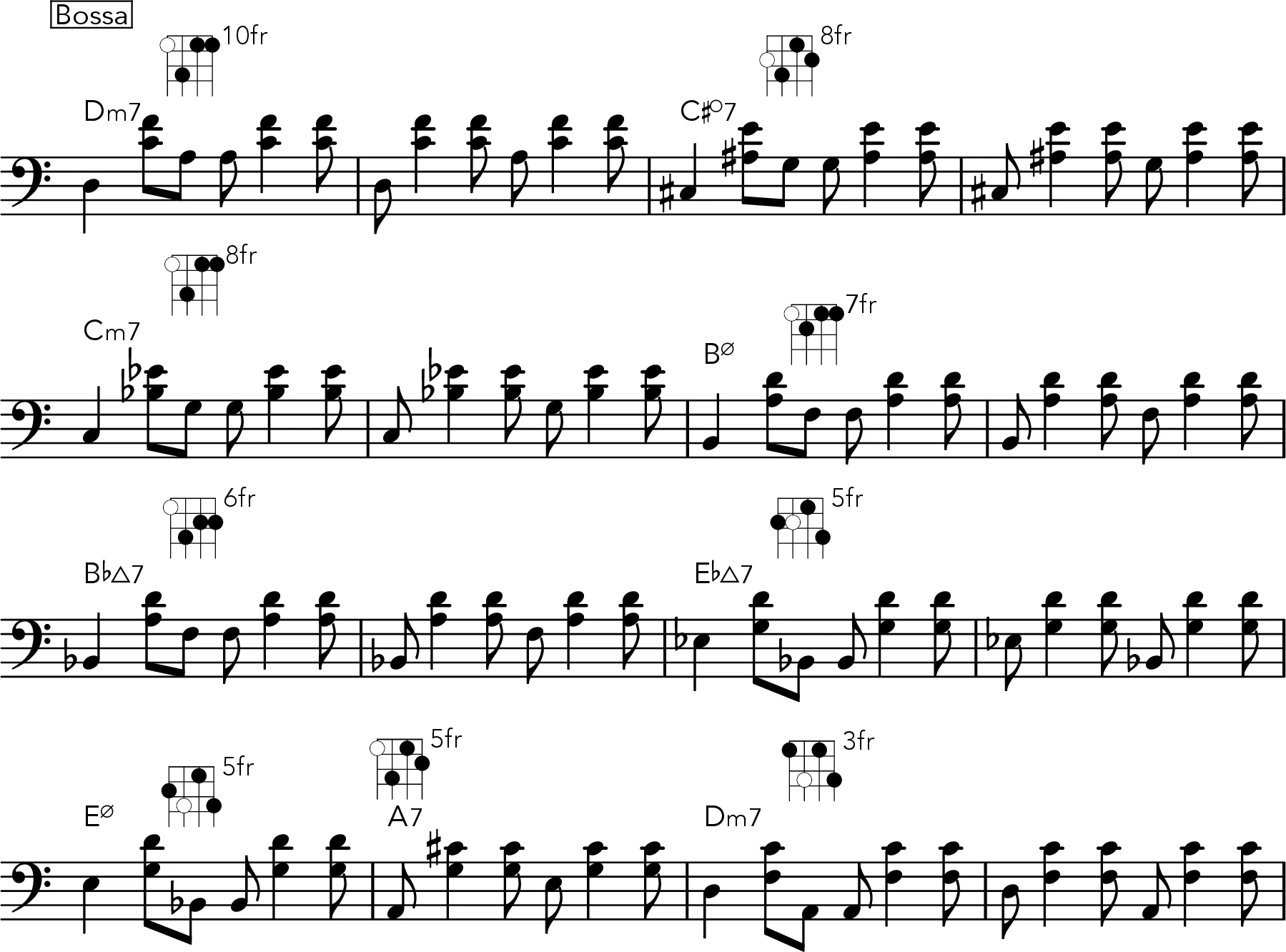
Below I give the first 16 measures of a well-known bossa tune as an example. I imagine it has not escaped your eye (ear) that while carrying the basic bossa bass feel with chord degrees 1. and 5., I have used the “voice leading” of degrees 3. and 7. as chords.
“Bass, Bass, Those Chords, Re Laaa Laaaa.” Muttering something along those lines, I once again make a swift exit from the scene. (Slightly “dragging”, but that’s the drummer’s hihat’s fault, honest…)