Bass Line 6
Translated from the Turkish original. Read the Turkish original.
Çağlayan Yıldız :
Bass Layn- Bass Line No.6 Lazy-lick: Easy “outside” Tips
WARNING: According to a bulletin issued by the CSE (Jazz Standards Institute), knowing theory in the abstract, failing to apply it on your instrument and, above all, failing to HEAR it may cause dryness in playing and writing, unnecessarily intellectual-sounding results and confusion. To prevent these side effects, everything learned in theory must be played, sung -even if your voice is terrible- and, by whatever means necessary, HEARD. Or you should skip this theory business altogether and, as has been possible throughout Music history, learn Music simply by listening to recordings/ playing/ learning directly from masters (if there happen to be any around). Otherwise, our institution accepts no responsibility for any complications that may develop later.
Let me tell you that you can find my column from last issue and all my lessons at www.caglayanyildiz.com, and once again get straight to the point.
This issue I will give you a few tips and run. I actually touched on them in the pentatonics lesson, but they were not particularly obvious, buried under that hefty pile of information.
We all have our various ways of playing “outside”, that is, outside the harmony. (If you don’t, keep quiet for now and pretend you do; the very easy method I am about to discuss will let you sound as though you’re doing something terribly impressive.) There may be a fact like the following that many of us are unaware of, and that might be worth investigating for every scale:
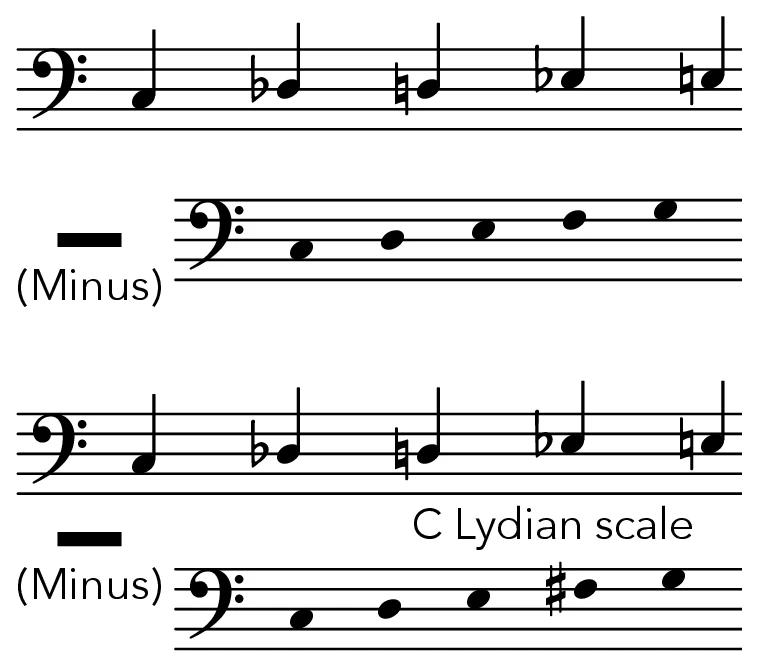
What I mean is that when we are playing inside any 7-note scale, there is actually a (12-7=) 5-note, or pentatonic, scale completely foreign to it. To explain the example above a little further: (please don’t take this as racism, but) if we are playing C major on the piano’s “white” keys, the “black” keys give us the 5 “outside” notes, which make up “Eb minor pentatonic”, the minor pentatonic a “minor 3rd above”. If we are playing C lydian, the 5 notes left “outside” give us “Bb minor pentatonic”, the minor pentatonic a “major 2nd below”. So, to keep this short, if we refer to our pentatonics lesson at www.caglayanyildiz.com, build a standard “inside-outside-inside” scenario (I was too embarrassed to write that in Turkish) using only pentatonics, and apply it to the “IIm7-V7-Imaj7” cadence we encounter so often we could throw up:
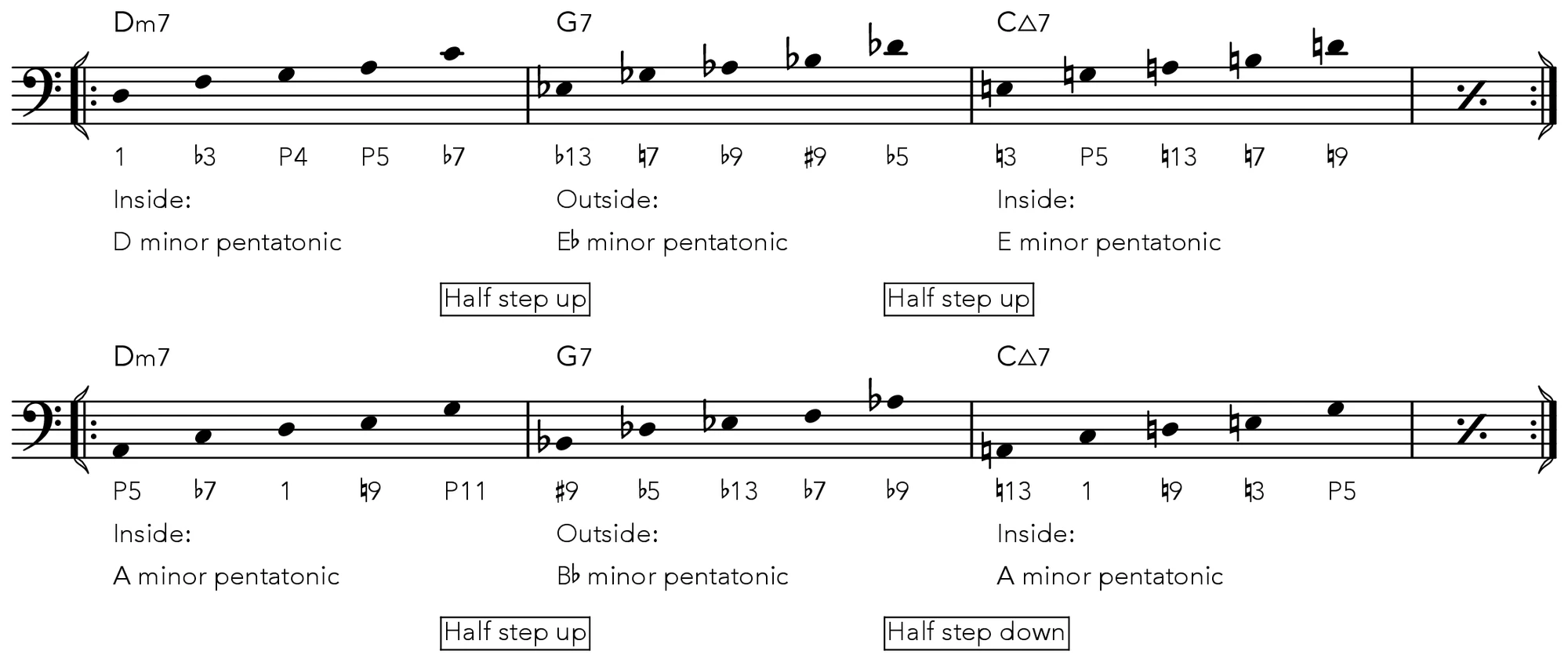
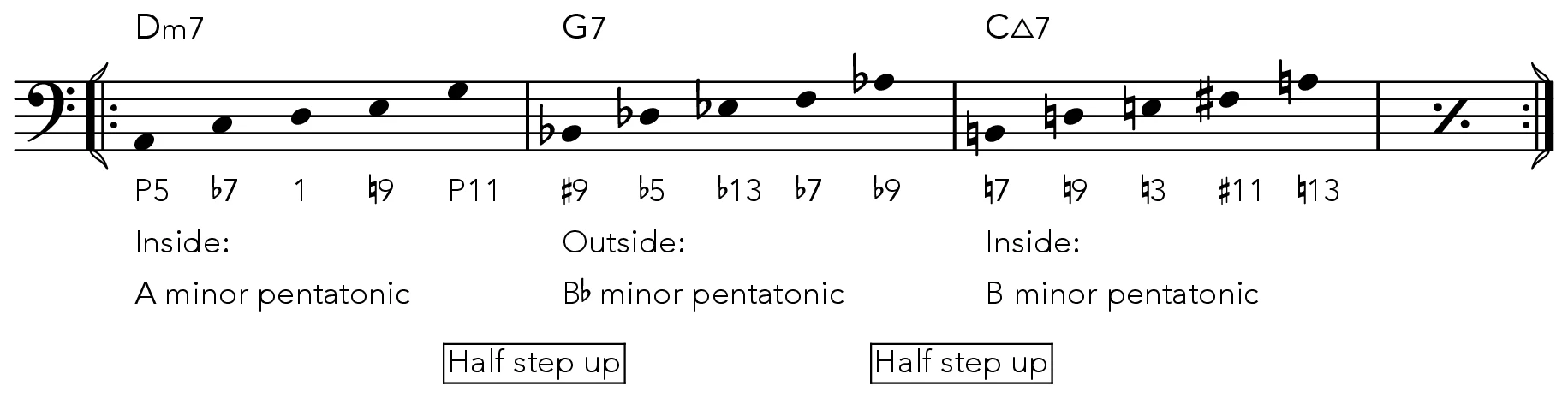
In the example above, we see the chords on top, and underneath which pentatonic corresponds to which chord degrees. The sharp-witted among you may say, “In the first line we’re playing Gb, or F#, over G7. Wrooong!” I would fend off these little devils with something along the lines of, in Music, any strong symmetrical movement will “wipe away” the generally accepted rules… So, to sum up what is going on above: we can take any pentatonic lick, pattern, etc. that we know and create an “inside-outside-inside” feeling in whatever major key we are in, either by starting with minor pentatonic on degree II. and transposing upward twice; or by starting with minor pentatonic on degree VI. and transposing once up and once down, or twice up. Some sources call this “side-slipping”, meaning “wearing slippers in Side”. What, huh? Really?… Sorry, it means “slipping sideways”… In Afyon? Anyway, if we take the most “lick-by-numbers”, even “banal”, lick as an example:
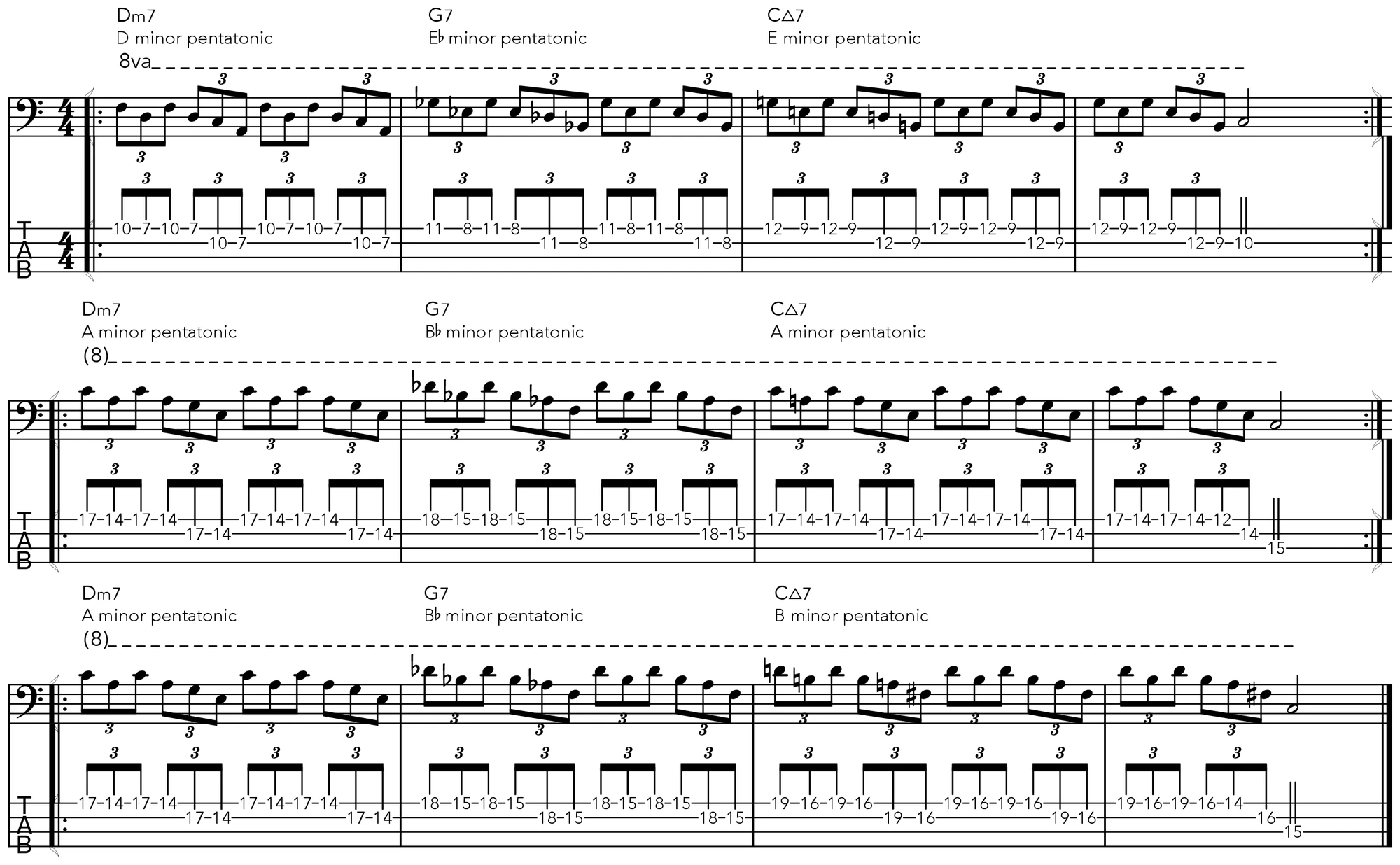
As we can see (hear), with extremely simple reasoning we have created a tension-resolution relationship and the illusion that we know what we want to do in life, that our lines have a purpose, a direction, and are heading somewhere with determination. Now look at the pentatonic licks you have packed away in mothballs, or are still wearing out through constant use, in this light, and try a few test shots over various tunes. Who knows, perhaps your love will flare up again… Spouting slogans like “Don’t be afraid of lazy-licks; be afraid of standing still,” I make a swift exit from the scene…