12 – Quartal Chords
Translated from the Turkish original. Read the Turkish original.
Çağlayan Yıldız
Very Boring Music Lessons 12:
Quartal Harmony (Harmony in Fourths)
WARNING: According to a bulletin issued by the CSE (Jazz Standards Institute), knowing theory in the abstract, failing to apply it on your instrument and, above all, failing to HEAR it may cause dryness in playing and writing, unnecessarily intellectual-sounding results and confusion. To prevent these side effects, everything learned in theory must be played, sung -even if your voice is terrible- and, by whatever means necessary, HEARD. Or you should skip this theory business altogether and, as has been possible throughout Music history, learn Music simply by listening to recordings/ playing/ learning directly from masters (if there happen to be any around). Otherwise, our institution accepts no responsibility for any complications that may develop later.
Let me tell you that you can find my column from last issue at www.gitardergisi.com, and all my lessons at www.caglayanyildiz.com, and once again get straight to the point.
In this lesson, to calm our public, who are working themselves into a frenzy saying, “We’ve finished this triadic harmony business, we know all the chords and all their possible ‘Drops’… Isn’t there aaanything more?”, we will touch on Quartal Harmony, or Harmony in Fourths.
Quartal Harmony is frequently used in both Modern Jazz and Contemporary Classical Music. The chords are formed by stacking 4th intervals within a scale/mode. Chords in Quartal Harmony sound modern, but we might call them “ambiguous”, because any of their notes can be perceived as the “root” and all notes carry equal weight. In other words, Quartal Chords “suggest” a key/modality, a color, rather than a “harmonic function”.
On the guitar, Quartal Chords can contain between 3 and 6 notes. Below we see the 3 most frequently used scales (major, melodic minor and harmonic minor) harmonized with Quartal Chords. Of course, Quartal Chords can also be built for any scale or mode outside these 3 scales and their modes.
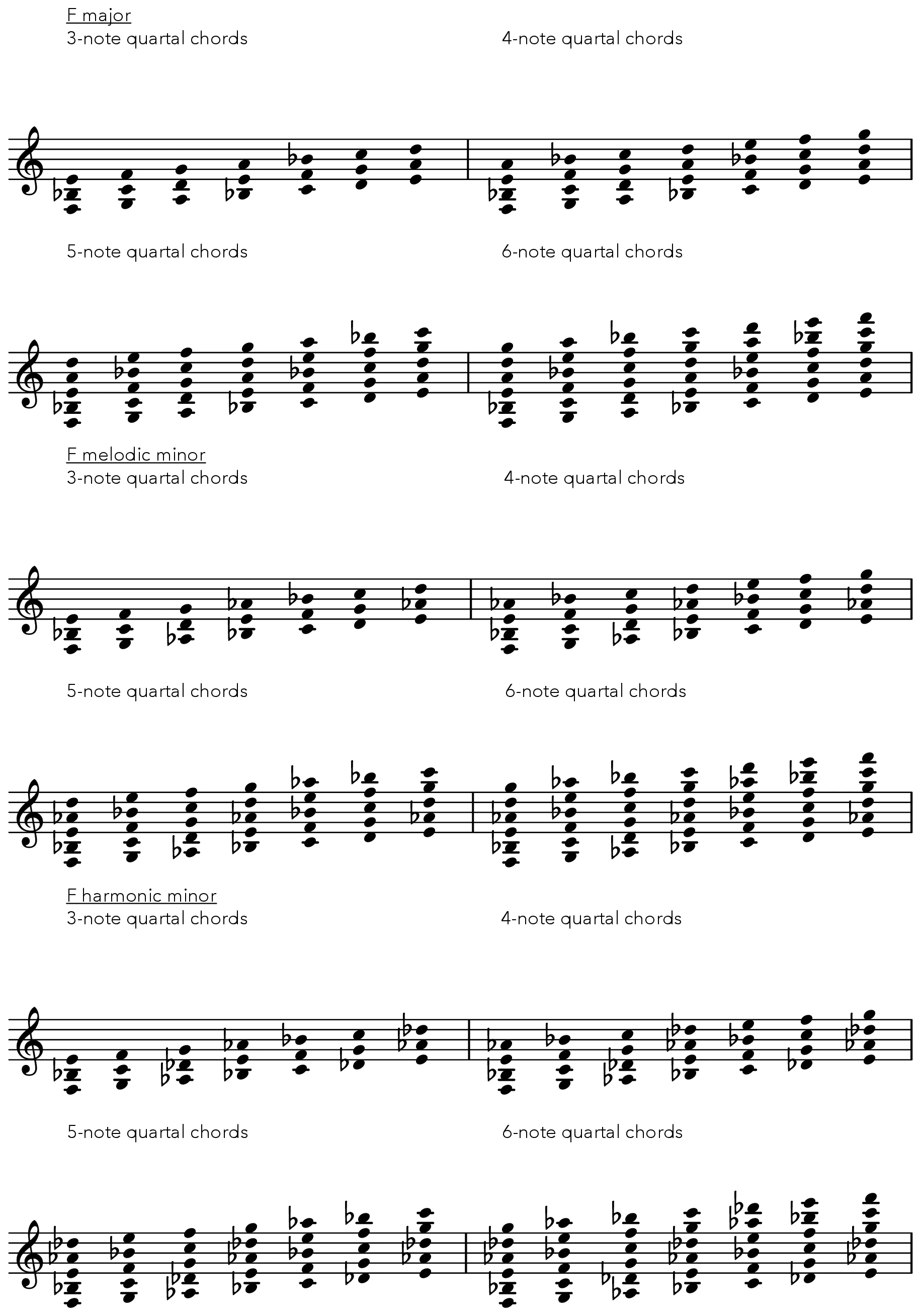
As you can see, because these chords are built in complete faithfulness to the scales’ interval structures, they consist of perfect, augmented and diminished fourths.
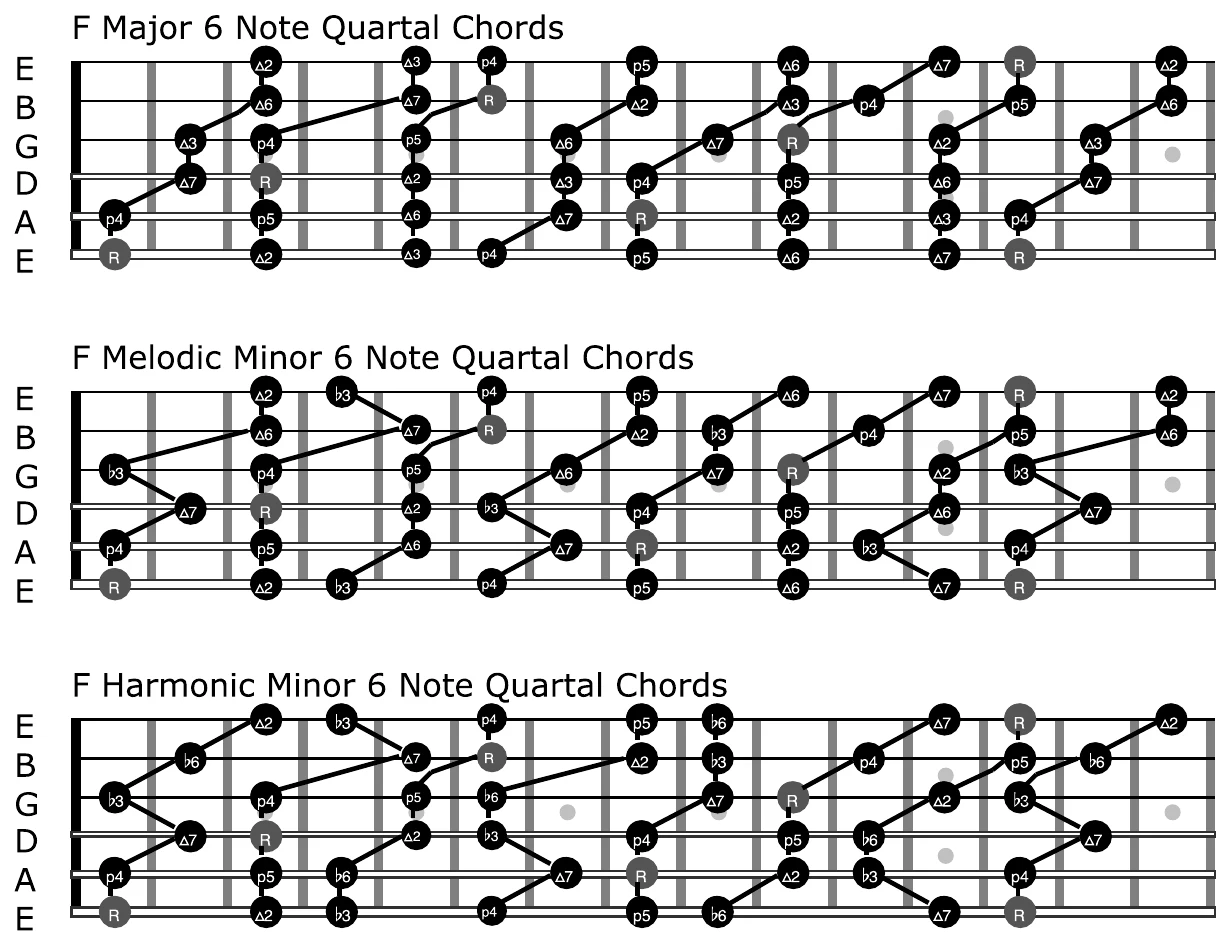
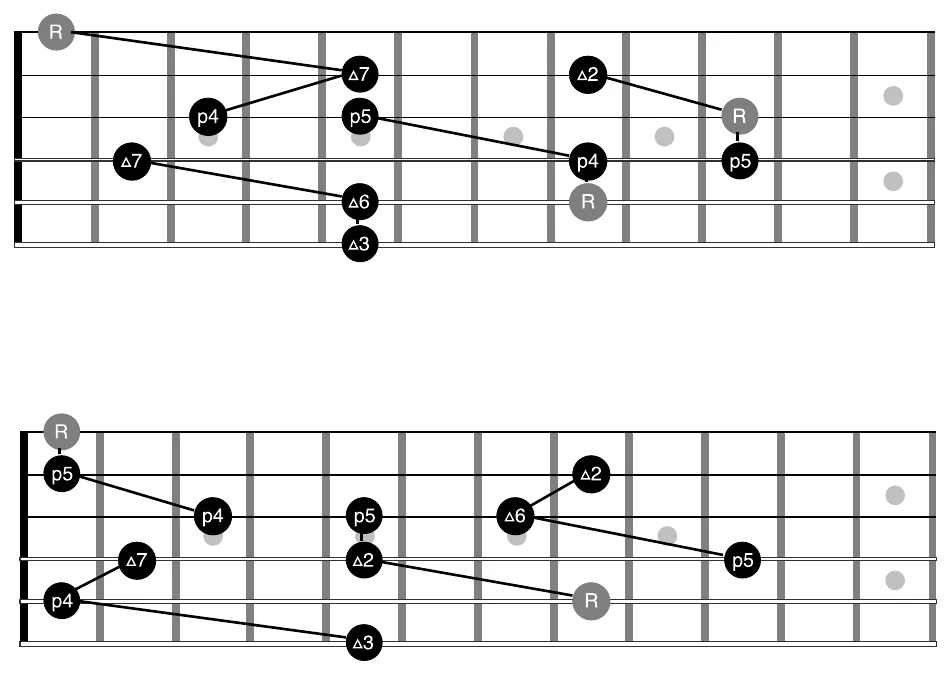
Below we will give only the shapes of the 6-note Quartal Chords of F major, F melodic minor and F harmonic minor, but you creative students will of course choose 3-4-5-6-note chords from them as you please and practice them on all “string sets”, in 12 keys as usual, won’t you? (“Look, the teacher’s started with the pointless pep talk again… Can’t even understand what he’s saying… What does ‘all string sets’ mean?”)
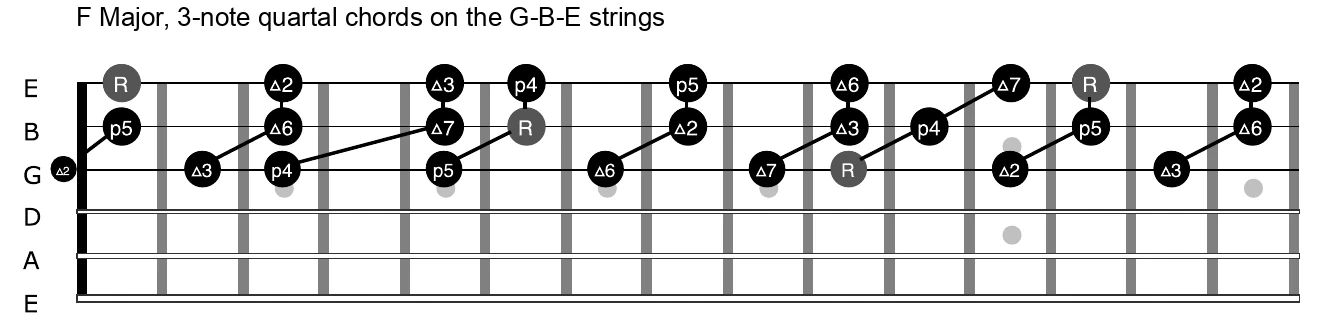
Let us give an example or two for our friends who are still looking blank, or have even plucked up the courage to emit a faint “huh?” To play F major 3-note Quartal Chords lengthwise along the G-B-E strings:
To play F major 3-note Quartal Chords while staying in position 1. (vertically):

Riiight, now that everyone understands, aaaand you have chosen whichever 3-4- 5-6-note Quartal Chords you want from the Major, Melodic Minor and Harmonic Minor scales, thought them all through and practiced them fluently on all “string sets”, lengthwise and within every position, in 12 keys as usual (“Good grief, what a stubborn, persistent man…”), we can now touch on Quartal Chord inversions. Like the chords themselves, the sound of these inversions is not functional and obvious. At least when compared with inversions of functional triadic chords…
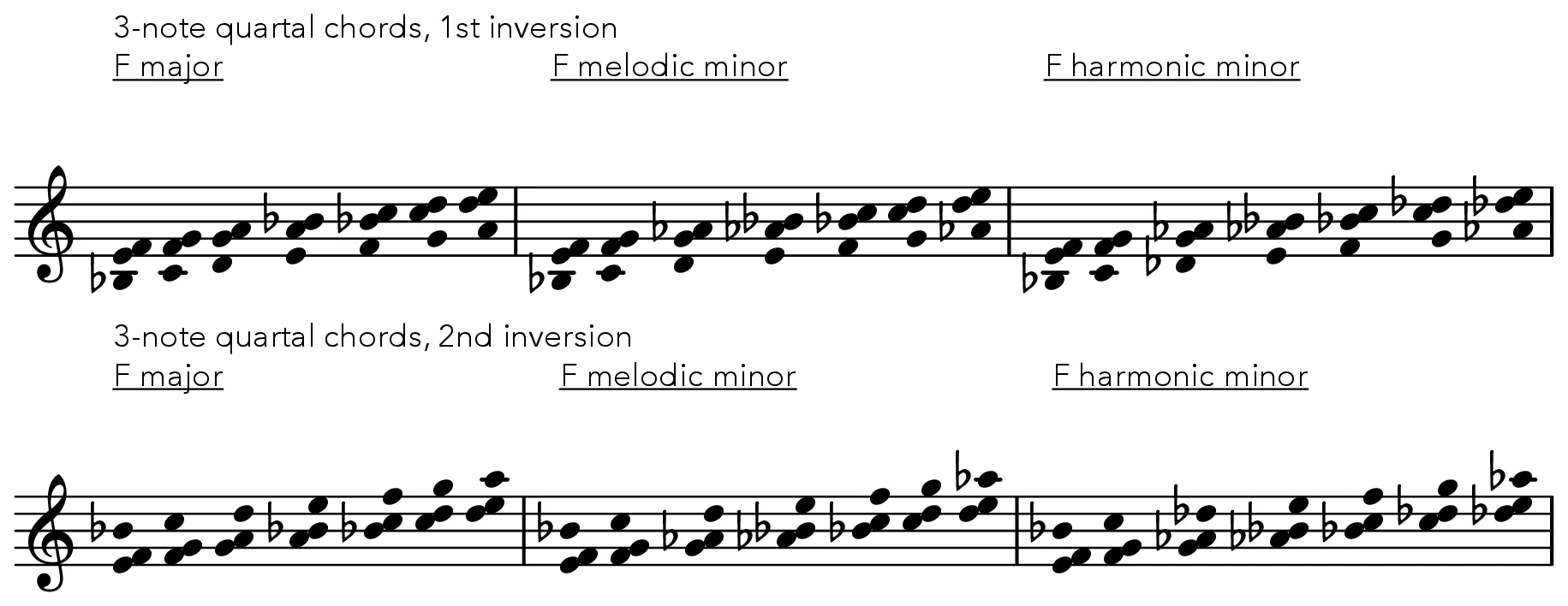
As we can see, the 1st inversion gives 4th+2nd intervals, and the 2nd inversion 2nd+4th intervals, which are very rich sounds.
Below, to avoid a tangle of lines, I have not drawn the notes over the entire neck, but have given one example on each 3-string set. Moving these inversions along the whole neck while staying within the scale we are practicing is up to you. Reading the notation above might actually be enough too :)
“A good Sensei opens doors for the students; walking through those doors and exploring infinity is the student’s job.” Muttering something “NonSensei” like that, I once again make a swift exit from the scene…