Bass Line 1
Translated from the Turkish original. Read the Turkish original.
Çağlayan Y ı l d ı z b
Bass Layn- Bass Line No1
Smoke on the Jazz Bass Mountain: Let’s “Walk”, Friends…
Welcome to my “Bass Layn- Bass Line” column, which I intend to write regularly from now on. Relying also on my “Very Boring Music Lessons” at www.caglayanyildiz.com, I am plunging headlong into “Walking Bass”, with no regard for any pedagogical introduction or development. Let me begin by mentioning that the other honorable mentions in my competition to find a title for this column were “Walk That Line” and “Let’s Walk a Bass Out of Here”; then I will carry on down the road (on foot) with the 3-5 stalwart friends who are not yet repulsed by me. “Walking Bass”, whose difficulty is exaggerated despite being very easy at the introductory level, is based on a few approaches. To touch briefly on rhythm: in this Music, mostly in 4/4 (and sometimes 3/4), the uninterrupted flow from chord to chord of quarter notes, the basic rhythmic unit (one note per beat), and the “bounce on beats 2. and 4.” create forward momentum. Trusting your rhythm, which I know already beats with swing like the pulse of a blue dragon, I will move straight to the harmonic-melodic side. First, let me start with one of the most basic bass rules (which you may already know), one I consider very, very important: ALWAYS PLAY WITH YOUR DESTINATION AND THE ROUTE YOU WILL TAKE TO IT IN MIND, RATHER THAN WHERE YOU ARE. And make those routes natural, smooth and flowing. We can say that there are 3 main elements we use to build our walking “Bass Lines” (the routes we will take):
- Chord tones (arpeggios, that is)
- Scale tones (diatonic notes)
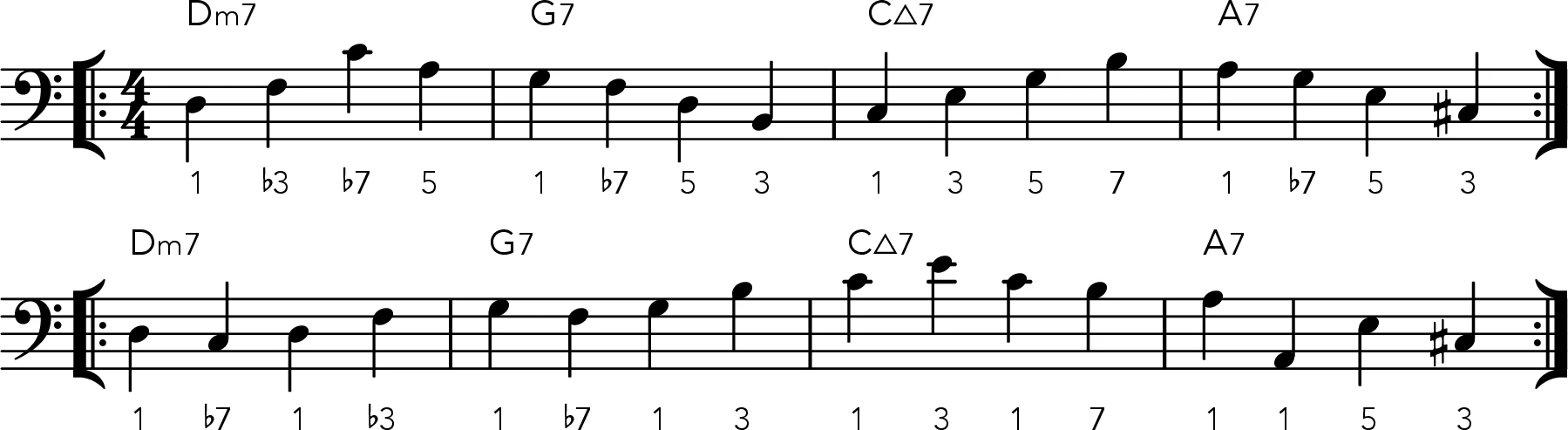
- Chromatic approach tones (half steps) In the following 2 examples I have used only chord tones and written the degrees below. Since we are just starting out, there are roots on beat 1. of each measure. But this is not actually compulsory. Once you have thoroughly learned to walk through the harmony this way, the harmonies can resolve to any possible chord tone on beat 1.
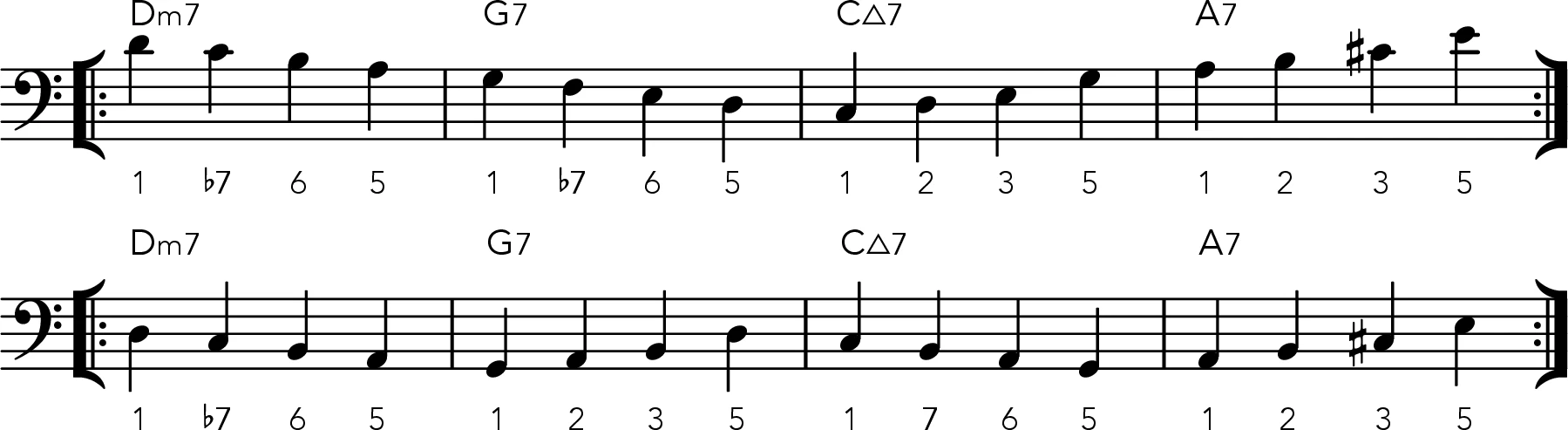
In the following 2 examples I have used only scale tones and written the degrees below. Again, there are roots on beat 1. of each measure (for now). (Anyone looking at me with an expression of painful gas, asking “But which scale do we use for which chord?”, is zapped off to the “Scales” lesson at www.caglayanyildiz.com.) You will notice that I have tried to create lines that “flow into one another” and change direction naturally.
Chromatic approach tones are a somewhat more varied subject. The first kind we will discuss is single-note chromatic approaches. These approach the “target” tone from a half step below or above, and we will call them “lower chromatic approach tones (l.c.a.)” and “upper chromatic approach tones (u.c.a.)”:

Chromatic movement is so powerful in its own right that it can be extended in either direction for as long as desired.

Another kind is “enclosing chromatic approach tones (e.c.a.)”, which “put parentheses around” the “target” note with the half steps above and below:

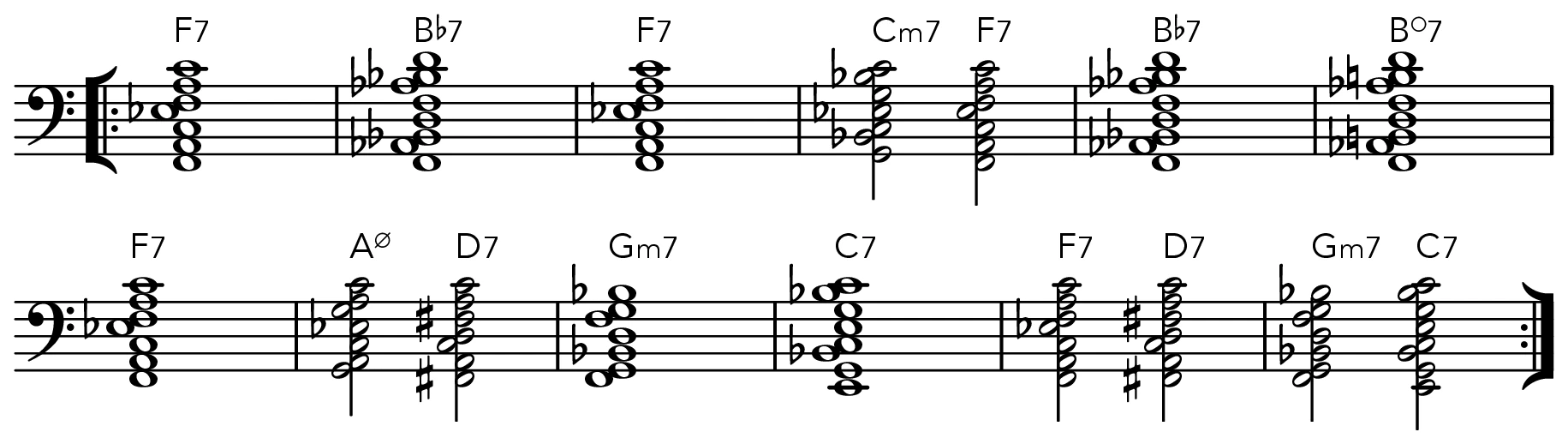
Below I have written out the chord tones for a blues within reasonable limits (without venturing into 5- and 6-string bass territory or going too high). As I said earlier, once you have mastered connecting roots, you can choose a “target chord tone” in each measure and apply each of the connecting techniques above.`
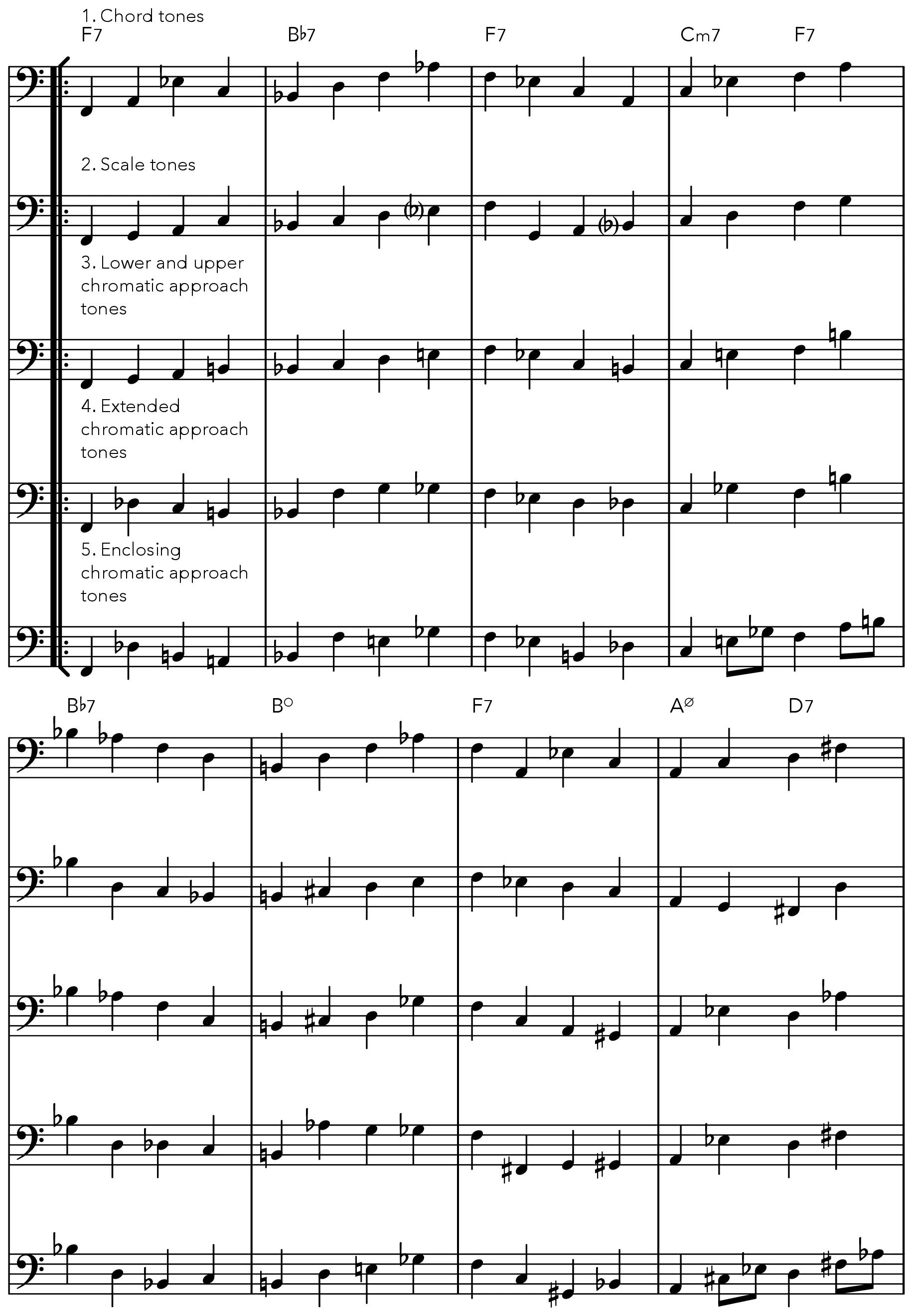
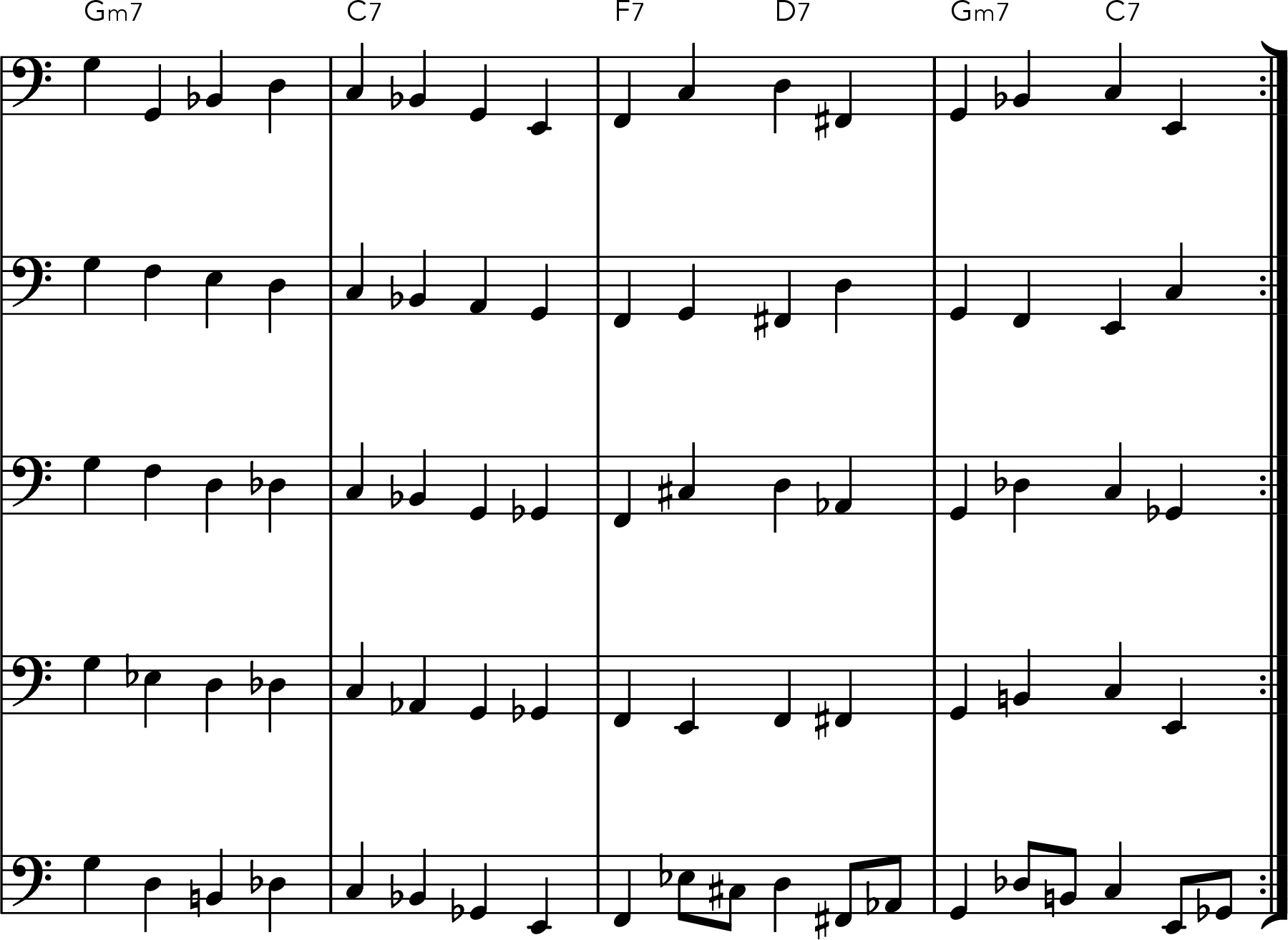
In the example below, line 1. has chord tones, line 2. has scale tones, and the other three lines have the three forms of chromatic approach we discussed. Generally, again, there are roots on beat 1. of each measure. But I repeat: you should use the example above to practice connecting whichever degrees you choose. In the example below, you can mix all the techniques by choosing a different measure each time, giving you 5 = 244,140,625 possibilities. (I hope the mathematics I left behind in high school is misleading me.) Play either within a particular system or by mixing them at random. And is there any reason not to write similar “bass lines” of your own? What a feeble “noooo” from the class…
“Walk on, my cool child…” Mumbling something along those lines, I once again make a swift exit from the scene. (Slightly “rushing”, but that’s the drummer’s ride’s fault, honest…)