13 – Slash Chords
Translated from the Turkish original. Read the Turkish original.
Çağlayan Yıldız
Very Boring Music Lessons 13:
Slash Chords
WARNING: According to a bulletin issued by the CSE (Jazz Standards Institute), knowing theory in the abstract, failing to apply it on your instrument and, above all, failing to HEAR it may cause dryness in playing and writing, unnecessarily intellectual-sounding results and confusion. To prevent these side effects, everything learned in theory must be played, sung -even if your voice is terrible- and, by whatever means necessary, HEARD. Or you should skip this theory business altogether and, as has been possible throughout Music history, learn Music simply by listening to recordings/ playing/ learning directly from masters (if there happen to be any around). Otherwise, our institution accepts no responsibility for any complications that may develop later. Let me tell you that you can find my column from last issue at www.gitardergisi.com, and all my lessons at www.caglayanyildiz.com, and once again get straight to the point.
In this lesson too, to calm our public, who are working themselves into a frenzy saying, “We’ve finished this triadic harmony business, we know all the 4-note chords and all their possible ‘Drops’… Thanks to the last column, we polished off Quartal harmony in 1 month too. Isn’t there aaanything more?”, we will touch on Slash Chords. Those protesting, “But this subject has already been covered soooo much,” I silence with, “So what? Hear it from me as well; perhaps a different perspective will help you notice something else,” and continue my column.
Slash Chords are frequently used in both Modern Jazz and Contemporary Classical Music. They share only a name with the chords played by Slash in “Guns N’ Roses”; they are not even distant relatives. These chords are formed by adding to the triads we now know inside out a bass note that is “not part of” the triad.
Below, to explore all possibilities, I have written the 4 types of triad in 12 keys over a C(do) bass, giving all 48 possible slash chords. Then, to find true 4-note chords, I marked chords in which C(do) was repeated with an “x”. Then, since inversions of “augmented” chords repeat themselves at every major 3rd, I marked these with triangular noteheads too. That left us with 30 true slash chords.
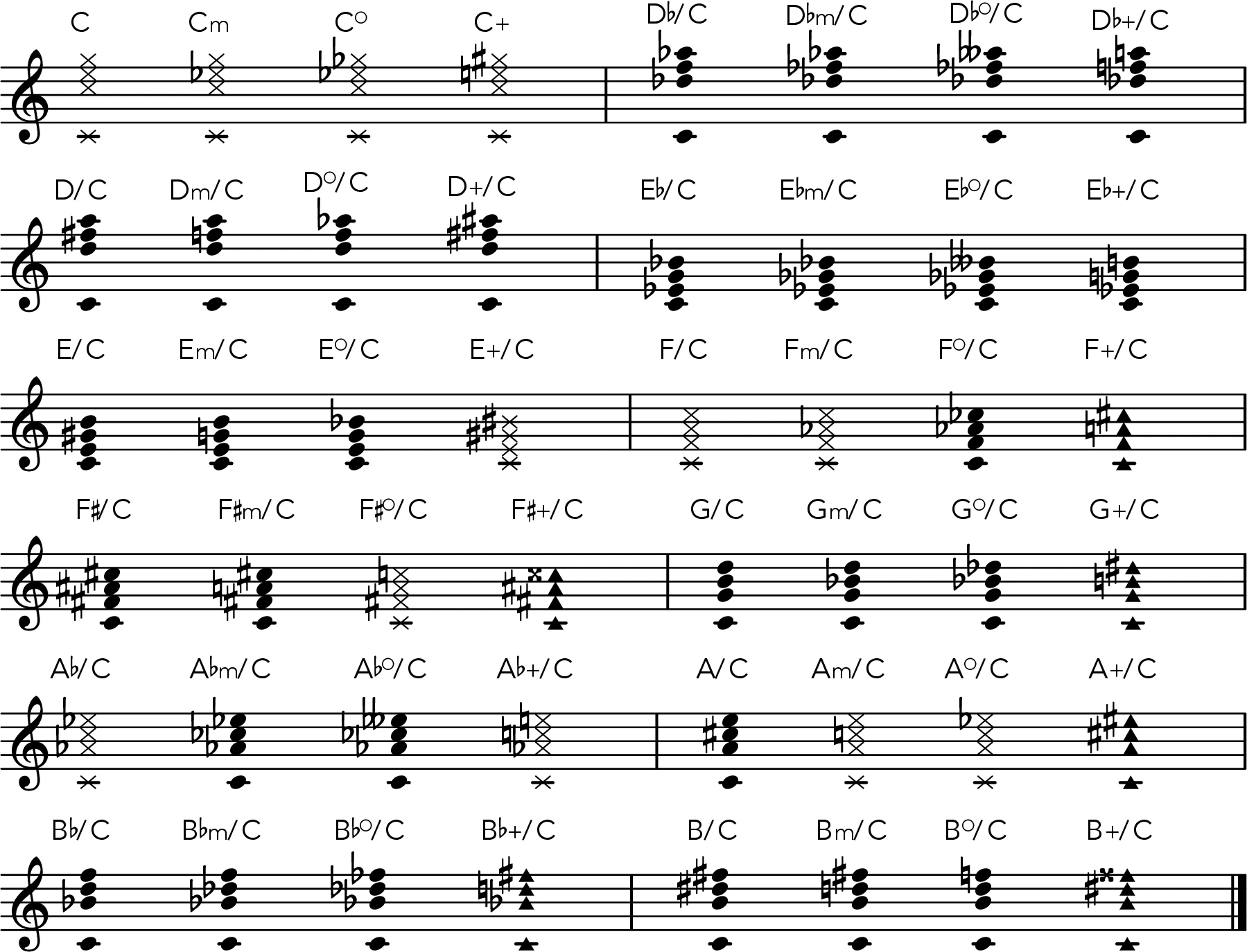
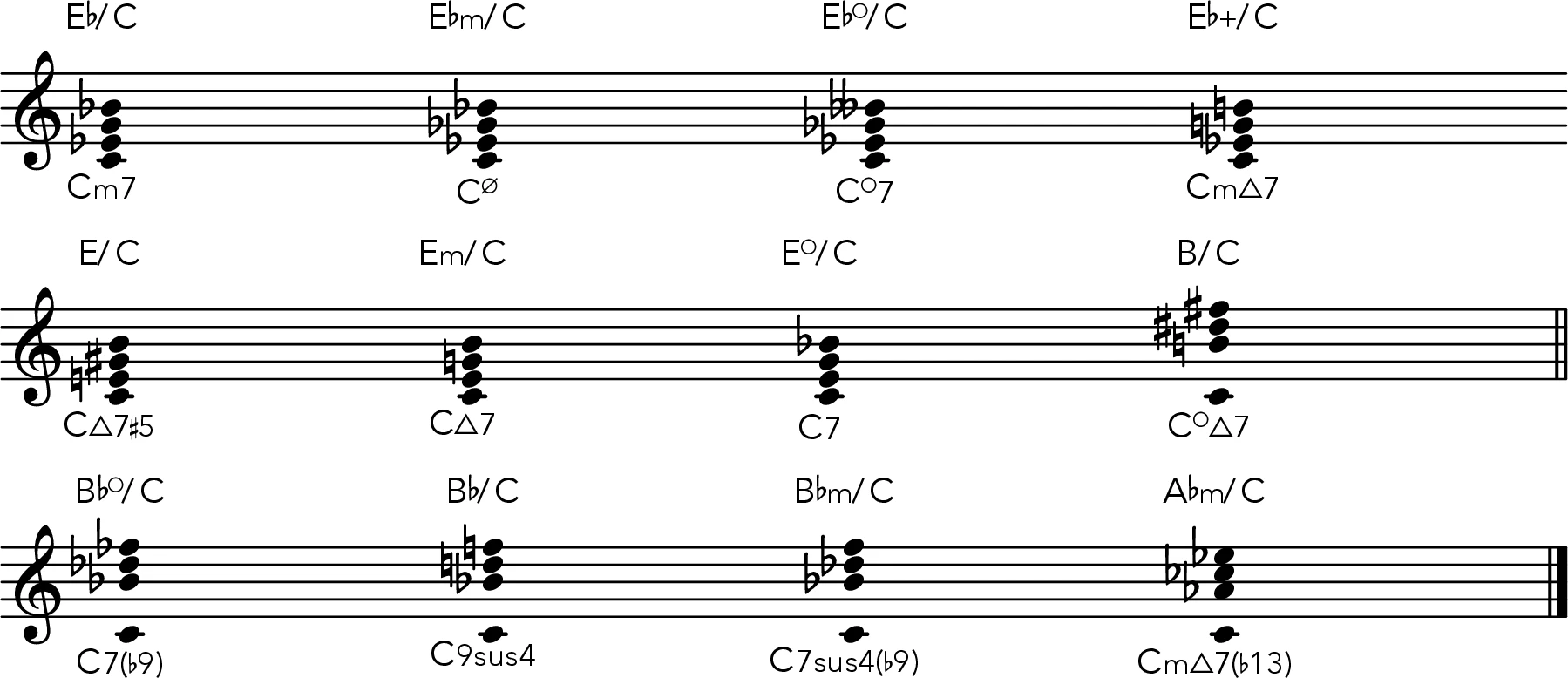
Examining these chords, we see that some yield entirely familiar functional 4-note chords, while others yield “color chords”. We can see this more clearly by analyzing the degree of each note in the resulting chord relative to the root. First, we find 8 obvious 4-note chords and 4 chords without a 5th (omit 5). I have written their slash-chord forms above and their functional harmony names below:
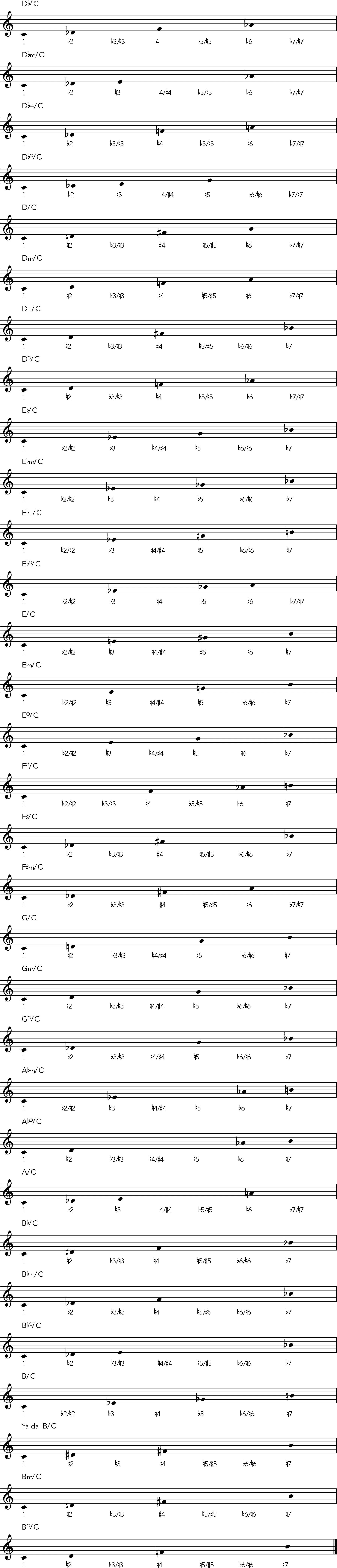
If we look at and play all the slash chords for long enough, we may notice that they give us 4 notes, and that the remaining 3 notes they do not give us, needed to form the commonly used 7-note scales, can be filled in by us as a multiple-choice exercise to suit our wishes…perhaps… Actually, I could try to explain everything more simply with a table like the one below. Why not? I can write the notes supplied by the slash chords as normal notes, and those not supplied as “headless” notes. Under these I can write their possible “accidentals” (sharp/flat). That way I might have provided a natural answer to the questions that have haunted humanity since the Dark Ages: “Which scales do I play over which slash chord? But why?”… The attentive among you (2 of the 7 people reading this column) will notice that I have modified the “accidentals” of certain chord degrees, and will work out the logic governing how the multiple-choice degrees interact…
“Need I say that these chords and scales contain very colorful possibilities for composition and improvisation?”… By saying that, I have said it whether I needed to or not. For lazy guitarists playing with a bassist or pianist, the practical advantage may be to leave the bass notes (the part of the chord symbol after the slash) to them and turn the triads over and over in all inversions across the entire neck. But guitarists who say, “I’m a grown man, mate, I’ll play my own slash… I don’t need anybody,” may find inspiration in the diagrams below. As you will have noticed, I have given triad inversions on the higher strings and bass notes “outside the triad’s chord tones” on the lower strings. For ease of writing, rather than keeping the bass fixed and changing the triad, I have given the options for keeping the triad fixed and changing the bass. Some bass notes may seem hard to reach at first, but give them a try. Moving the resulting shapes here and there on the neck and learning them in 12 keys is, of course, your job as always (should you choose to accept it, of course… Mission Impossibruuu…)
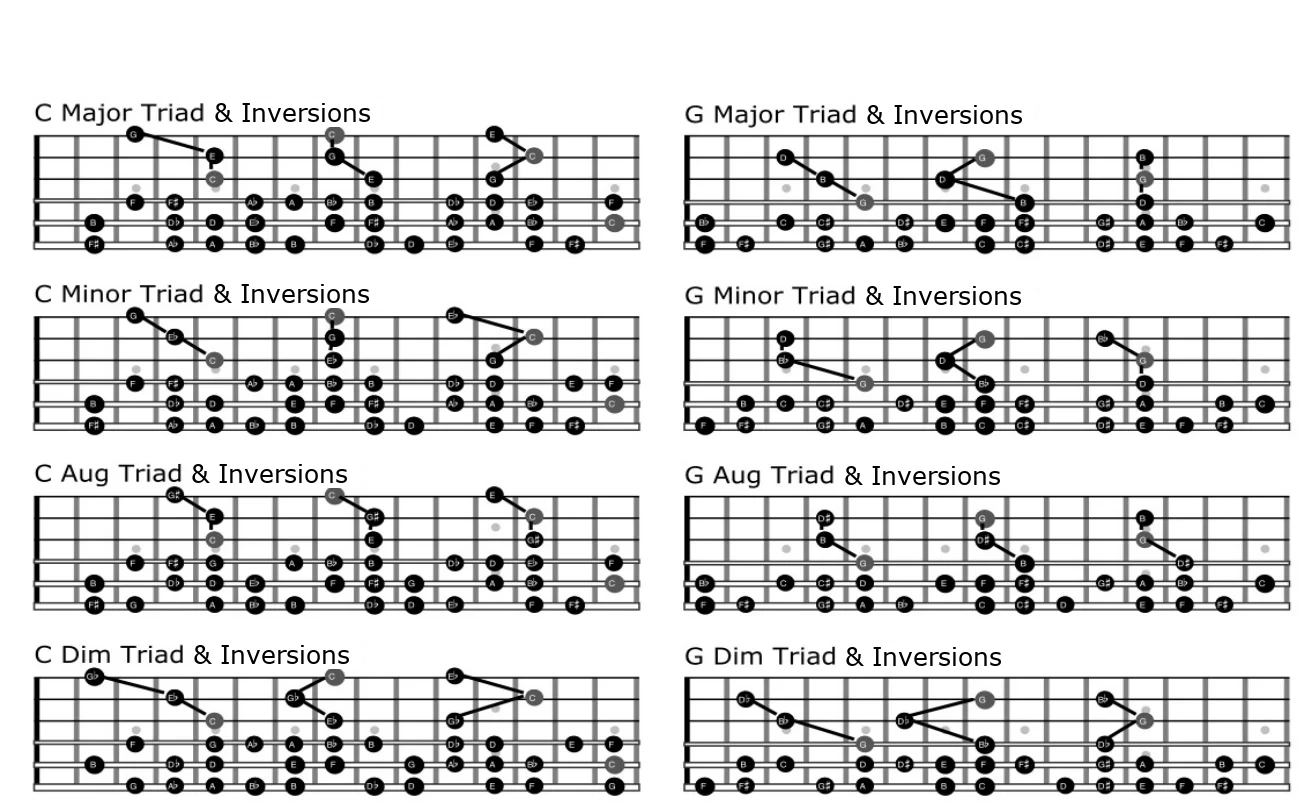
Yes, you understood correctly: you will add one more line to the ready-connected lines to add a bass note… It’s that simple… Spouting a meaningless slogan like “Play slash chords, not slosh chords,” I once again make a swift exit from the scene…