5 – Scales
Translated from the Turkish original. Read the Turkish original.
WARNING: According to a bulletin issued by the CSE (Jazz Standards Institute), knowing theory in the abstract, failing to apply it on your instrument and, above all, failing to HEAR it may cause dryness in playing and writing, unnecessarily intellectual-sounding results and confusion. To prevent these side effects, everything learned in theory must be played, sung -even if your voice is terrible- and, by whatever means necessary, HEARD. Or you should skip this theory business altogether and, as has been possible throughout jazz history, learn music simply by listening to recordings/ playing/ learning directly from masters (if there happen to be any around). Otherwise, our institution accepts no responsibility for any complications that may develop later.
Riiight, for the friends who finally cracked and emailed, “Teacher, enough of this harmony business. What do we play over these chords? You know, scales and modes and that sort of thing, should the need arise”; and also for Hüsamettin Bey the building contractor and his esteemed wife, who sent over a fruit platter from the table at the back on the left: SCAAALES…
Before we get to scales… (as you see, I’m not just blurting them out) might it perhaps be worth trying something like this? We all know the chromatic scale, don’t we? The one that divides an octave into 12. (Civilizations with thousands of years of microtonal culture should really call it the “crude-o-matic” scale.) Right, what if we played and recorded any one of the 4-note chords from our previous lessons on a harmonic instrument (piano, guitar, vibraphone, ork, etc.) or on 4 monophonic instruments (4 saxophones, 4 neighbors with voices and ears that aren’t too terrible, etc.), then played the notes of the “crude-o-matic” scale over it one at a time, holding each for a good long while and listening to the effect each note has over each chord? I offer this as a citizen who believes in the equality and brotherhood of notes. If a note doesn’t fit the chord below it, which nearby note does fit? Where does each note feel at ease when it moves? That sort of thing… Are we hearing it? Hmm? We’re not hearing it because we’re not playing it? Come on now, is the corporal’s tuba playing sfarzando here for nothing?
What I mean is: scales can help us create melodies over harmonies, develop a more linear approach and explore different tonal possibilities. But in improvisation, the aim should always be to move beyond “thinking in scales” to “phrasing”. Otherwise we end up with the following poems, which we encounter in so many musicians:
ABCÇDEFGĞHIİ JKLMNOÖP RSTSRPÖONMLK JİIHĞGFEDÇCBA
They asked Jim Hall, “Why the long neck?” Sorry, I mean, “Which scales do you play over that chord?” “I’ve never played a scale in my life,” he said, being a master guitarist who studied composition rather than guitar…
All right, now I’m writing for the friends saying, “Waaaiter, where are our scales?”:
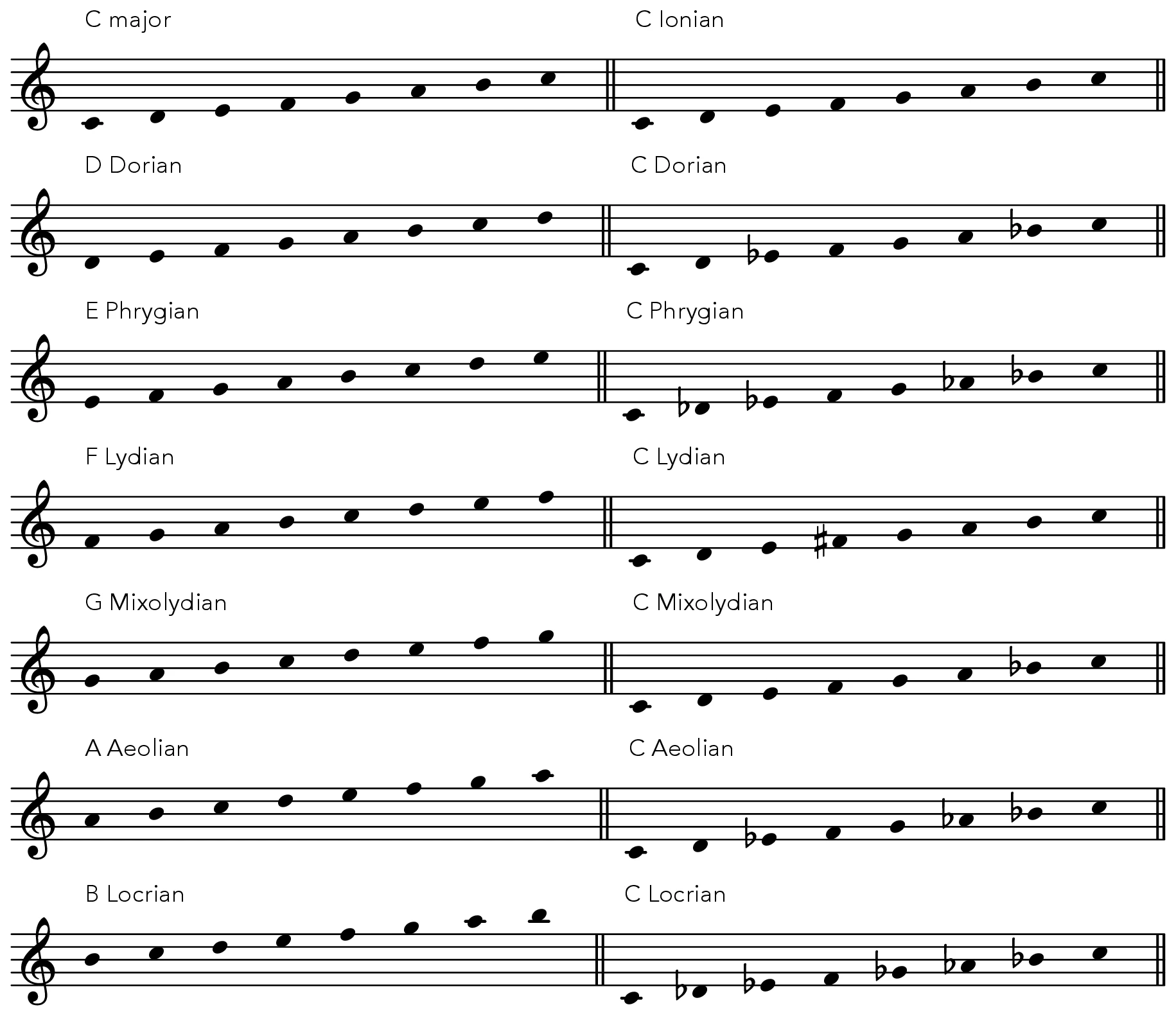
If we start with modes (it’s traditional; gives you a good buzz), the first thing we do is write the major scale starting from each of its steps in the left column of the table below. Then, in the right column, we transpose the interval structure of each scale on the left to a C root. (As an inept teacher who has to explain modes 10 times even face to face, I realize what a swamp I’ve wandered into.) One of the most frequent questions is: “Teacher, when we write the C major scale from Re to Re, what changes that warrants giving it another name?” It’s like this: TOKA- OKAT- KATO- ATOK. In other words, the meaning and content
change like that. Playing C major over a D root gives one feeling /meaning, playing it over E another…etc… It’s also a bit like cinnamon: sprinkled over rice pudding it tastes one way, added to hot wine another way, added to carrot salad another. I don’t know how to explain it better without playing it, which is why I’m talking nonsense. You’d best play it, hear it and understand. Those who get it can explain it to those who don’t. (High-school regression.) In the right column you see all the major-scale modes from C; homework 1 is to transpose them to 12 keys and learn them.
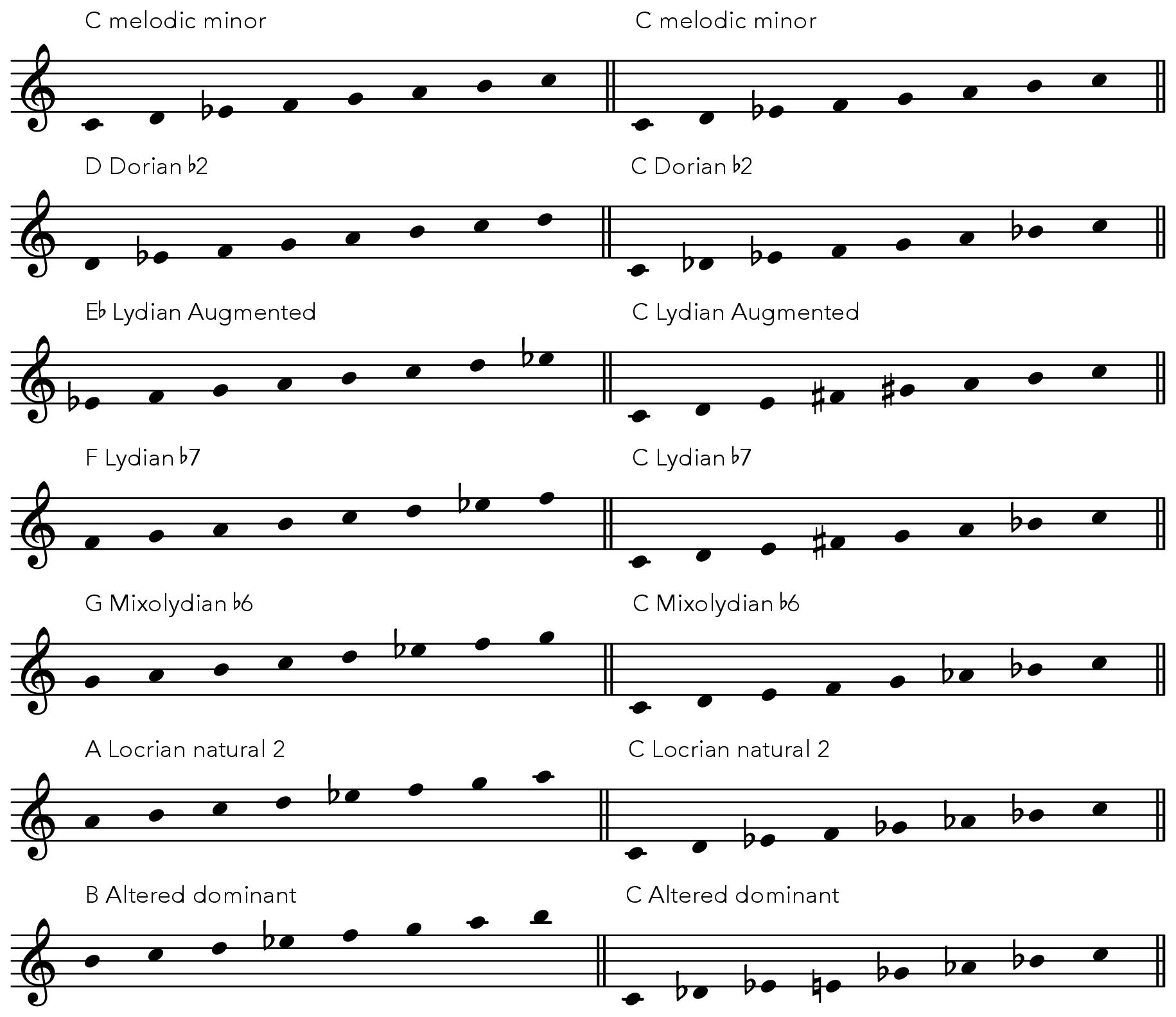
Now, as though we have understood and digested the above, we will do to melodic minor what we did to major (hahahahaaaa):
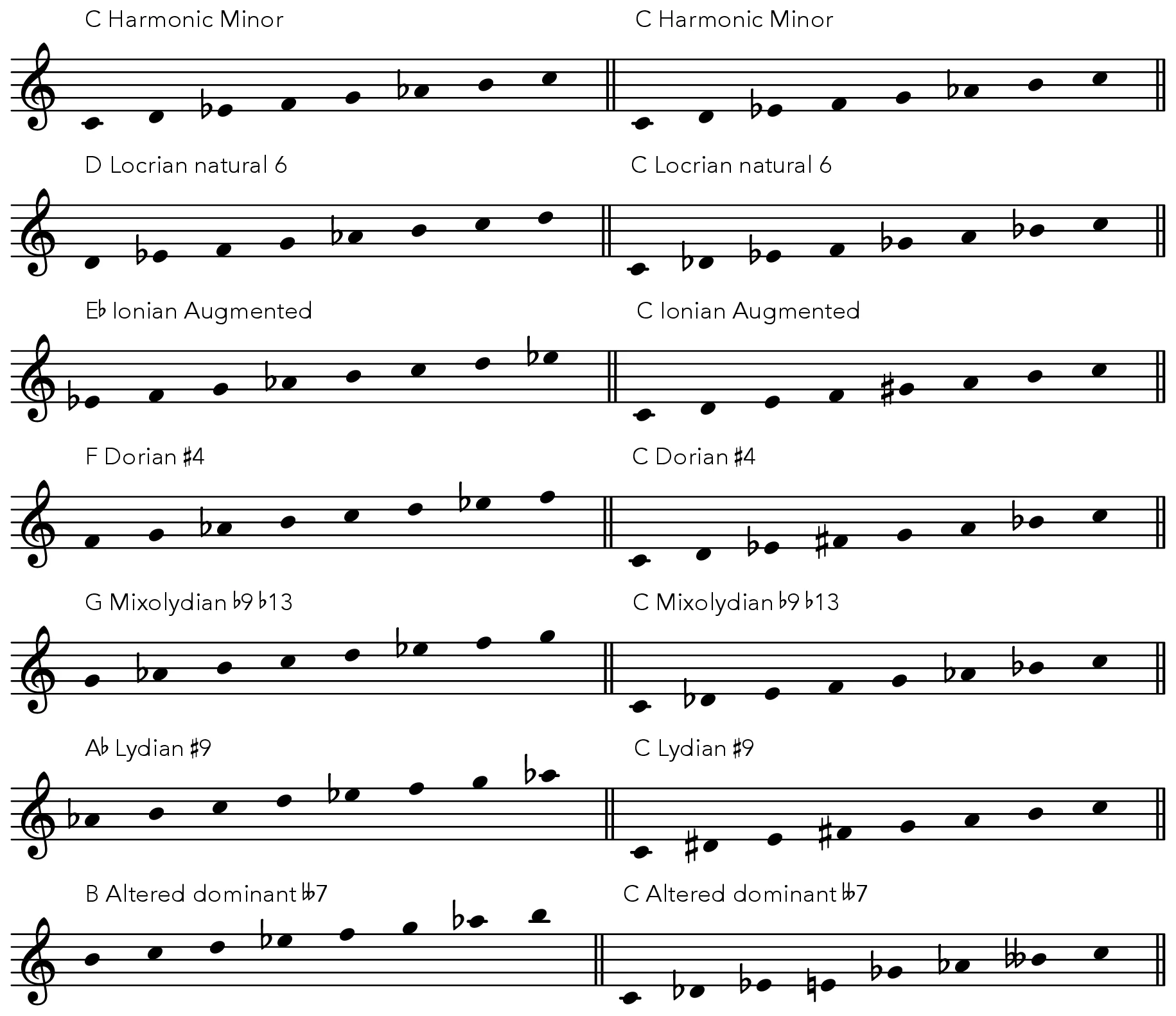
And to harmonic minor:
And if we add the three symmetrical scales that have become part of the jazz language:

As you will have noticed, unlike the other scales, the whole-tone scale consists of 7 notes and the diminished of 9. Because they are symmetrical, there are only 2 whole-tone scales, starting on C and Db, and 3 diminished scales, starting on C, Db and D. (I have to use the space allotted to me for jokes, so I will offer no further explanation and entrust the subject to the boundless practical ingenuity of the Turkish people. And finally, a table showing which chords we can use these scales over, how and where (if we are going to use them at all):
| Chord type | Suitable scale-mode | Parent scale and position | Most frequent use |
|---|---|---|---|
| Maj7/ Maj6 | İonian 1 2 3 4 5 6 7 | Major scale on the root | I maj7- I6 (all tonic major chords, that is) |
| Lydian 1 2 3 #4 5 6 7 | -P4 (+P5) major scale | IV maj7 and all “non-tonic” major chords | |
| Dominant 7 | Mixolydian 1 2 3 4 5 6 b7 | -P5 (+P4) major scale | V7 and V7/IV in major harmony, I7 in blues |
| Lydian b7 1 2 3 #4 5 6 b7 | -P4 (+P5) melodic minor | I7, bII7, II7, bIII7, IV7, V7 in maj, bVI7, VI7, bVII7 | |
| Altered 1 b2 #2 3 #4 #5 b7 | +m2 melodic minor | bII7, II7 in min, III7, IV7, V7 in maj/min, VI7, VII7 | |
| Diminished (1-2)1 b2 #2 3 #4 5 6 b7 | Root-1-2-1 etc… root | I7, bII7, II7, III7, V7 in maj, bVI7, VI7, bVII7 | |
| Mixolydian b9 b13 | -P5(+P4) Harmonic minor | V7 in min, VI7 in maj/min | |
| Whole tone | Root-2-2-2…root | II+7 in maj, V+7 in maj/mel min | |
| Dominant 7 sus 4 | Mixolydian sus 4 | -P5(+P4) Major scale | All Dominant 7 sus 4 |
| Dominant 7 sus 4 b9 | Mixolydian sus 4 b9 | -P5(+P4) Harmonic minor | All Dominant 7 sus 4 b9 |
| Minor maj7 | Melodic Minor | Melodic Minor on the root | All Minor maj7 |
| Harmonic minor | Harmonic minor on the root | All Minor maj7 | |
| Minor 6 | Melodic Minor | Melodic minor on the root | All Minor 6 |
| Minor 7 | Dorian | -M2 major scale | II-7, bIII-7, IV-7, bVI-7, bVII-7, I-7 |
| Phrygian | -M3 major scale | III-7 | |
| Aeolian | +m3 major scale | VI-7 | |
| Minor 7 b5 | Locrian | +m2 major scale | All Minor 7 b5 |
| Locrian natural 9 | +m3 Melodic minor | II-7b5 in maj, III-7b5, IV-7b5, #IV-7b5, V-7b5, VI-b5 | |
| Locrian natural 13 | -M2 Harmonic minor | II-7b5 in min | |
| Diminished (2-1) | Root-2-1-2-1… | All diminished | |
| Maj7 #5 | Ionian augmented | -m3 Harmonic minor | All Maj7 #5 |
| Lydian augmented | -m3 Melodic minor | All Maj7 #5 | |
| Augmented | Root-m3-m2-m3-m2… | All Maj7 #5 |
I make a swift exit from the scene, leaving you alone with this problem for years to come.
Note: Since this column was written under the influence of last-minute deadline panic between 04:30- 06:30 in the morning, for the safety of life and property you would do well to check the scales against other Music books before using them.