3 – Seventh Chords (Four-Note Chords)
Translated from the Turkish original. Read the Turkish original.
WARNING: According to a bulletin issued by the CSE (Jazz Standards Institute), knowing theory in the abstract, failing to apply it on your instrument and, above all, failing to HEAR it may cause dryness in playing and writing, unnecessarily intellectual-sounding results and confusion. To prevent these side effects, everything learned in theory must be played, sung -even if your voice is terrible- and, by whatever means necessary, HEARD. Or you should skip this theory business altogether and, as has been possible throughout jazz history, learn music simply by listening to recordings/ playing/ learning directly from masters (if there happen to be any around). Otherwise, our institution accepts no responsibility for any complications that may develop later.
Yes, ladies and gentlemen, that warning will appear in every column; every cigarette packet has one too, saying “harmful to health” and so on. Smokers don’t read it anyway, and nonsmokers don’t read it anyway anyway. Right, what was I saying?
My apologies for the typesetting errors in my last column. Now, straight to the test I promised last issue, which I know you have been looking forward to. Anyone I catch cheating is toast, just so you know. Yes, our subject last time was triads, and here are your questions:
What are the notes of the X ( major/ minor/ dim/ aug) triad? X is the 3rd/ 5th of which ( major/ minor/ dim/ aug) triad? What are the four triads of which X is the 3rd/ 5th? If X is the 3rd of a ( major/ minor/ dim/ aug) triad, what is its 5th? If X is the 5th of a ( major/ minor/ dim/ aug) triad, what is its 3rd? If X is the (bottom, middle, top) note of a ( major/ minor/ dim/ aug) triad in (root position/ 1st inversion/ 2nd inversion), what are the chord’s other notes? [For example, if Sol is the middle note of a minor triad in 2nd inversion, the chord is naturally sol minor, so the note above it is Si b and the note below is Re.]
Yes, as children of the nation that invented “cook it yourself, eat it yourself”, you can prepare and ask yourselves as many questions as you like. I’ll have my answers well done, please. You at the back: no slacking just because we haven’t asked the questions outright; you’ll be crying later when you can’t play this stuff. Of course you put a note name in place of X…
Now we can move on to our new subject. Writing about four-note chords does not mean, of course, that I will add one more note to the previous column in every issue (interval+one note= triad, triad+one note= four-note chord, etc.). If it did, I would be writing about 32-note chords in the July 2008 issue. Anyway, enough nonsense.
By a twist of fate, our seventh chords (four-note chords) are obtained by adding a note to a triad. You will notice that here we will also use the “sus4 (1-4-5)” and “1-3-b5” triads, which we did not mention before in three-note harmony. Yes, here are the four-note chords we obtain by adding M7-m7- M6 to three-note chords in turn, along with their most common symbols:
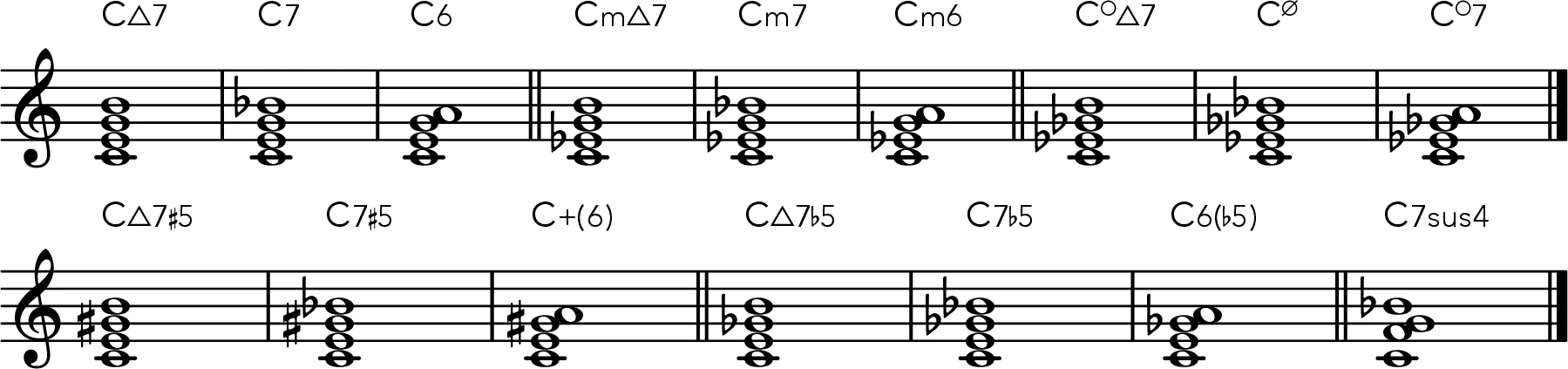
Of the chords above, those in the first row are used more frequently and should be acquired first; of course, the others must be learned too. We have no choice. And of course they must all be written out and learned, played and heard in 12 keys. Yes, things are getting harder, but what can we do? This is why being a musician these days has become a kind of knighthood. Somehow the dragons must be fought, the princesses rescued from the dungeons and the Holy Grail found. On top of everything, these chords have inversions and close/ open positions too, just like triads:
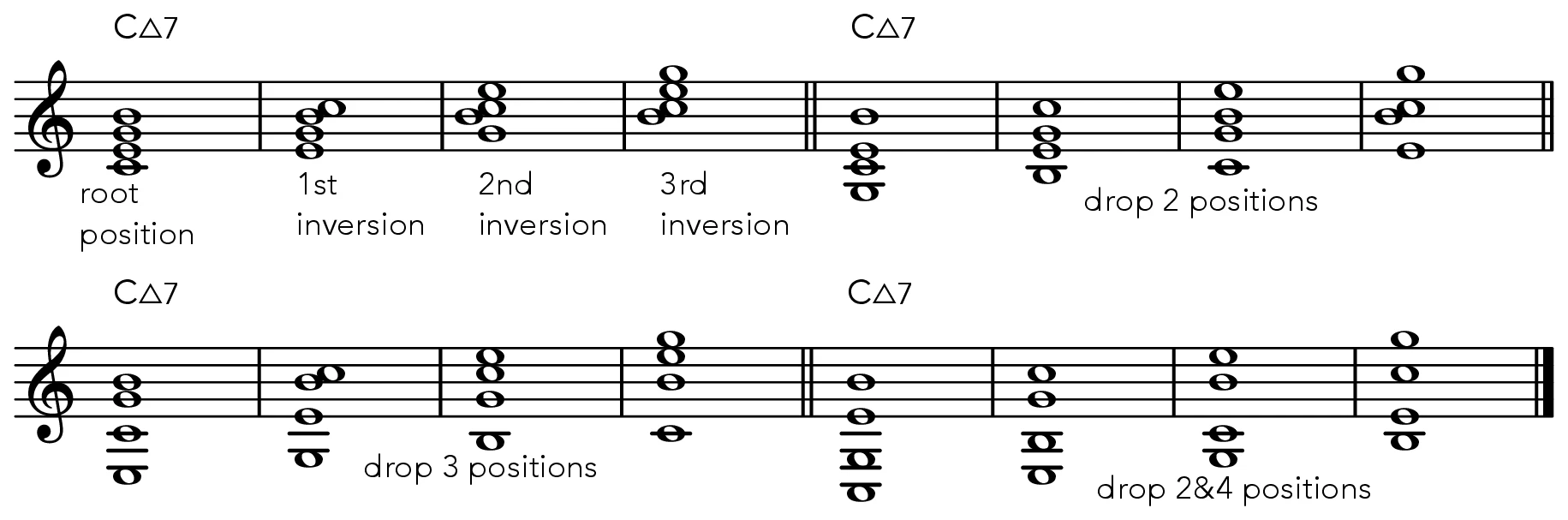
In the first four measures above, we see the inversions in close position. In the next four measures, we take the 2nd note from the top of the chords in the first four measures down 1 octave and, very creatively, call this “drop 2”. Applying the same process to the 3rd note from the top, and then to notes 2&4, gives the other familiar results. We can use these positions for all sorts of things, from writing arrangements to making close-position chords that cannot be fingered on the guitar playable. Still, I would advise against using them outside Music…
Those with any strength left: all the four-note chords, in 12 keys, all inversions/ positions… you know. I’m going to have a minibus sticker made: “Bless the musician who learns it in 12 keys before I even ask.” With fluorescent treble and bass clefs shedding tears on either side.
Now let us build four-note chords on the major, melodic minor and harmonic minor scales and observe the results impartially:
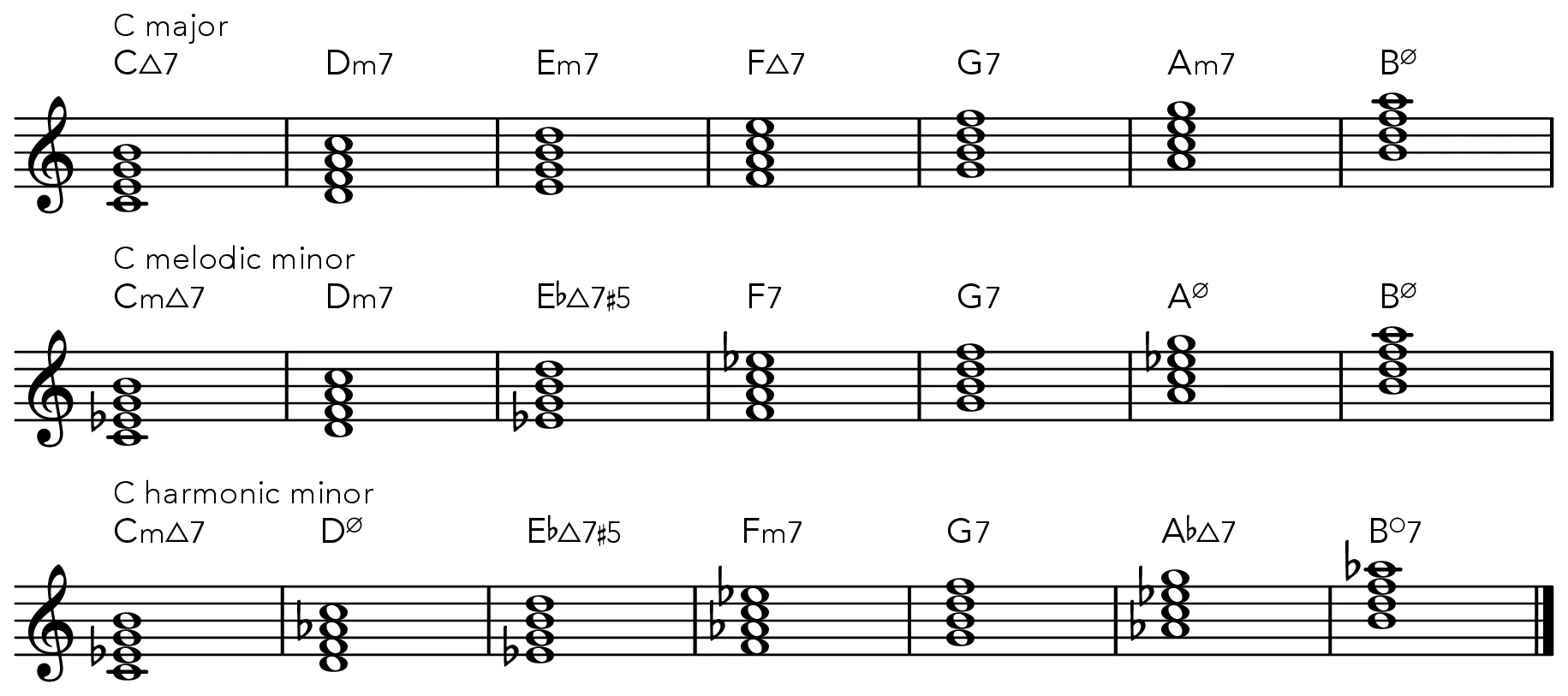
Those accustomed to our earlier lessons will not condemn me for going straight to the table and assessing the results:
| Chord-Scale | Maj7 | Min7 | 7 | Min7b5 | Min/maj7 | Maj7#5 | dim7 |
|---|---|---|---|---|---|---|---|
| Major scale | I, IV | II, III, VI | V | VII | - | - | - |
| Melodic min | - | II | IV,V | VI, VII | I | III | - |
| Harmonic min | VI | IV | V | II | I | III | VII |
This Music business is interesting, isn’t it? I mean, how shall I put it… there are chooords, there are scaaales, there are relationships betweeeen them, there are 12 keeeys… But we must stay optimistic: apparently, on Saturn they divide an octave into 843, and their Music averages 427 notes. So you could have been attending the conservatory there. Another test next issue, more misery, and perhaps the application of the above to diatonic harmony, or modes. Who knows?