16 – Techniques for Creating Exercises II
Translated from the Turkish original. Read the Turkish original.
Very Boring Music Lessons 16: A Few Techniques for Creating Exercises II
WARNING: According to a bulletin issued by the CSE (Jazz Standards Institute), knowing theory in the abstract, failing to apply it on your instrument and, above all, failing to HEAR it may cause dryness in playing and writing, unnecessarily intellectual-sounding results and confusion. To prevent these side effects, everything learned in theory must be played, sung -even if your voice is terrible- and, by whatever means necessary, HEARD. Or you should skip this theory business altogether and, as has been possible throughout Music history, learn Music simply by listening to recordings/ playing/ learning directly from masters (if there happen to be any around). Otherwise, our institution accepts no responsibility for any complications that may develop later.
Let me tell you that you can find my column from last issue at www.gitardergisi.com, and all my lessons at www.caglayanyildiz.com, and once again get straight to the point.
In this issue I will give you a few tips I actually mentioned before in lesson 8, “A Few Techniques for Creating Exercises”, but which were not particularly obvious because they were buried under that hefty pile of information, and then run. Although you can read/practice this lesson independently of lesson 8, reading that lesson first is violently recommended. (Yes, violence has now infiltrated our lives as far as recommendations.) For those who will violently refuse to follow violent recommendations, I will repeat that column’s introductory paragraph here word for word, so as not to repeat myself by repeating myself in different words:
“The world of Music publishing is overflowing with thousands of books of patterns, technical exercises and scale-harmony relationships. (And most of them are now just a “Download” button away.) The defining feature of the vast majority is that, while they could teach you “how to fish with a single book”, each book “gives you a single fish”: in other words, it spreads material that could be summed up in a few pages over a few hundred pages and hands you “ready-made knowledge”… Then it publishes the book’s second, fifth, tenth volumes and keeps handing out a fish a day… When we “read” and play these books, our fingers and eyes are usually busy, but most of us hardly think about what the content we are practicing is, or how it was produced. That is why, when we improvise or compose, this material cannot find its way into our Music by itself.”
Recently, when I asked several students at different levels to work through lesson 8, I saw how completely they had overlooked the infinite possibilities of the following “Pattern Arrows” table:
| Pattern 1. | ↑↑↑↑ | Pattern 2. | ↓↓↓↓ |
| Pattern 3. | ↑↑↑↓ | Pattern 4. | ↓↓↓↑ |
| Pattern 5. | ↑↑↓↑ | Pattern 6. | ↓↓↑↓ |
| Pattern 7. | ↑↓↑↑ | Pattern 8. | ↓↑↓↓ |
| Pattern 9. | ↓↑↑↑ | Pattern 10. | ↑↓↓↓ |
| Pattern 11. | ↑↑↓↓ | Pattern 12. | ↓↓↑↑ |
| Pattern 13. | ↑↓↑↓ | Pattern 14. | ↓↑↓↑ |
| Pattern 15. | ↑↓↓↑ | Pattern 16. | ↓↑↑↓ |
In this table, upward arrows represent upward movement in Music, that is, rising in pitch; downward arrows represent downward movement, that is, falling in pitch. Now we will look at how, by combining these arrows with different “pitch set”s, or “sets of notes”, we can generate enough exercises and melodic patterns from this lesson alone to last several lifetimes.
As a first example, let us say we will practice 2nd intervals in C Dorian mode. To do this, we need to write the 2nd intervals within C Dorian mode, with one “set of notes” per beat:
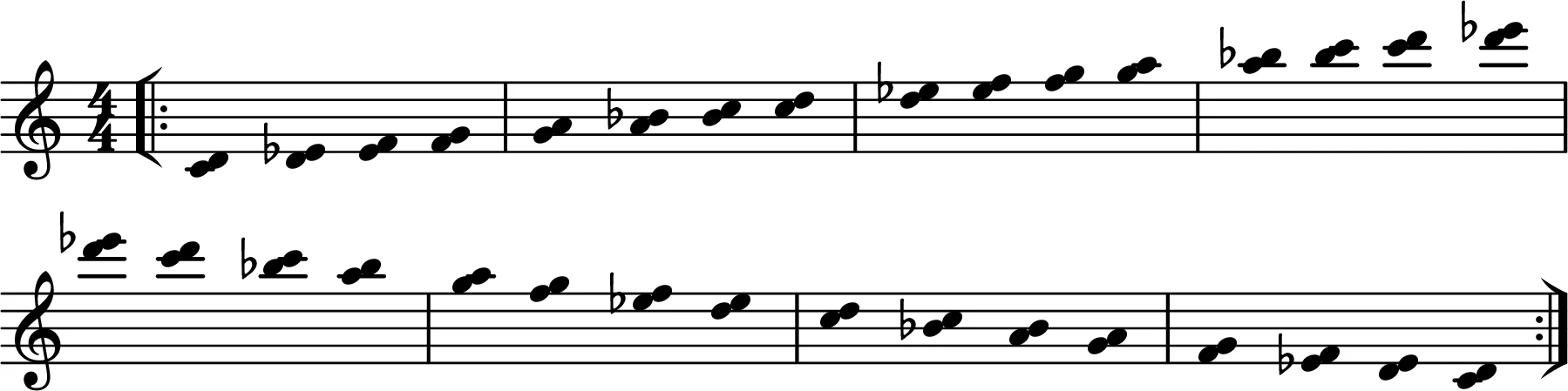
As you will have noticed straight away:
-
We wrote the “sets of notes” “without stems” so that they are easy to read.
-
We wrote 4 bars ascending and 4 bars descending, to cover as wide a range as possible (in this example 2 octaves + a 2nd) and to keep it symmetrical.
Now let us combine the “sets of notes” above with our “Pattern Arrows” table, in order, starting with the first:
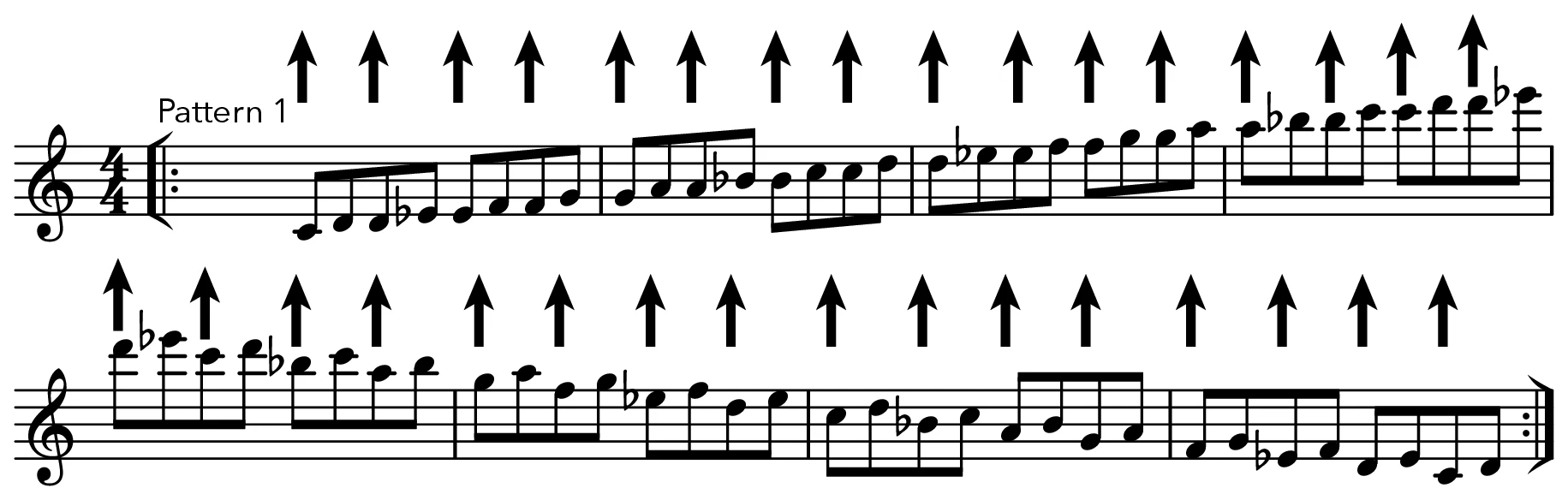
An interesting thing I have noticed in my lessons: when we start from here at the beginning of a lesson, the students’ “so what’s the big deal?” attitude turns into a “haaa” that drops in pitch right at bar 5 of the example above. When we move on to “Pattern 2”, this “haaa” becomes even more of a “haaa”, and at “Pattern 3” it settles fully into place and may turn into a sort of musical “haaazza”. I will now leave you alone for a while, so that you can savour this magnificent process to the full and combine all the “Patterns”, in order, with the “Sets of Notes” above on your own…
Didn’t get it? Never mind, for those whose “haaa” comes a little late, let me combine “Pattern 15” as an example:
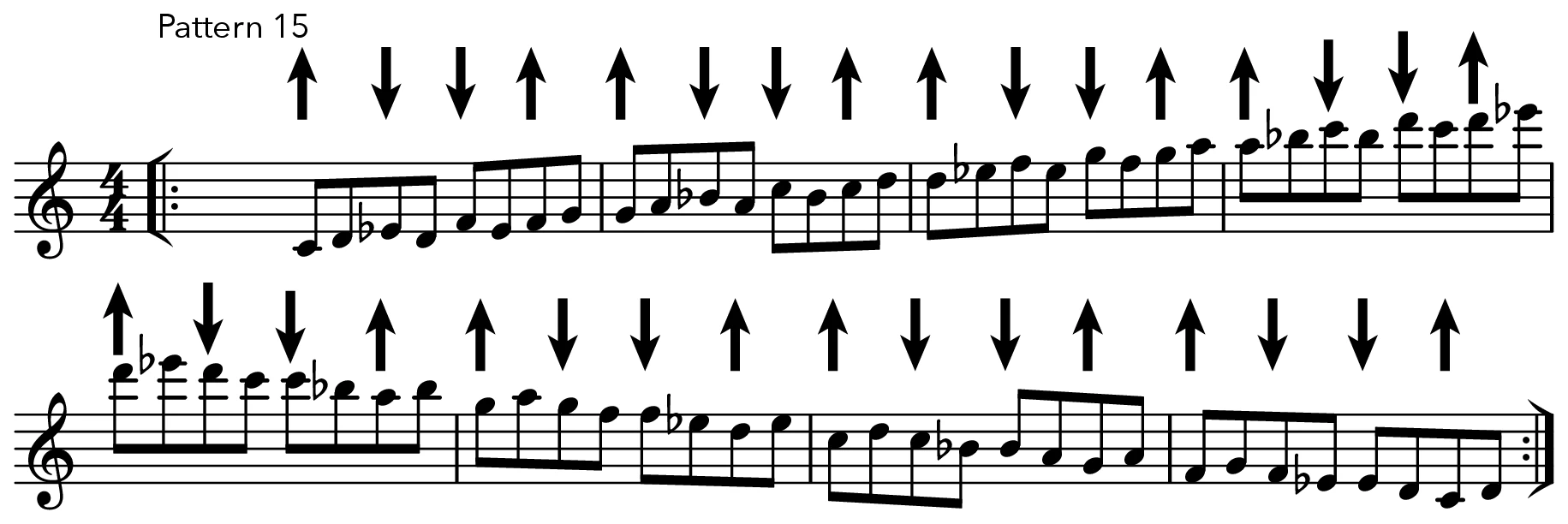
Of course, since we have started practicing “Intervals” on C dorian, we will complete this “project” and practice all the intervals this way, won’t we, friends? That is, we will write all the intervals (3rds, 4ths, 5ths, 6ths, 7ths, octaves and, for the keen, 9ths and beyond) as “Sets of notes” or, better still, without writing them, just by thinking, and combine them with our “Pattern Arrows” table, won’t we, friends?
All the same, as a precaution, for those whose “haaa” comes a little late, let me combine “Pattern 16” with the 4th intervals within C dorian as an example:
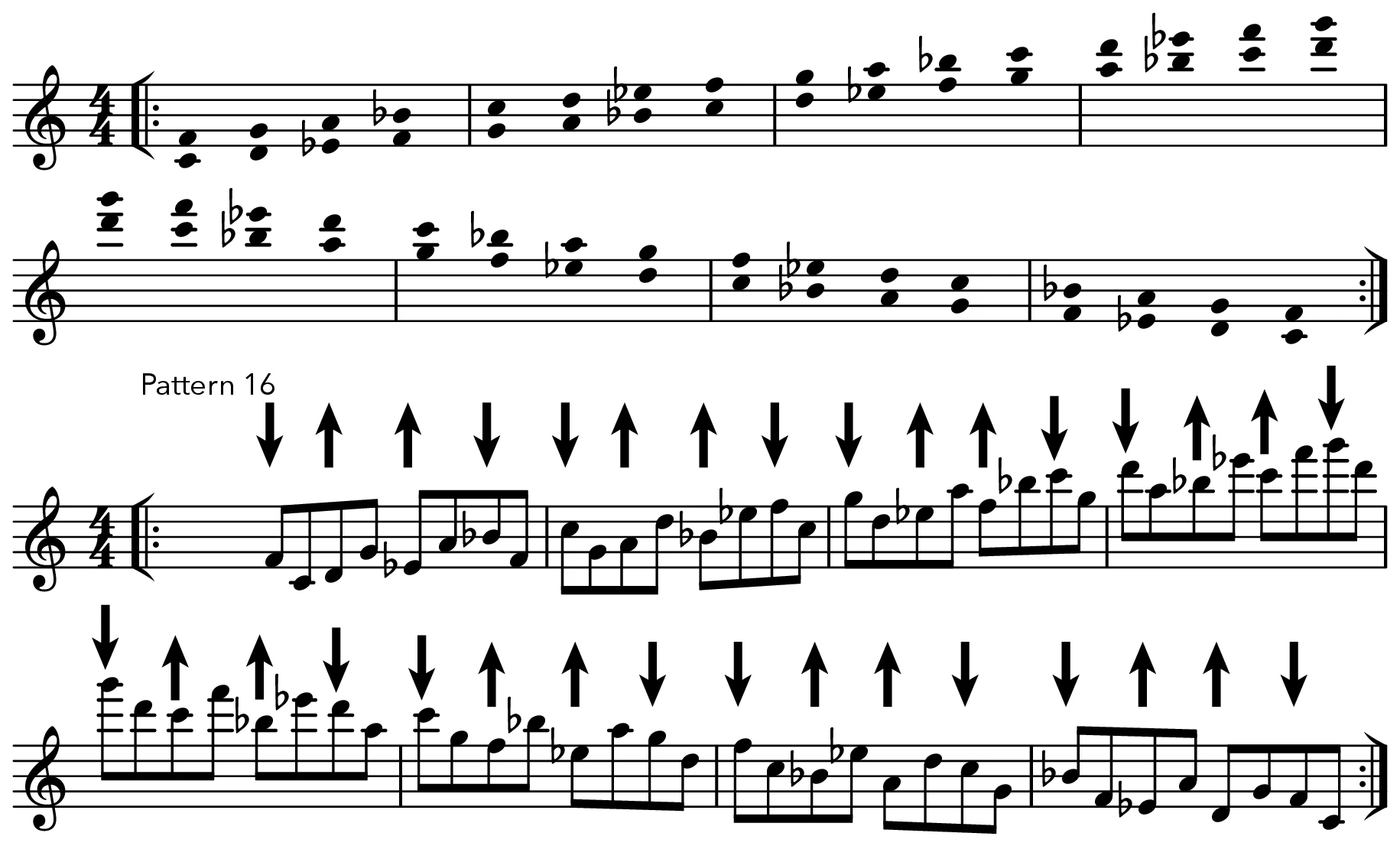
Wow! We are practicing this in a single scale in a single key, and only with “Intervals”, and suddenly we find ourselves at a pretty tough spot, aren’t we?
Now let us address the roughly one in a million of Turkey’s population who are asking, “what else can we do with this logic?” Above we worked with 2-note “Sets of Notes”. Is there any reason not to work with sets of 3, 4, 5, 6, 7… notes? I don’t think so either.
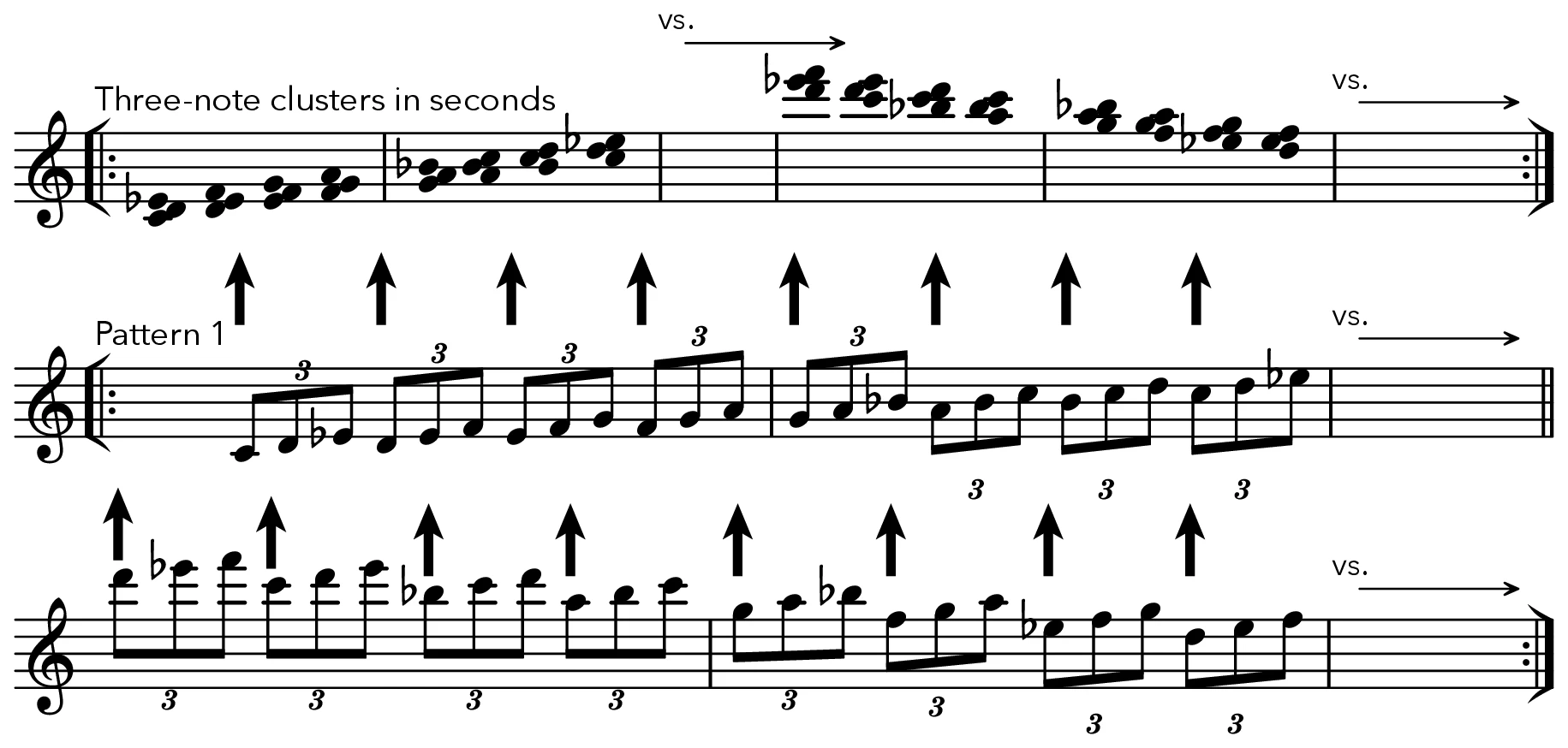
Above we worked with 3-Note Sets in 2nds. Is there any reason not to work with mixed intervals and with sets that use different numbers of notes? I don’t think so either.

“Jump into sets to jump between sets.” Making a dreadful joke like that, I make a swift exit from the scene, lest I get stuck in a pattern and come to nothing…